
With the Super Heavy booster catch now a confirmed success, the immediate focus for SpaceX shifts to integrating this reusability into a fully operational Starship system. The company will likely analyze the vast amount of data from both the 13th flight and the booster catch to refine its designs and operational procedures. Elon Musk has indicated that the 13th flight could mark a turning point, provided post-flight data doesn't uncover major issues. However, the path to routine launches still requires the U.S. Federal Aviation Administration (FAA) to approve SpaceX's investigation into Flight 13's 'burn shortfall' and any subsequent corrective actions. This regulatory hurdle, alongside ongoing engineering work, will dictate the timing of the next major objective: the Starship upper stage achieving a full orbital flight profile and demonstrating its own re-entry and landing capabilities. Observers should anticipate continued testing, iterative design changes, and a careful dance with regulatory bodies before Starship can begin its envisioned role in deploying Starlink V3 satellites at scale and preparing for lunar and Martian missions.
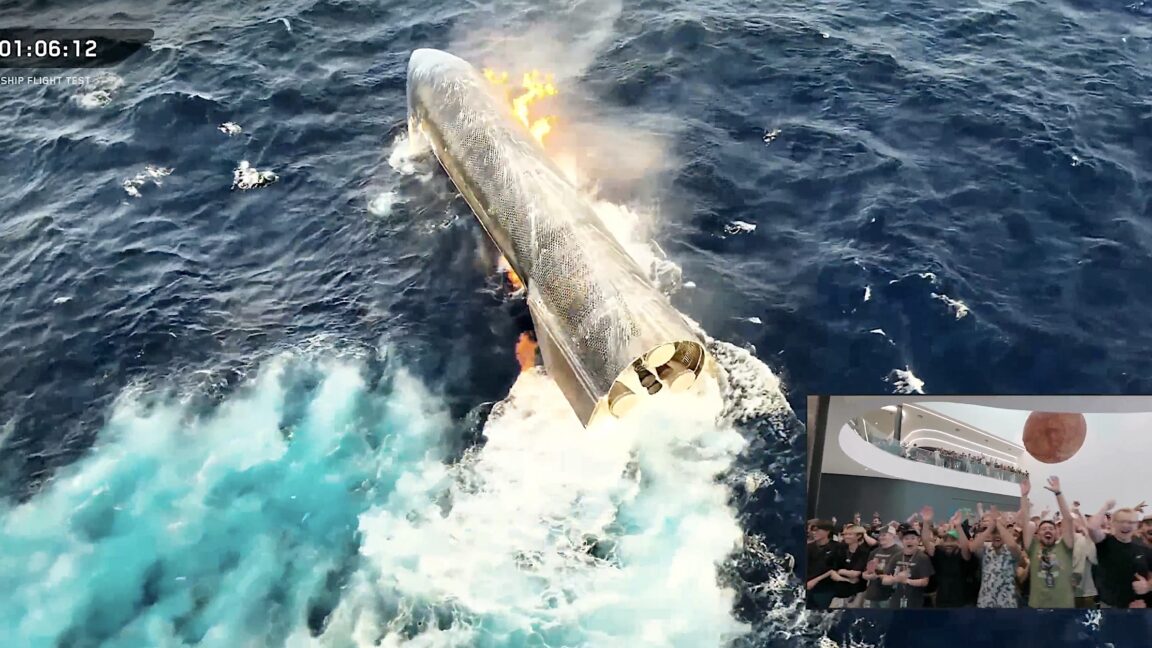
Image: courtesy of Ars Technica
SpaceX's Super Heavy Tower Catch: What the Milestone Means for Starship's Orbital Future
SpaceX achieved a critical milestone on July 26, 2026, successfully catching a Super Heavy booster with its launch tower. This engineering feat followed the 13th Starship flight test, which launched on a transatmospheric trajectory and deployed 20 Starlink satellites. While the booster's return and catch dramatically advance SpaceX's vision for rapid reusability, the full Starship system's first orbital flight and its path to routine, cost-effective space transport continue to navigate complex engineering challenges and regulatory approvals.
Outlook
Background
The ambition behind SpaceX's Starship program is not merely to build a larger rocket, but to create a fully and rapidly reusable space transport system. This means both the Super Heavy booster (the first stage) and the Starship upper stage (the second stage and spacecraft) must be able to launch, perform their mission, and return to their launch site for quick refurbishment and re-flight. The tower catch is central to this. Unlike the Falcon 9, which lands vertically on a drone ship or landing pad, Super Heavy is designed to be 'caught' by giant mechanical arms on the launch tower. This method, often referred to as 'Mechazilla,' is intended to reduce turnaround time and eliminate the need for costly landing legs, making the booster lighter and more efficient. The successful catch on July 26, 2026, represents a significant validation of this highly complex and unique recovery strategy, a critical step towards the rapid reusability that underpins Starship's economic model.
Flight 13, which preceded the booster catch, was itself a pivotal test. It launched on a transatmospheric trajectory, a path that brings it close to space but does not complete a full orbit. The mission successfully deployed 20 Starlink V3 satellites, demonstrating Starship's capability as a payload delivery vehicle. However, the flight also experienced a 'burn shortfall,' indicating that while the primary mission objective was met, there are still engineering challenges to overcome in the vehicle's propulsion system. The FAA's role in this process is paramount. As the primary regulator for commercial space launches in the United States, the agency must sign off on every aspect of SpaceX's flight test program, from environmental impact assessments to safety protocols and incident investigations. Each anomaly, like Flight 13's burn shortfall, triggers an FAA-mandated investigation and requires approved corrective actions before another launch license can be issued. This creates a regulatory rhythm that often dictates the pace of SpaceX's ambitious testing schedule.
See also
Precedents
SpaceX's development philosophy has always centered on rapid, iterative testing and learning from failures. This approach was evident during the early days of the Falcon 9 program, where numerous prototypes and test flights were conducted, often ending in spectacular explosions, before the company perfected its vertical landing technology. The Falcon 9's eventual success in routine booster recovery transformed the economics of space launch, proving that reusability was not just technically possible but economically advantageous.
Starship's development has followed a similar, albeit even more aggressive, trajectory. Early prototypes of the Starship upper stage underwent numerous 'hop tests,' with many resulting in fiery disassemblies before successful landings were achieved. The Super Heavy booster's development has also seen its share of ground tests and static fire campaigns. The transition from controlled vertical landings (like Falcon 9) to the more complex 'tower catch' method for Super Heavy represents another leap in this iterative process. This historical pattern suggests that while the successful catch is a major triumph, it is one step in a long series of tests, refinements, and regulatory engagements. Each success builds confidence and provides crucial data, but also reveals new challenges. The company's ability to quickly identify root causes of issues, implement design changes, and gain regulatory approval has been a hallmark of its progress, and it will be tested again as Starship moves towards its full orbital capabilities.
The successful Super Heavy tower catch is more than just an impressive technical display; it is a profound validation of SpaceX's core strategy for making space travel routine and affordable. For years, the cost of accessing space has been dominated by the expense of building single-use rockets. Starship aims to shatter that economic model. By achieving rapid, full reusability for both stages of the rocket, SpaceX intends to drive launch costs down to unprecedented levels. This has several far-reaching implications.
Firstly, for Starlink, SpaceX's satellite internet constellation, routine and cheap Starship launches are essential. Flight 13 already demonstrated Starship's ability to deploy 20 Starlink V3 satellites, a significant increase in payload capacity compared to Falcon 9. A fully reusable Starship could accelerate Starlink's deployment, enhance its global coverage, and improve its economic viability.
Secondly, the ability to rapidly launch and recover a vehicle of Starship's immense size is crucial for SpaceX's long-term ambitions, particularly human missions to the Moon and Mars. These missions require not only massive payload capacity but also the ability to refuel Starship in orbit, a process that relies on multiple Starship launches. The tower catch is a foundational piece of the infrastructure needed to support such an ambitious cadence.
Finally, the success of Starship's reusability could redefine the entire space industry. If SpaceX can prove the economic model, it will put immense pressure on competitors to develop similar reusable heavy-lift systems, potentially sparking a new era of innovation and competition that makes space more accessible for scientific research, commercial ventures, and even space tourism. The human stakes are tangible: cheaper launches could mean more scientific missions, more affordable access to space for nations and companies, and a faster timeline for humanity to become a multi-planetary species.
Scenarios
AnalysisThe successful Super Heavy booster catch opens several distinct pathways for the Starship program, each with its own set of challenges and potential rewards.
One likely outcome is that SpaceX will now push aggressively towards the first full orbital flight of the Starship upper stage. This mission would involve the upper stage reaching orbital velocity, performing a controlled re-entry, and ideally, attempting its own landing, either on a pad or in the ocean, depending on the test profile. Achieving this would validate the entire Starship system's ability to reach and operate in space, a critical step before any human-rated missions or large-scale satellite deployments. The timing of this next flight will depend heavily on the FAA's approval process and how quickly SpaceX can address any remaining engineering issues, such as the burn shortfall identified on Flight 13.
Another significant outcome could be an accelerated development of Starship's operational capabilities for Starlink deployment. With Flight 13 successfully delivering satellites, and the booster catch demonstrating a key aspect of reusability, SpaceX may now focus on increasing the cadence of Starlink V3 launches. Each successful deployment, even if not fully orbital for the upper stage, provides valuable data and generates revenue. This could see Starship becoming a regular, albeit still experimental, workhorse for Starlink before it fully matures into a multi-purpose transport system.
A less favorable, though still possible, scenario involves unforeseen engineering challenges or regulatory delays that slow the program's momentum. While the booster catch was a success, the 'burn shortfall' on Flight 13 indicates that the Starship upper stage still has refinements pending. Any new anomalies during subsequent tests, or a prolonged FAA review of existing issues, could push back the timeline for full orbital flight and routine operations. This would introduce further execution risk and potentially impact SpaceX's financial models that rely on rapid reusability to bring down costs.
Finally, the success of the tower catch could lead to increased confidence and investment in Starship's long-term goals, such as its role as a lunar lander for NASA's Artemis program or its eventual use for Mars missions. With a major technical hurdle cleared, stakeholders and investors may see a clearer path to these ambitious objectives, potentially leading to greater resources being allocated to accelerate development in these areas, even as the immediate focus remains on achieving routine orbital flight.
Timeline
Frequently Asked Questions
Discussion
Be the first to share your thoughts.