
This article explores the implications of Stella Juva's successful trial for the future of healthcare delivery in remote, underserved regions, particularly across Africa. It will examine the technical achievements, the inherent challenges of scaling such a solution, and the broader context of global health equity. We will look at what this prototype proves, what questions it leaves unanswered, and what institutional and financial hurdles lie ahead for widespread adoption.
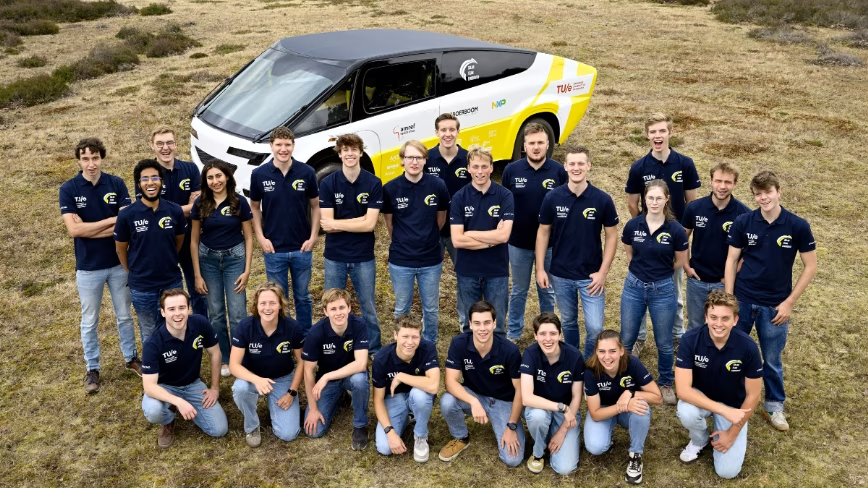
Image: courtesy of Thenextweb
Beyond the Test Drive: What a Solar Mobile Clinic's Kenyan Success Means for Off-Grid Healthcare
A solar-powered mobile clinic, named Stella Juva, successfully completed an 800-kilometer journey across Kenya in August 2026. The vehicle, developed by Solar Team Eindhoven, demonstrated its ability to generate more energy than it consumed, even while powering critical medical equipment such as an X-ray machine, an ultrasound scanner, and a vaccine refrigerator. This trial specifically targeted off-grid areas in Nakuru, Narok, and Kajiado counties, including a visit to the Mosiro clinic, which lacks grid electricity. While no real patients were treated during the trial, simulations indicated the clinic could potentially serve around 200 people daily. The Stella Juva is now being shipped back to the Netherlands for further assessment.
Outlook
Background
Access to basic healthcare remains a profound challenge for millions of people globally, especially in rural and remote communities. In many parts of sub-Saharan Africa, including large swathes of Kenya, essential services are often hundreds of kilometers away, hindered by poor road infrastructure and a complete absence of reliable electricity grids. This means clinics cannot power diagnostic tools, refrigerate medicines, or even light examination rooms reliably. The lack of infrastructure effectively creates medical deserts, where preventable diseases become fatal and treatable conditions escalate.
Traditional mobile clinics, while offering a partial solution, typically rely on fuel-powered generators or grid connections, making them expensive to operate, prone to breakdowns, and limited by fuel supply chains in remote areas. This is where Stella Juva offers a significant departure. Its core innovation lies in its complete energy self-sufficiency. By integrating advanced solar panels and efficient energy storage, the clinic not only powers its onboard medical equipment but also generates a surplus. This 'energy positive' capability means it can operate autonomously for extended periods, recharging its own systems and potentially even providing power to local, off-grid facilities. The successful 800-kilometer journey, traversing difficult clay roads in Kenya's interior, confirms the vehicle's robust design and operational resilience under challenging real-world conditions.
The medical equipment carried – an X-ray machine, an ultrasound scanner, and a vaccine refrigerator – are not merely conveniences; they are foundational tools for modern healthcare. X-rays are crucial for diagnosing fractures and certain respiratory conditions, while ultrasounds are vital for prenatal care and identifying internal issues. A reliable vaccine refrigerator is indispensable for maintaining the cold chain, ensuring vaccines remain effective, especially in regions battling infectious diseases. The ability to bring these capabilities directly to communities without existing infrastructure represents a significant step forward in addressing health disparities.
Precedents
The concept of mobile clinics is not new. For decades, organizations worldwide have deployed vehicles, boats, and even aircraft to deliver medical services to hard-to-reach populations. From 'doctor wagons' of the early 20th century to modern, custom-fitted vans, the goal has always been to overcome geographical barriers. However, these initiatives have consistently faced limitations related to operational costs, fuel dependency, and the sheer challenge of powering sophisticated medical equipment in remote settings.
In Africa, specifically, mobile health initiatives have often struggled with sustainability. Many projects are reliant on external funding, and the logistical complexities of maintaining a fleet of vehicles, procuring fuel, and staffing specialized personnel in diverse environments can be overwhelming. The intermittent nature of grid electricity in many regions has also meant that even if a mobile clinic could reach a remote village, its advanced equipment might be unusable without a separate, often noisy and polluting, generator.
What Stella Juva represents is a convergence of established mobile healthcare needs with rapidly advancing solar and battery technology. The idea of energy self-sufficiency for remote operations has gained traction in other sectors, from off-grid solar home systems that provide lighting and phone charging, to solar-powered water pumps for agriculture. This project essentially extends that proven model to a high-stakes, high-impact application: critical medical care. Previous attempts at solar-powered vehicles have often been proof-of-concept races, demonstrating speed or endurance. Stella Juva, however, focuses on utility and sustained power generation, marking a shift from pure engineering challenge to practical, humanitarian application. This trial builds on a broader trend of leveraging distributed, renewable energy to bypass traditional infrastructure limitations, a pattern increasingly seen in telecommunications and education as well.
Stella Juva's successful trial in Kenya is more than an engineering feat; it represents a tangible pathway to addressing one of the most persistent inequities in global health: access to care in off-grid communities. For millions in places like rural Kenya, a simple diagnosis or a vital vaccine shot can mean the difference between life and death. This clinic, by bringing advanced diagnostics and cold-chain capabilities directly to the point of need, could fundamentally alter health outcomes.
The vehicle's ability to generate more energy than it consumes is a critical detail. It means the clinic is not just mobile, but truly self-sufficient. It does not need to return to a charging station, nor does it require a constant supply of diesel for a generator. This drastically reduces operational costs, environmental impact, and logistical hurdles, making it a sustainable model in areas where fuel is expensive and infrastructure is non-existent. The potential for the clinic to also power local facilities or even charge community devices could foster broader development in these areas, creating a ripple effect beyond direct medical care.
Beyond immediate health benefits, this project challenges existing paradigms of healthcare delivery. It suggests that expensive, centralized hospitals might not always be the only answer. Instead, a network of agile, self-powered mobile units could provide a complementary, and in some cases, superior solution for initial diagnostics, preventive care, and emergency response in dispersed populations. This model could strengthen primary healthcare systems by extending their reach, reducing the burden on overstretched central facilities, and building trust within communities that have historically been neglected by formal medical services. The successful navigation of rough terrain in Kenya also proves the vehicle's ruggedness, a crucial factor for deployment in similar challenging environments worldwide.
Scenarios
AnalysisThe successful trial of Stella Juva opens several distinct paths for the future of solar mobile clinics and healthcare delivery in remote regions:
1. Accelerated Development and Strategic Partnerships for Scaled Deployment: The confirmed technical viability of Stella Juva suggests that the next phase could involve moving beyond a prototype to a more robust, deployable solution. This would likely require significant investment and strategic partnerships. Universities and research teams, like Solar Team Eindhoven, often excel at innovation but lack the infrastructure for mass production and long-term operational deployment. Therefore, we could see collaborations with established automotive manufacturers, medical device companies, and international health organizations (such as Doctors Without Borders, WHO, or national health ministries). These partnerships would be crucial for industrializing the design, securing funding for manufacturing, and establishing logistical networks for widespread deployment across various African nations and other remote regions globally. Such a scaled effort would focus on refining the vehicle for diverse climates, improving interior layouts for patient flow, and developing sustainable maintenance and training programs for local staff. The vehicle being shipped back to the Netherlands indicates a period of analysis and potential design refinement before any larger-scale production or deployment plans are announced.
2. Regulatory and Operational Challenges Limiting Widespread Adoption: While technically sound, the path to widespread adoption is rarely straightforward. Even with successful trials and potential partnerships, significant regulatory and operational hurdles remain. Different countries have varying regulations concerning mobile medical units, medical licensing for practitioners, and the approval of onboard equipment. Navigating these fragmented policy landscapes could slow deployment. Furthermore, the cost of manufacturing these specialized vehicles, even if optimized, may still be substantial, requiring innovative funding models or significant government subsidies to make them accessible to health systems in developing economies. There is also the challenge of human capital: ensuring a consistent supply of trained medical professionals willing and able to operate in remote areas, combined with the technical expertise to maintain and repair these advanced solar vehicles. Without a comprehensive strategy addressing these non-technical factors, the Stella Juva project, despite its promise, may struggle to move beyond successful pilot programs to truly transform healthcare access at scale.
Timeline
August 2026
Stella Juva Completes 800km Trial in Kenya
The solar mobile clinic successfully drove 800 kilometers across Kenya, including off-grid areas in Nakuru, Narok, and Kajiado counties. It demonstrated energy self-sufficiency while powering medical equipment, with simulations suggesting a capacity to serve 200 people daily.
September 1, 2026
Vehicle Shipped Back to Netherlands
Following the successful trial, the Stella Juva is currently being transported back to the Netherlands for further analysis and potential design refinements by Solar Team Eindhoven.
Frequently Asked Questions
Stella Juva is a solar-powered mobile clinic developed by Solar Team Eindhoven. It is designed to bring essential medical services, including diagnostic equipment like X-ray and ultrasound, and vaccine refrigeration, to remote and off-grid areas.
Discussion
Be the first to share your thoughts.