
The semiconductor industry, already grappling with intense demand for AI infrastructure, can expect this partnership to reshape competitive dynamics. Samsung is positioning itself as a comprehensive 'turnkey' solution provider for AI chips, offering everything from advanced memory to manufacturing and packaging under one roof. For Broadcom, the deal secures a crucial supply of high-performance components, essential for its AI accelerator business, against a backdrop of tight global chip capacity. Observers will be watching how this deep integration impacts product development cycles and market share for both companies and their rivals in the coming years.
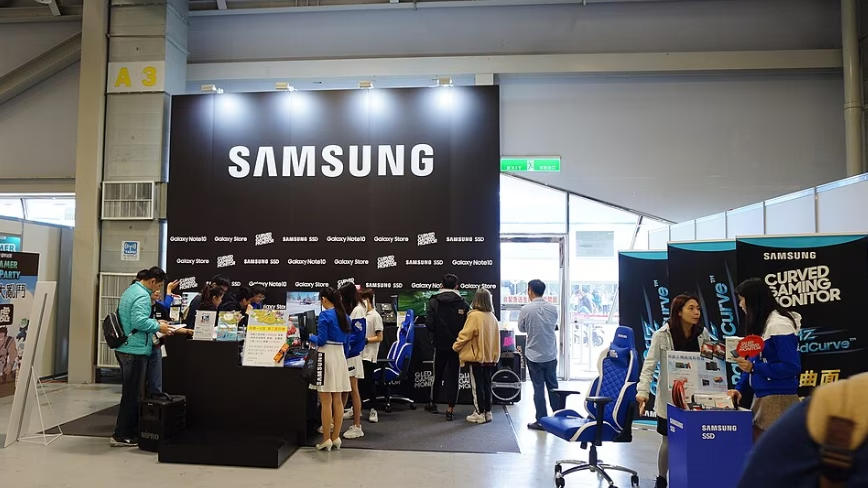
Image: courtesy of Thenextweb
Samsung's $200 Billion Broadcom Deal Positions It Deeper in the AI Chip Race
Samsung Electronics and Broadcom have entered into a strategic agreement valued at over $200 billion, securing a significant supply chain for artificial intelligence semiconductors through 2030. The pact covers critical components including next-generation High Bandwidth Memory (HBM), advanced foundry services for sub-2-nanometer chips, and sophisticated packaging solutions. This long-term commitment, announced on Saturday, July 25, 2026, at an AI summit in San Francisco, signals Broadcom's deep reliance on Samsung's integrated capabilities and Samsung's aggressive push to capture a larger share of the burgeoning AI chip market.
Outlook
Background
The global surge in artificial intelligence development has created unprecedented demand for specialized semiconductors. AI chips, which include graphics processing units (GPUs) and custom accelerators, require not only immense processing power but also incredibly fast memory and sophisticated packaging to function efficiently. High Bandwidth Memory, or HBM, is a type of RAM that stacks multiple memory dies vertically, allowing for much higher data transfer rates than traditional memory. This is crucial for feeding the massive datasets that AI models process.
Foundry manufacturing refers to the process where companies like Samsung or TSMC produce chips designed by other firms. The move to 'sub-2-nanometer' technology signifies a push to create even smaller, more powerful, and energy-efficient transistors on these chips. Advanced packaging, meanwhile, is no longer just about protecting the chip; it's about integrating multiple components (like processors and HBM) into a single, high-performing unit. This 'turnkey' approach, where one vendor provides memory, manufacturing, and packaging, is becoming increasingly attractive to chip designers like Broadcom, who seek to simplify their supply chains and accelerate product development.
Broadcom is a major player in networking and broadband communication chips, but it has also been expanding its footprint in custom AI accelerators. Securing a reliable, cutting-edge supply chain is vital for its growth in this segment. For Samsung, historically a leader in memory chips (DRAM and NAND), this deal represents a significant validation of its efforts to expand its foundry business and establish itself as a formidable competitor to TSMC, which currently dominates the advanced chip manufacturing market. The deal's $200 billion valuation over five years through 2030 ranks it among the largest semiconductor partnerships ever, reflecting the immense capital and technological investment required in the AI era.
See also
Precedents
Large-scale, multi-year supply agreements are not new in the semiconductor industry, but their scope and financial commitment have escalated significantly with the advent of AI. Historically, chip designers would often source memory from one vendor, foundry services from another, and packaging from a third. However, as chip designs become more complex and the need for seamless integration grows, the trend has shifted towards more consolidated, 'turnkey' solutions.
Major technology companies, like Apple, have long leveraged deep, multi-year manufacturing partnerships to secure critical components and intellectual property. What is distinct about the Samsung-Broadcom pact is its sheer scale and the breadth of technologies it encompasses, from memory and advanced logic manufacturing to sophisticated packaging. This mirrors a broader industry pattern where companies are seeking to de-risk their supply chains and gain competitive advantages by locking in access to cutting-edge technologies. The memory market, in particular, has seen cycles of oversupply and shortage, making long-term commitments for HBM crucial for AI developers.
For Samsung, this deal echoes its past strategies of leveraging its integrated device manufacturer (IDM) model – producing memory, logic, and even consumer electronics – to offer a more holistic solution. This contrasts with pure-play foundries like TSMC, which focus solely on manufacturing. The success of such large, integrated deals often hinges on the ability of both partners to innovate together and manage the complexities of next-generation manufacturing processes, especially as the industry pushes towards sub-2-nanometer nodes.
This $200 billion agreement reshapes several critical aspects of the AI chip supply chain. For Samsung, it is a definitive statement of intent. The company has been aggressively pursuing market share in advanced foundry services, directly challenging TSMC's dominance. This deal provides a massive, stable revenue stream and a critical anchor customer for its next-generation HBM memory, sub-2-nanometer process technology, and advanced packaging capabilities. It validates Samsung's integrated approach, potentially attracting other major AI chip designers looking for comprehensive solutions.
For Broadcom, the stakes are equally high. By securing a long-term 'turnkey' supply of cutting-edge AI chip components, Broadcom significantly de-risks its future product roadmap. In an environment where access to advanced foundry capacity and HBM is a major bottleneck, this partnership guarantees Broadcom a competitive edge in delivering its AI accelerators. The cost certainty provided by a $200 billion deal also helps Broadcom plan its capital allocation with greater precision.
The broader consequence for the industry is a potential acceleration of the 'turnkey' model. If this partnership proves successful, it could encourage other major chip designers to seek similar integrated deals, further consolidating the supply chain around a few key players capable of offering such a wide range of advanced services. It also intensifies the competitive pressure on TSMC and Intel, who are also vying for advanced AI chip business. This deal is not just about two companies; it is about setting a new benchmark for strategic collaboration in the hyper-competitive world of AI hardware.
Scenarios
Analysis1. Samsung Solidifies Its Foundry Position: The partnership provides a substantial revenue base and a showcase for Samsung's advanced manufacturing capabilities, especially its sub-2-nanometer processes and HBM. This could attract more high-profile clients, allowing Samsung to significantly narrow the market share gap with TSMC in the advanced foundry segment by 2030. Success here would validate its integrated device manufacturer (IDM) strategy over the pure-play foundry model.
2. Broadcom Gains Significant Supply Chain Advantage: With guaranteed access to leading-edge memory, foundry, and packaging, Broadcom could accelerate its AI product development and deployment. This secured supply might allow it to outcompete rivals facing procurement bottlenecks, leading to increased market share for Broadcom's AI accelerators and custom silicon solutions. The 'turnkey' nature could also reduce design complexity and time-to-market.
3. Increased Pressure on Rivals: The sheer scale and long-term nature of this deal could force competitors like TSMC, Intel, and other memory manufacturers to re-evaluate their own partnership strategies and investment plans. They may need to offer more integrated services or form deeper alliances to compete for similar large-scale AI chip contracts, potentially leading to further consolidation or novel collaborations within the industry.
4. Technological Innovation Acceleration: A deep, long-term collaboration often leads to co-development and faster innovation. Samsung and Broadcom may jointly push the boundaries of HBM, sub-2-nanometer process technology, and advanced packaging, potentially creating new industry standards or proprietary advantages that further differentiate their offerings.
Timeline
2026-07-24
AI Summit in San Francisco
The memorandum of understanding between Samsung Electronics and Broadcom was reportedly signed at an AI summit in San Francisco.
2026-07-25
Samsung Confirms $200 Billion Deal
Samsung Electronics publicly announced and confirmed its strategic collaboration with U.S. chip designer Broadcom, valued at over $200 billion, covering memory, foundry, and advanced packaging for AI semiconductors.
2030
Partnership Duration End
The strategic agreement between Samsung and Broadcom is set to run for five years, covering supply chain collaboration through 2030.
Frequently Asked Questions
The agreement covers three key areas for artificial intelligence semiconductors: memory chips (specifically next-generation HBM), advanced foundry manufacturing (for sub-2-nanometer chips), and advanced packaging solutions. This allows Broadcom to source a comprehensive, integrated solution from Samsung.
Discussion
Be the first to share your thoughts.