
The immediate consequence of the limited rollout is that the most advanced AI capabilities are not broadly accessible to developers, businesses, or the general public. Access remains restricted to a select group vetted by the US government. OpenAI has indicated it plans to broaden access to GPT-5.6 Sol in the coming weeks, potentially as early as next week, including some international partners. This expanded access will likely still involve a vetting process, though perhaps less stringent than the initial government-mandated list. The company's public statement about not wanting this level of government intervention to become the 'long-term default' suggests a future push for more independent release strategies, but that will depend heavily on evolving regulatory frameworks and geopolitical pressures surrounding AI development. For now, the path to wider availability remains subject to government oversight.
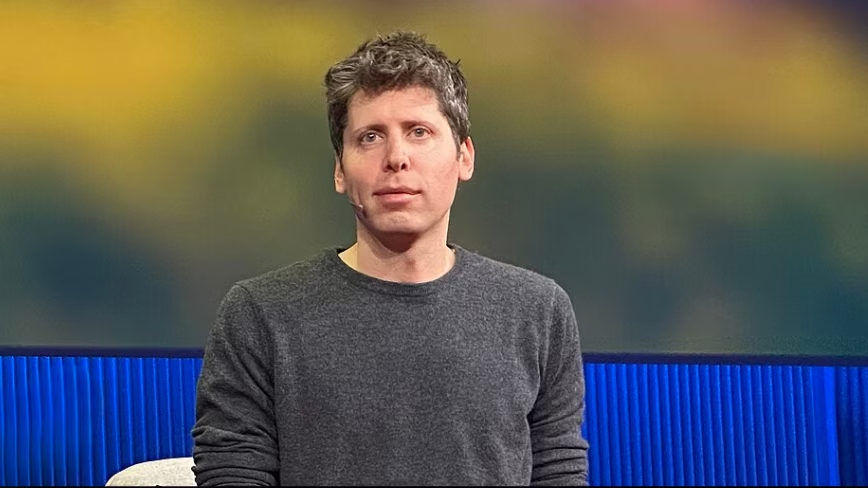
Image: courtesy of Thenextweb
OpenAI's GPT-5.6 Sol: The US Government's Grip on Next-Gen AI
OpenAI, the leading artificial intelligence developer, released its most powerful model, GPT-5.6 Sol, on Friday, June 26, 2026. However, its rollout was tightly controlled, limited to approximately 20 government-approved partners at the explicit request of the Trump administration. This move signals a significant shift in how advanced AI models are brought to market, prioritizing national security concerns over broad, immediate public access, a decision OpenAI itself expressed reservations about.
Outlook
Background
The release of GPT-5.6 Sol arrives at a moment of intensifying global competition in artificial intelligence. Governments worldwide are grappling with the dual nature of advanced AI: its immense potential for economic growth and societal benefit, alongside significant national security risks. Concerns range from the misuse of powerful models for cyberattacks and disinformation campaigns to their potential role in autonomous weapons systems. The Trump administration's intervention in OpenAI's rollout reflects a growing consensus among policymakers that 'frontier AI' models, those at the cutting edge of capability, cannot be treated like standard software releases. This approach echoes historical precedents in other dual-use technologies, such as nuclear technology or advanced cryptography, where government oversight and controlled dissemination became standard practice. The fact that OpenAI, a company initially founded with an 'open' ethos, acquiesced to this pressure, even while voicing its discomfort, highlights the immense leverage governments now hold over critical AI infrastructure and development pathways. This also occurs shortly after rival Anthropic reportedly had to disable access to two of its models, although the specific reasons for that action were not detailed in the available context.
See also
Precedents
The tension between technological innovation and government control is not new. Historically, breakthroughs in fields like atomic energy, rocketry, and early computing were often met with significant government interest, leading to classification, export controls, and restricted access. During the Cold War, for instance, much of the advanced computing research was funded and controlled by defense agencies. More recently, debates around encryption standards pitted tech companies against government agencies seeking 'backdoor' access for law enforcement and national security. The current situation with advanced AI models like GPT-5.6 Sol shares similarities with these past conflicts. Governments, particularly the US, are increasingly viewing powerful AI as a strategic national asset, akin to critical infrastructure or military technology. The concern is that if these models are released without safeguards, they could fall into the wrong hands or be exploited in ways that undermine national security or societal stability. This often leads to a 'dual-use' problem: technologies designed for benign purposes can also be weaponized. The pattern suggests that as AI capabilities grow, so too will government attempts to regulate, monitor, and potentially control their development and deployment, especially for models deemed to possess 'general purpose' capabilities that could be adapted for various applications.
The US government's direct involvement in how OpenAI releases its most advanced AI model redraws the lines of power in the tech industry. It signals a new era where national security concerns can override a company's preferred release strategy, effectively classifying frontier AI as a strategic asset requiring state oversight. For developers and businesses, this means that access to the cutting-edge tools could become politicized, with innovation potentially constrained by regulatory hurdles and government approval processes. It creates a two-tiered system: a privileged few with early, government-sanctioned access, and the broader ecosystem waiting for a later, potentially diluted, release. This approach risks slowing down broader innovation by limiting the number of minds working with and building upon these foundational models. On a global scale, it sets a precedent for how other nations might choose to control their own advanced AI, potentially leading to a more fragmented and nationalized AI ecosystem rather than a truly open and collaborative one. The long-term implications involve not just economic competitiveness but also fundamental questions about who controls the most powerful technologies of our age and for what purposes.
Scenarios
AnalysisOne possible outcome is that the current model of government-mandated limited access becomes the de facto standard for all future releases of frontier AI models. This could lead to a 'national champions' approach, where governments heavily influence or even directly fund and control the development of powerful AI within their borders, granting access only to approved entities. Such a scenario might accelerate AI development for specific government objectives, such as defense or intelligence, but could stifle commercial innovation and the broader democratisation of AI tools. It might also deepen the divide between nations with advanced AI capabilities and those without, exacerbating geopolitical tensions.
Another outcome is a more formalized regulatory framework, similar to those seen in pharmaceuticals or aviation, where AI models undergo rigorous testing and certification by government bodies before commercial release. This could involve mandatory 'red teaming' to identify potential harms and a licensing system for developers and users of powerful models. While this might address some safety and security concerns, it could also create significant bureaucratic overhead, slow down the pace of innovation, and favor larger companies with the resources to navigate complex regulatory landscapes. OpenAI's expressed concerns about the current ad-hoc process could push for such a formalized, transparent system as a lesser of two evils.
A third, more optimistic scenario, though less likely under current pressures, is that the initial limited release serves as a temporary measure to establish trust and develop best practices. As confidence in AI safety measures grows, and as governments better understand the technology, the restrictions could gradually ease, allowing for more open access. This would require significant collaboration between government, industry, and academia to develop robust safety protocols and a shared understanding of responsible AI deployment, potentially leading to a more balanced approach that marries innovation with security.
Timeline
Frequently Asked Questions
Discussion
Be the first to share your thoughts.