
The acquisition of Mesh Optical Technologies by Elon Musk is not merely a financial transaction; it represents a strategic move to internalize a critical component of the advanced computing infrastructure needed for artificial intelligence. Expect a rapid integration of Mesh's optical transceiver technology, particularly its Alpha C1 1.6 Tbps product, into Musk's existing and planned data center operations. This could streamline development, reduce reliance on external suppliers, and potentially accelerate the deployment of high-performance AI computing clusters. The emphasis will likely be on optimizing these components for demanding, high-bandwidth applications, mirroring the intense engineering focus seen in other Musk-led companies.
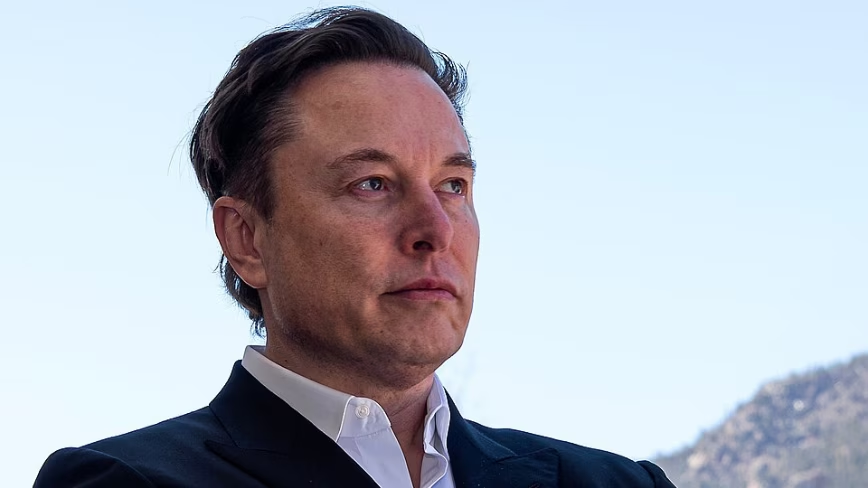
Image: courtesy of Thenextweb
FTC Clears Elon Musk to Acquire Mesh Optical Technologies, Bolstering His AI Data Center Ambitions
Elon Musk has received Federal Trade Commission approval to acquire Mesh Optical Technologies, a startup founded by former SpaceX engineers that specializes in optical transceivers for AI data centers. The clearance, granted on June 25, 2026, marks a significant step in Musk's push for vertical integration in his burgeoning hardware and AI infrastructure ventures, though financial terms of the deal were not disclosed.
Outlook
Background
The Federal Trade Commission (FTC) officially granted regulatory approval for Elon Musk's acquisition of Mesh Optical Technologies Corp. on June 25, 2026. This approval, listed under transaction number 20261601, signals that regulators found no significant competitive concerns with the deal, allowing it to proceed on an accelerated timeline. Mesh Optical Technologies, which emerged from 'stealth mode' in February 2026, was founded by a team of engineers who previously worked at SpaceX, another company under Musk's leadership. The startup had raised $50 million in Series A funding, with Thrive Capital leading the round. Its flagship product, the Alpha C1 optical transceiver, is designed to handle data transfer rates of 1.6 terabits per second (Tbps), a crucial capability for modern AI data centers. The financial specifics of the acquisition, including the purchase price, have not been publicly disclosed by either party.
See also
Precedents
Elon Musk has a consistent history of vertical integration across his various companies, a pattern that defines much of his business strategy. At Tesla, this meant controlling everything from battery cell design to software and charging networks. With SpaceX, the company manufactures most of its rocket components in-house, from engines to avionics, rather than relying heavily on external suppliers. This approach aims to reduce costs, accelerate development cycles, and ensure quality control over critical technologies. The acquisition of Mesh Optical Technologies fits squarely into this established pattern. For his AI ambitions, which demand immense computational power and high-speed data transfer, controlling the underlying hardware infrastructure, particularly specialized components like optical transceivers, is a logical extension of this strategy. This mirrors how other large tech companies, like Google and Amazon, have increasingly designed their own custom chips and networking hardware for their data centers to gain efficiency and performance advantages.
This acquisition is more than just another tech deal; it's a strategic maneuver that could significantly shape the future of AI infrastructure. Optical transceivers are the unsung heroes of modern data centers, converting electrical signals into light pulses for high-speed data transmission over fiber optic cables. As artificial intelligence models grow larger and more complex, the demand for faster and more efficient communication between graphics processing units (GPUs) and memory within data centers has skyrocketed. Mesh's 1.6 Tbps Alpha C1 transceiver is at the cutting edge of this technology, offering the bandwidth necessary to prevent bottlenecks that can cripple AI training and inference.
By bringing Mesh in-house, Musk gains direct control over a vital choke point in the AI compute stack. This implies a potential for faster innovation cycles, custom integration tailored to his specific AI projects, and a reduction in supply chain risks for these critical components. For the broader industry, it reinforces the trend of major tech players investing deeply in specialized hardware to support their AI ambitions, rather than solely relying on off-the-shelf solutions. It also highlights the increasing value of niche hardware expertise, especially when it originates from a talent pool like former SpaceX engineers, known for tackling complex engineering challenges.
Scenarios
AnalysisOne immediate outcome of the acquisition is that Mesh's optical transceiver technology will likely be integrated directly into the infrastructure supporting Musk's various AI initiatives. This could lead to a rapid scaling of specialized data centers optimized for AI workloads, potentially offering a competitive edge in developing and deploying advanced AI models. The deep technical collaboration between Mesh's engineers and existing teams within Musk's ecosystem, particularly those focused on AI and high-performance computing, could accelerate product development and customization for specific applications.
A second potential outcome involves the broader market for optical components. By internalizing this technology, Musk could intensify competition within the optical transceiver market, pressuring existing suppliers to innovate faster or face losing potential business from large-scale AI infrastructure projects. This move might also inspire other major tech firms to pursue similar vertical integration strategies, either through acquisitions or by developing their own in-house capabilities, further fragmenting the market and driving specialized hardware development.
Looking further out, there is a speculative possibility that Mesh's technology could eventually find applications beyond dedicated AI data centers. Given the company's roots in SpaceX, which has ambitious plans for satellite internet and space-based computing, Mesh's expertise in high-speed, robust optical communications could potentially be leveraged for future inter-satellite links or ground-to-space data transfer systems. This would represent a significant expansion of Mesh's initial focus, but aligns with Musk's broader vision of integrated, high-performance networks across various domains.
Timeline
2026-02
Mesh Optical Technologies Emerges from Stealth
Mesh Optical Technologies, a startup founded by former SpaceX engineers, publicly announced its existence and raised $50 million in Series A funding, led by Thrive Capital. The company revealed its focus on developing high-speed optical transceivers for AI data centers.
2026-06-25
FTC Grants Acquisition Approval
The Federal Trade Commission provided regulatory clearance for Elon Musk to acquire Mesh Optical Technologies Corp. The approval was granted via an official early termination notice, transaction number 20261601, indicating no significant competitive concerns.
2026-06-27
Acquisition News Confirmed
Reports confirmed that Elon Musk secured FTC clearance to acquire Mesh Optical Technologies, with the news widely disseminated across financial and technology news outlets.
Frequently Asked Questions
Mesh Optical Technologies is a startup founded by former SpaceX engineers. It specializes in designing and developing high-speed optical transceivers, which are crucial components for transmitting data rapidly within artificial intelligence (AI) data centers.
Discussion
Be the first to share your thoughts.