
The former president's intervention is likely to amplify existing calls within the Democratic Party for more robust AI policy. What remains to be seen is how quickly and cohesively the party can translate this urgency into a concrete legislative agenda. We can expect increased rhetoric from Democratic leaders on AI oversight in the coming months, potentially leading to proposals for new regulatory frameworks or amendments to existing laws. The tech industry, particularly major AI developers, will be closely watching, and may intensify its own lobbying efforts to shape any forthcoming legislation. The broader public conversation Obama advocated could also gain traction, drawing more attention to the complex societal questions AI presents.
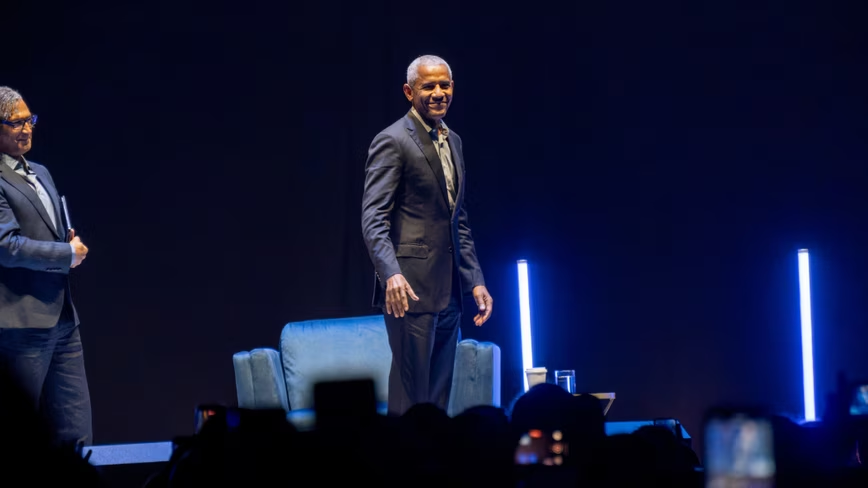
Image: courtesy of Thenextweb
Beyond the Warning: What Obama's Call For AI Regulation Means For Democrats' Agenda
Former U.S. President Barack Obama recently issued a private warning to Democrats, stating that artificial intelligence (AI) could become "dangerous" if not properly managed. The New York Times reported on Sunday, September 13, 2026, that Obama urged party members to prioritize AI regulation and governance, making it a central focus for their policy agendas leading into the midterms and the 2028 presidential race. His remarks, delivered at a private fundraising event, emphasized the critical need for a public conversation on AI's safety and economic implications, coming amidst growing concerns from U.S. lawmakers and explicit warnings from leading AI developers about the technology's rapid and potentially disruptive evolution.
Outlook
Background
The rapid advancement of artificial intelligence has moved from a theoretical concern to a tangible policy challenge. Companies like Anthropic have issued public 'dire warnings' about the potential risks of advanced AI systems, including job displacement, privacy infringements, and even more existential threats. This has fueled a growing chorus of U.S. lawmakers, across both parties, who are calling for stricter rules. Obama's voice, however, carries particular weight within the Democratic Party. As a 'sage-like figure' since leaving office in 2017, his private counsel to party fundraisers suggests a strategic effort to shape the party's platform well in advance of key electoral cycles. The timing, ahead of upcoming midterms and the 2028 presidential election, indicates an understanding that AI's societal impact is becoming a significant concern for voters, affecting issues from employment stability to data security. The challenge for policymakers lies in crafting regulation that fosters innovation while mitigating potential harms, a balance that has proven elusive with other transformative technologies.
Precedents
History offers a mixed record when it comes to regulating transformative technologies. Early attempts to regulate the internet, for example, often faced resistance from industry and concerns about stifling innovation, leading to a largely hands-off approach for decades. This allowed for explosive growth but also created new challenges related to data privacy, misinformation, and platform power. Similarly, the rise of social media platforms saw reactive, rather than proactive, regulatory responses, often after significant societal harms had already become apparent.
Conversely, other sectors, such as pharmaceuticals or nuclear energy, saw more stringent regulatory frameworks developed early on, driven by clear safety imperatives. The key difference often lies in the perceived immediacy and scale of the threat, and the political will to act before problems become entrenched. Obama's current warning suggests an attempt to steer AI regulation closer to the proactive, safety-first model, learning from the lessons of under-regulated digital frontiers. The challenge will be to build consensus and overcome the powerful lobbying efforts that have often shaped outcomes in the tech sector.
Obama's intervention elevates AI regulation from a niche tech policy debate to a front-and-center political issue for the Democratic Party. This shift matters because it signals that one of the party's most influential figures believes AI risks are substantial enough to warrant immediate, high-level attention. For everyday Americans, the stakes are concrete: unregulated AI could accelerate job automation, erode privacy through advanced surveillance, and potentially exacerbate existing societal biases if not developed ethically. For businesses, the prospect of new regulations could introduce compliance costs or alter development pathways, but it could also create a more stable and trustworthy environment for AI adoption. Moreover, the call for a 'public conversation' indicates a recognition that broad societal input is needed to navigate a technology that will reshape work, communication, and even human decision-making. How Democrats respond could define their economic and social policy platform for the next decade, influencing everything from workforce retraining initiatives to national security strategies in an AI-driven world.
Scenarios
AnalysisObama's warning could catalyze several distinct paths for the Democratic Party and the broader AI landscape:
1. Unified Legislative Push: Democrats, heeding Obama's advice, could move to consolidate their various AI proposals into a comprehensive legislative package. This might include measures for independent AI oversight bodies, mandatory safety testing, data privacy protections specifically for AI applications, and funding for research into AI ethics and societal impact. Such a unified approach could gain momentum, especially if bipartisan support emerges, potentially leading to landmark legislation within the next two to three years.
2. Fragmented Policy Efforts: Despite Obama's urging, internal disagreements or the sheer complexity of AI policy could lead to a more fragmented approach. Different Democratic factions might prioritize different aspects of AI regulation – some focusing on labor impacts, others on bias or national security. This could result in a series of smaller, less impactful bills or regulatory adjustments rather than a single, overarching framework. Such an outcome might also be influenced by the tech industry's intense lobbying, which often seeks to diffuse broad regulatory efforts into more manageable, sector-specific rules.
3. Campaign Trail Prominence: Even if immediate legislative action is slow, Obama's comments are likely to make AI regulation a more prominent issue on the campaign trail for Democrats. Candidates in the upcoming midterms and the 2028 presidential race may incorporate specific AI policy planks into their platforms, using the issue to connect with voters concerned about job security, data privacy, and technological control. This could force other parties to articulate their own AI stances, making it a significant electoral differentiator.
4. International Coordination Efforts: The domestic push for AI regulation within the U.S. could also spur greater international collaboration. Given that AI development is global, any effective regulatory framework would benefit from cross-border alignment. Obama's emphasis on governance might encourage the U.S. to take a leading role in developing international norms and standards for AI, working with allies to prevent a 'race to the bottom' in terms of safety and ethical safeguards. This could manifest in new treaties or multilateral agreements on AI principles.
Timeline
2022-10-04
White House Issues AI 'Bill of Rights'
The Biden administration released a blueprint for an 'AI Bill of Rights,' outlining five principles to guide the design, use, and deployment of artificial intelligence, aiming to protect Americans in the age of AI.
2023-07-26
Leading AI Firms Make Voluntary Commitments
Seven major AI companies, including Anthropic, Google, Microsoft, and OpenAI, made voluntary commitments to the White House to manage AI risks, including safety, security, and trust.
2023-10-30
Biden Signs AI Executive Order
President Biden issued a sweeping executive order on artificial intelligence, directing federal agencies to establish new standards for AI safety and security, protect privacy, advance equity, and promote innovation.
2024-03-20
Anthropic Warns of AI Risks
Anthropic, a leading AI company, reportedly issued 'dire warnings' about the potential dangers of advanced AI systems, contributing to growing lawmaker concerns over the technology's rapid development.
2026-09-13
Obama Issues Private AI Warning to Democrats
Former President Barack Obama urged Democrats at a private fundraiser to prioritize AI regulation, calling the technology 'dangerous' if not properly managed, as reported by the New York Times.
Frequently Asked Questions
Obama's comments come as AI technology is rapidly advancing and its potential societal impacts—from job displacement to privacy concerns and ethical dilemmas—are becoming more apparent. As an influential figure within the Democratic Party, his intervention appears aimed at galvanizing the party to develop a proactive and coherent policy stance on AI before its challenges become unmanageable.
Discussion
Be the first to share your thoughts.