
Expect to see a continued push from Beijing to integrate advanced robotics into various sectors of its economy, particularly manufacturing and logistics. The speed at which humanoid robots are moving from research labs to commercial deployment suggests that the initial barriers to adoption, such as cost and reliability, are being overcome faster than anticipated. This could translate into more announcements from Chinese companies regarding mass production targets and new application areas throughout 2026. The focus will likely remain on industrial settings first, where the value proposition of automation is clearest, before a broader expansion into service roles. Regulatory frameworks and government subsidies will also likely evolve to support this rapid expansion, aiming to cement China's position as a global leader in humanoid robotics.
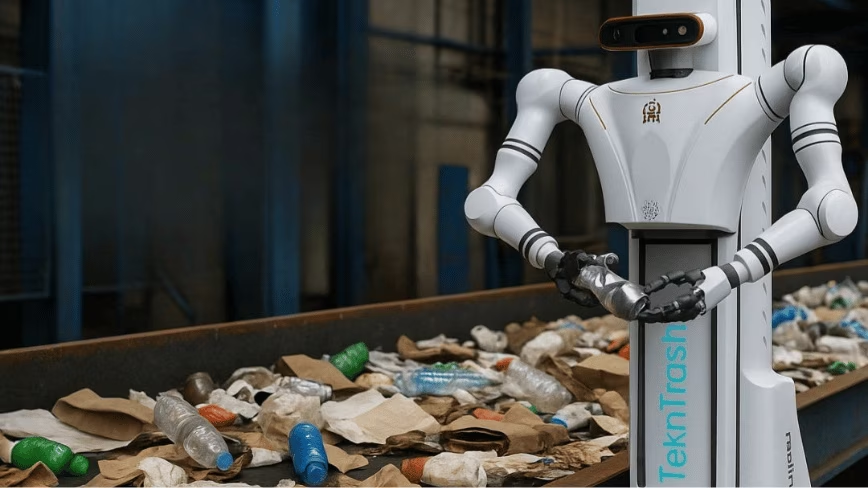
Image: courtesy of Thenextweb
Morgan Stanley Doubles China Robot Forecast Again Amid Rapid Commercial Deployment
Morgan Stanley has once again sharply increased its forecast for humanoid robot shipments in China, now projecting 50,000 units for 2026. This latest revision, nearly double its previous estimate of 28,000 from January, reflects a quicker-than-anticipated shift from demonstration phases to active commercial use in factories, retail, and hospitality settings. The investment bank points to aggressive production plans from Chinese companies, including electric-vehicle maker Xpeng, as a key driver, suggesting China is accelerating its lead in the global robotics market with significant policy and industrial backing.
Outlook
Background
Morgan Stanley's latest projection, issued on Tuesday, June 24, 2026, marks the second time this year the bank has significantly raised its outlook for China's humanoid robot market. Earlier in January, it had already doubled its forecast to 28,000 units for the year. This aggressive upward revision indicates a fundamental re-evaluation of the market's growth trajectory, driven by concrete developments on the ground. The bank specifically cited the move from 'stage demos to real factories, shops and restaurants' as the primary reason for its optimism.
This rapid commercialization is not happening in a vacuum. It is deeply intertwined with China's broader strategic goals for technological self-sufficiency and industrial upgrading, often referred to as 'Made in China 2025' or more recent iterations of industrial policy. The government has consistently prioritized advanced manufacturing and artificial intelligence, providing substantial subsidies and policy support for domestic robotics companies. Companies like AgiBot, a leading Chinese embodied intelligence startup, are already accelerating the application of their humanoid robots across industrial, commercial, and household settings, showcasing their advancements at major conferences and securing significant orders.
For example, Xpeng, a prominent electric vehicle manufacturer, has publicly announced plans for mass production of humanoid robots by the end of this year. Such commitments from established industrial players signal a critical turning point, moving beyond experimental prototypes to scalable manufacturing. This kind of institutional backing and investment suggests a robust ecosystem is forming, capable of supporting rapid deployment and iteration.
See also
Precedents
The rapid ascent of China's robotics industry follows a familiar pattern seen in other high-tech sectors, notably electric vehicles and solar energy. In these areas, initial government backing, coupled with a vast domestic market and aggressive manufacturing capabilities, allowed Chinese companies to quickly scale production, reduce costs, and eventually dominate global supply chains.
Historically, China has leveraged its manufacturing prowess to turn niche technologies into mass-market products. The government often plays a dual role: both as a strategic investor and as a massive first customer, creating demand that helps domestic firms achieve economies of scale. This approach often leads to a 'hockey stick' growth curve, where initial slow adoption is followed by an exponential surge once key cost and performance thresholds are met.
The current trajectory for humanoid robots appears to mirror this. What begins as a strategic imperative for industrial automation quickly becomes a competitive advantage for individual companies, driving further innovation and market expansion. This aggressive push for domestic leadership also often involves significant investments in research and development, talent acquisition, and intellectual property development, creating a self-reinforcing cycle of innovation and commercialization. The speed of Morgan Stanley's forecast revisions itself is a historical pattern — financial institutions often lag behind the true pace of technological adoption, only catching up after seeing undeniable evidence of accelerated deployment.
The doubling of Morgan Stanley's forecast for China's humanoid robot shipments is more than just a revised number; it signals an acceleration in a crucial technological race. For global manufacturers, it means China is not just a market but a rapidly evolving hub for advanced automation, potentially setting new benchmarks for efficiency and cost. Companies that fail to keep pace with these developments risk falling behind in global competitiveness.
For investors, this shift points to significant opportunities within the Chinese robotics supply chain, from component manufacturers to software developers and integrators. However, it also introduces execution risk for companies attempting to scale complex technologies rapidly.
From a societal perspective, the widespread deployment of humanoid robots could reshape labor markets, particularly in manufacturing and service industries. While it promises increased productivity and potentially addresses labor shortages, it also raises questions about job displacement and the need for workforce retraining.
Ultimately, this rapid commercialization solidifies China's ambition to be a leader in the next generation of industrial and service automation. It could dictate future global standards and supply chain dynamics for robotics, much like it has for electric vehicles and renewable energy.
Scenarios
AnalysisOne possible outcome is that China successfully meets or even exceeds Morgan Stanley's revised forecast for 2026 shipments. If companies like Xpeng can indeed mass-produce humanoid robots efficiently, it could trigger a broader industrial adoption wave, particularly as costs come down and capabilities improve. This would solidify China's position as the leading market for humanoid robotics and accelerate its technological independence.
Another scenario is that while commercial deployment continues to accelerate, the sheer scale of 50,000 units in a single year might face unforeseen logistical or technical bottlenecks. Scaling complex robotic systems from pilot projects to mass production often involves significant challenges related to supply chain stability, software integration, and maintenance infrastructure. This could lead to a slightly slower, though still robust, growth trajectory than the most optimistic forecasts suggest.
A third outcome could see a divergence in adoption rates across different sectors. Industrial applications, where tasks are often repetitive and environments controlled, may see faster and more successful integration. However, deployment in more complex and less predictable environments like retail or personal services could prove more challenging, leading to slower uptake in those specific areas despite overall market growth.
Finally, the rapid expansion could intensify global competition and even lead to new trade barriers or regulatory scrutiny from other nations concerned about China's technological dominance in critical sectors.
Timeline
Frequently Asked Questions
Discussion
Be the first to share your thoughts.