
Expect Microsoft to continue this measured approach, expanding the use of its MAI models in applications where cost-efficiency and specific task performance align with its internal capabilities. This does not imply an immediate or complete break from OpenAI or Anthropic; rather, it suggests a more diversified AI strategy. We are likely to see more 'model optionality' within Microsoft's product suite, where the most suitable (and often most cost-effective) model is deployed for a given task. This could also prompt other major tech firms to accelerate their own internal AI development to mitigate reliance on external vendors and manage escalating infrastructure costs.
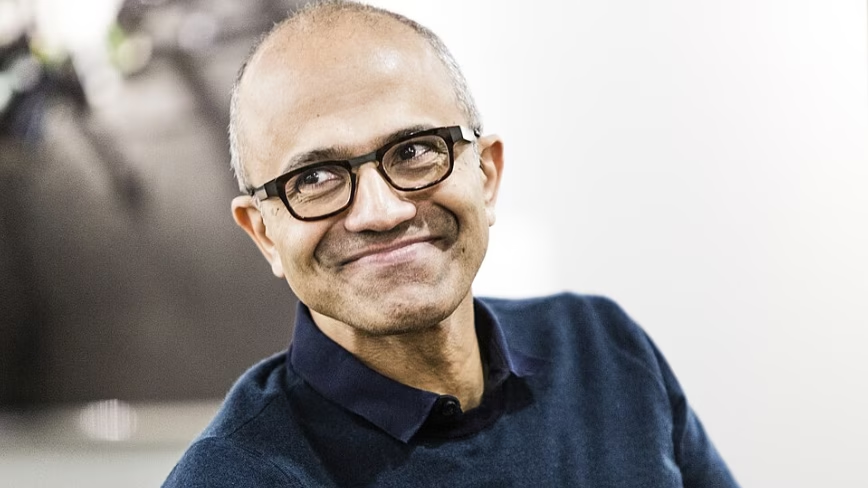
Image: courtesy of Thenextweb
Microsoft's Quiet AI Shift: The Strategic Play Behind Swapping Partner Models for Its Own
Microsoft has begun a strategic, gradual process of replacing AI models from partners like OpenAI and Anthropic with its own internally developed MAI models in certain applications, including Excel and Outlook. This move, which began on July 7, 2026, is primarily driven by a need to reduce the substantial operational costs associated with running large language models at scale. While Microsoft maintains its deep partnerships, this shift signals a maturing of its in-house AI capabilities and a broader effort to optimize its AI infrastructure.
Outlook
Background
For years, Microsoft has been a central player in the artificial intelligence boom, notably through its multi-billion dollar investment in OpenAI, which began in 2019 and intensified in 2023 with a 'multiyear, multibillion-dollar investment' to ensure AI benefits are widely shared. This partnership also designates Microsoft Azure as OpenAI's exclusive cloud provider. More recently, Microsoft expanded its AI partnerships by integrating Anthropic's technology alongside OpenAI's for some AI features within Office 365 applications.
The decision, confirmed on July 7, 2026, to gradually replace some of these external models with Microsoft's own MAI (Microsoft AI) models in applications such as Excel and Outlook, comes down to economics. Running tens of thousands of AI queries daily, across a vast user base, incurs significant computational costs. As the demand for AI-powered features grows, managing these expenses becomes a critical operational challenge for any company operating at Microsoft's scale. This shift indicates that Microsoft's internal AI research and development have progressed to a point where its own models can handle specific workloads effectively and at a lower cost than third-party alternatives. It is not an abandonment of partners, but rather a strategic optimization of its AI supply chain.
See also
Precedents
This move by Microsoft echoes a well-established pattern in the technology industry: vertical integration for critical components. Historically, major tech companies have often started by relying on external suppliers for key technologies, only to eventually develop their own in-house alternatives once the technology matures and becomes strategically vital.
Consider Apple's transition from Intel processors to its custom-designed Apple Silicon chips for its Mac lineup. This shift allowed Apple greater control over performance, power efficiency, and product differentiation, while also reducing its reliance on an external vendor. Similarly, Amazon Web Services (AWS) developed its own custom Graviton processors to power its cloud infrastructure, moving away from a sole reliance on Intel and AMD. This gave AWS a competitive edge in cost and performance for specific workloads.
In the realm of AI, Google has long invested in its own Tensor Processing Units (TPUs) to power its AI workloads, rather than relying solely on Nvidia's GPUs. The motivations are consistent: cost reduction, performance optimization, greater customization, and reduced dependency on external vendors. Microsoft's move to leverage its MAI models for certain tasks represents this same strategic imperative, asserting greater control over its core AI infrastructure as the technology becomes more pervasive across its product portfolio. It's a natural evolution for a company of Microsoft's size and ambition in a rapidly maturing technological domain.
This isn't merely a technical tweak; it's a significant strategic recalibration for Microsoft and holds broad implications for the AI industry.
For Microsoft, the immediate benefit is financial. The operational costs of serving millions of users with AI-powered features are substantial. By deploying its own MAI models where they are more cost-effective, Microsoft can significantly reduce its ongoing expenses, potentially freeing up capital for further AI research or other strategic investments. This also grants Microsoft greater control over its AI stack, allowing for deeper integration with its applications, more tailored performance optimizations, and reduced dependency on external partners for critical functionalities. It signals an increasing maturity and confidence in Microsoft's internal AI capabilities, moving beyond simply being a platform for others' models.
For OpenAI and Anthropic, this development introduces a new layer of complexity. While Microsoft remains a crucial investor and cloud partner, the decision to 'swap out' models, even incrementally, means that their market within Microsoft's vast ecosystem is not guaranteed for every use case. It forces these AI developers to continually demonstrate superior performance or unique capabilities to justify their continued use over Microsoft's internal alternatives, especially for high-volume, cost-sensitive tasks. This internal competition could drive further innovation across the AI model landscape.
More broadly, this shift highlights the escalating economic reality of large-scale AI deployment. The cost of inference – running AI models for real-world applications – is becoming a major factor in strategic decisions. Other large tech companies and enterprises currently relying heavily on third-party LLMs will be closely watching Microsoft's experience, potentially accelerating their own efforts to develop proprietary models or at least diversify their AI model providers. It suggests that 'AI model nationalism' – where companies prioritize their own models – may become a more prevalent trend as the technology matures and costs become a primary concern.
Scenarios
Analysis1. Accelerated Internal AI Development: Microsoft could significantly ramp up its investment in its own MAI models, expanding their capabilities and deployment across more applications. This could lead to a more diversified AI portfolio within Microsoft, with different models (internal and external) optimized for specific tasks, balancing performance, cost, and strategic control. This implies Microsoft would continue to be a dominant player in AI, but with a more self-reliant core.
2. Increased Competition for Third-Party AI Providers: OpenAI, Anthropic, and other AI model developers may face increased pressure to differentiate their offerings on factors beyond raw performance, such as specialized capabilities, unique data handling, or even more aggressive pricing, to maintain their foothold within large enterprise clients like Microsoft. This could lead to a more competitive and fragmented market for foundational AI models, where providers must constantly innovate to justify their value proposition.
3. Industry-Wide Shift Towards Hybrid AI Strategies: Other large tech companies and enterprises could adopt similar hybrid AI strategies, combining external, state-of-the-art models for cutting-edge or niche applications with more cost-effective, in-house models for high-volume, routine tasks. This would represent a maturation of enterprise AI adoption, moving beyond a singular reliance on a few dominant models towards a more nuanced, optimized approach to AI infrastructure and deployment.
Timeline
2019
Microsoft's Initial OpenAI Investment
Microsoft makes its first significant investment in OpenAI, kickstarting a long-term partnership aimed at advancing AI research.
2023
Multi-Billion Dollar OpenAI Investment
Microsoft announces the third phase of its partnership with OpenAI, involving a multiyear, multibillion-dollar investment, further solidifying their collaboration and making Azure the exclusive cloud provider for OpenAI.
Early 2025 (approx.)
Microsoft Adds Anthropic to Office 365
Microsoft expands its AI partnerships by integrating Anthropic's technology alongside OpenAI's for some AI features in Office 365 applications, indicating a strategy of diversified external model use.
2026-07-07
Microsoft Begins Internal AI Model Swaps
Microsoft starts replacing some OpenAI and Anthropic models with its own MAI models in applications like Excel and Outlook, driven by cost-reduction goals and maturing internal AI capabilities.
Frequently Asked Questions
MAI stands for Microsoft AI. These are artificial intelligence models developed internally by Microsoft's research and engineering teams. They are designed to power various Microsoft products and services, often tailored for specific tasks and optimized for the company's own infrastructure.
Discussion
Be the first to share your thoughts.