
The milestone reveals a calculated shift in how traditional automakers approach infrastructure. Rather than chasing sheer volume, Mercedes-Benz has focused on high-throughput locations equipped with 400-kilowatt chargers supplied by ChargePoint and Alpitronic. With nearly 1,000 individual ports now active and over 550,000 sessions recorded since November 2023, the network is preparing for its next hardware evolution: the rollout of Alpitronic’s HYC 1000 system, capable of delivering up to 600 kW per charger. This infrastructure scaling comes as automakers grapple with shifting consumer demand and messy connector transitions.
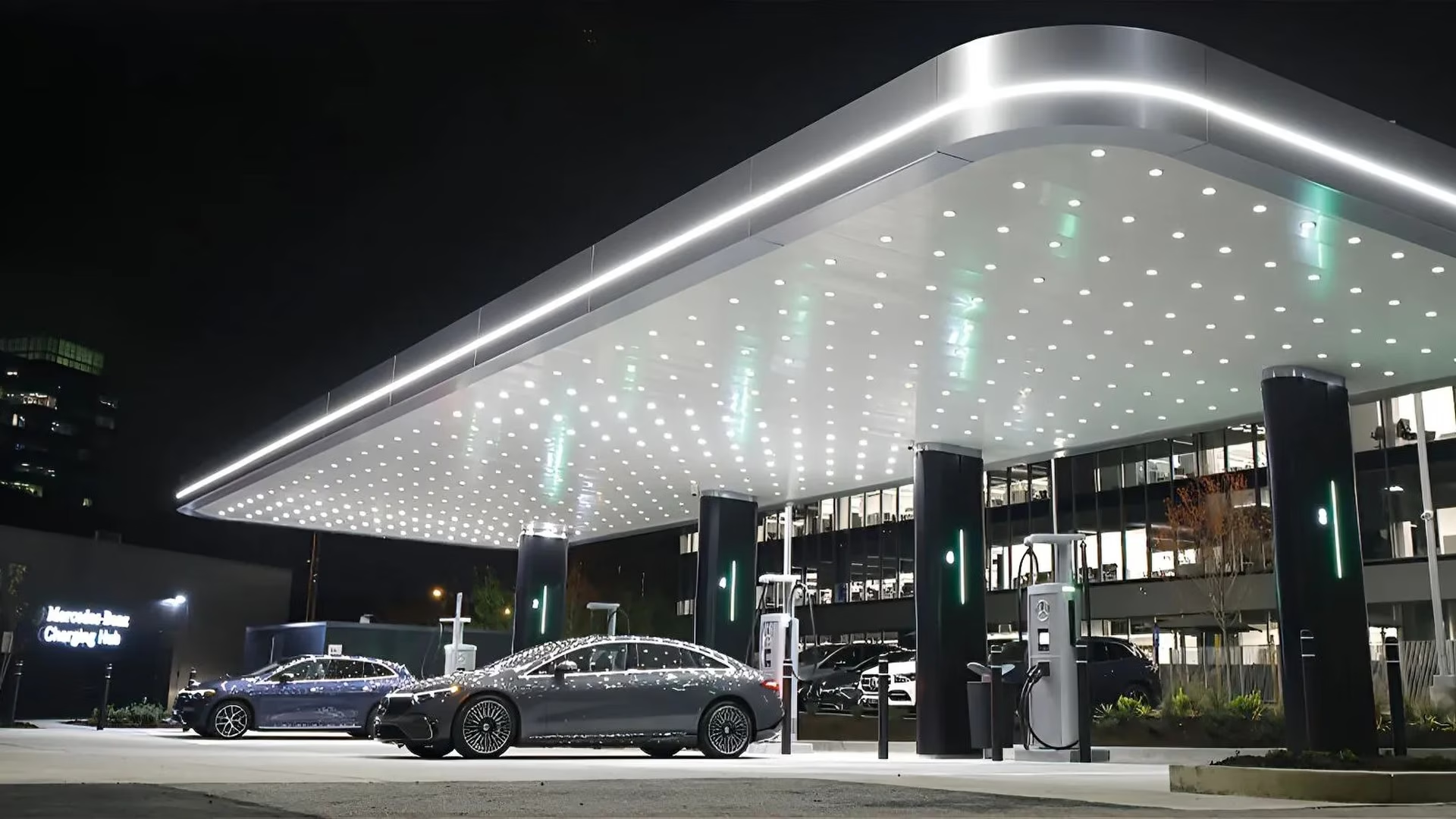
Image: courtesy of Thenextweb
Mercedes Built 100 EV Charging Stations in Three Years. Here Is How It Compares to Everyone Else.
Three years after opening its first station outside corporate headquarters in Georgia, the Mercedes-Benz High-Powered Charging network has reached 100 locations across 28 U.S. states and British Columbia. While raw numbers pale in comparison to Tesla's massive footprint, the German automaker's strategy relies on reliability, high-output hardware, and a physical buildout designed to solve the chronic friction points of early EV ownership.
Outlook
Background
The North American charging landscape has experienced severe growing pains. For years, independent networks suffered from broken screens, failing payment processors, and sub-optimal uptime that frustrated everyday drivers. Mercedes entered this market with a distinct playbook: prioritize the physical charging experience and keep failure rates low. Confirmed figures show that the company's first-time success rate has climbed above 90%, up from roughly 84% in the network's infancy. Charging sessions currently cost between $0.35 and $0.60 per kilowatt-hour, placing the service firmly in the premium tier of public fast charging. Meanwhile, the network has achieved this physical footprint while simultaneously restructuring its international operations, including the recent sale of its 47 European charging hubs to France's Electra.
See also
Precedents
Automakers historically avoided retail energy distribution, treating fueling as a third-party utility problem. Tesla broke that mold by building Superchargers as a core product feature, proving that vehicle sales depend entirely on a friction-free refueling experience. Traditional legacy brands watched from the sidelines, relying on fragmented third-party operators like Electrify America or EVgo. When those networks struggled with maintenance backlogs and scaling bottlenecks, premium brands realized they had to intervene. Mercedes following Tesla's vertically integrated blueprint mirrors the early days of petroleum distribution, where oil conglomerates realized they had to own the pumps if they wanted consumers to buy the cars.
A 100-site network is a drop in the ocean compared to the tens of thousands of plugs operated by Tesla or major fuel station chains. But the strategic importance lies in quality control and hardware readiness for heavy-duty commercial and luxury electric vehicles. As charging speeds push past 400 kilowatts, electrical grid constraints and thermal management become major operational hurdles. By standardizing around dual CCS and NACS connectors at 84% of its sites and targeting ultra-fast hardware upgrades, Mercedes is effectively building a proprietary luxury amenity disguised as public infrastructure. For the consumer, it means an alternative to broken public stalls, albeit at a premium price point that underscores how reliability commands a financial markup in the modern automotive market.
Scenarios
AnalysisAnalyses suggest that Mercedes-Benz could expand its charging footprint past 300 locations by the end of the decade as heavy-duty electric commercial vehicles enter the luxury segment. Another possible outcome is that high operating and grid-connection costs could force the automaker to spin off the network into a joint venture or open it more aggressively to institutional capital, mirroring similar moves by rival European automotive groups. Alternatively, if hardware reliability metrics remain high, the network could become a primary brand differentiator that drives loyalty among high-income EV buyers who refuse to use unreliable public chargers.
Timeline
November 2023
First Station Opens
Mercedes-Benz opens its very first high-powered charging station in Sandy Springs, Georgia, launching the network with just a handful of stalls.
November 2026
The 100-Site Milestone
The network reaches 100 active locations and nearly 1,000 ports across 28 U.S. states and British Columbia, having recorded over 550,000 sessions.
2026 and Beyond
Hardware Evolution
Mercedes plans to introduce Alpitronic’s HYC 1000 fast-charging system, pushing charging speeds up to 600 kW per charger.
Frequently Asked Questions
As of November 2026, the Mercedes-Benz High-Powered Charging network has reached 100 active sites with 934 charging ports across 28 U.S. states and British Columbia.
Discussion
Be the first to share your thoughts.