
Manna's strategy involves a dual approach: establishing a major manufacturing and operational base in Tulsa while simultaneously launching full-scale delivery services there. The company expects to create a thousand local jobs, primarily focused on drone manufacturing and operational support. This move is designed to rapidly scale Manna's presence across the U.S., with plans to expand into six additional American cities by the end of 2027. The company's founder and CEO, Bobby Healy, has relocated his U.S. leadership team, and his family, to Tulsa, signaling a deep commitment to the new hub. The core expectation is a ramp-up in both production capacity and delivery service coverage, directly positioning Manna against the existing leaders in the autonomous drone delivery space.
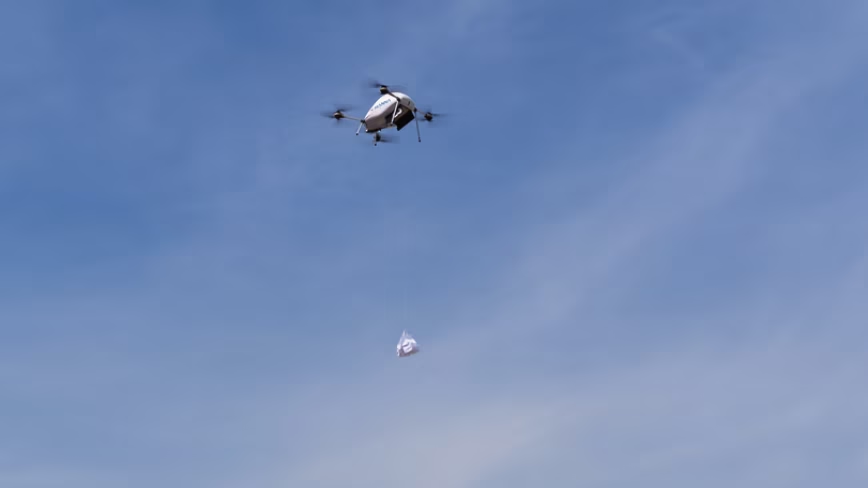
Image: courtesy of Thenextweb
Manna's 1,000-Person Tulsa Factory: A Direct Challenge to Zipline and Wing’s US Drone Dominance
Manna, an Irish drone delivery startup, is making a significant push into the U.S. market, announcing plans to build a 1,000-person factory in Tulsa, Oklahoma. This expansion, backed by recent venture capital funding, aims to establish Tulsa as Manna's central operational hub in the United States and directly challenge established players like Zipline and Wing in the burgeoning last-mile delivery sector. The factory is slated to begin manufacturing drones and creating jobs by the end of 2027.
Outlook
Background
Manna, founded in Ireland in 2018, has been a notable, though smaller, player in the global autonomous drone delivery market. The company has a confirmed track record, having completed nearly 380,000 deliveries worldwide. Its recent expansion is supported by a $50 million venture capital round secured in April 2026. While the company's innovation and headquarters remain in Ireland, the Tulsa facility represents a critical strategic pivot to penetrate the lucrative and competitive U.S. market.
Tulsa, Oklahoma, has been actively positioning itself as a hub for aerospace and innovation, offering incentives and a supportive environment for tech companies. This regional effort likely played a role in Manna's decision. The drone delivery sector in the U.S. is currently dominated by companies like Zipline and Wing, both of whom have extensive operations and partnerships. Manna's entry with a dedicated manufacturing facility suggests a long-term commitment to controlling its supply chain and scaling its fleet independently, rather than relying solely on third-party manufacturers or smaller, localised deployments. The company's drones are designed to carry an 8 lb payload, a capacity suitable for a wide range of common household and food deliveries.
See also
Precedents
The history of new technology adoption often sees an initial phase of fragmented innovation, followed by consolidation and aggressive market entry by well-funded startups. Drone delivery is no different. Early attempts faced significant regulatory hurdles, public skepticism, and technical limitations. However, as drone technology matured and regulatory bodies like the Federal Aviation Administration (FAA) developed clearer guidelines, the path to commercialization has become more viable.
Previous efforts by companies to establish new manufacturing or operational hubs in mid-sized U.S. cities, often outside traditional tech centers, have shown mixed results. Success stories, like the growth of Austin, Texas, or Raleigh-Durham, North Carolina, as tech hubs, typically involve strong local government support, a skilled workforce, and a lower cost of living compared to coastal cities. Failures often stem from an inability to attract sufficient talent, unforeseen logistical challenges, or a lack of sustained capital.
In the drone delivery space specifically, early movers like Zipline focused on medical supply delivery, proving the technology's reliability in critical applications before expanding. Wing, backed by Alphabet, leveraged its parent company's resources for rapid expansion in select markets. Manna's approach of building its own factory from the ground up to support a broad metropolitan rollout echoes the vertical integration strategies seen in other industries where controlling manufacturing proved crucial for scaling and cost efficiency. This mirrors historical patterns where companies, once they reach a certain scale and funding level, move to internalize production to gain greater control over quality, cost, and intellectual property.
Manna's significant investment in Tulsa changes the competitive dynamics of the U.S. drone delivery market. Until now, Zipline and Wing have enjoyed a relatively clear field, steadily expanding their footprints. Manna's entry with a dedicated, large-scale manufacturing facility indicates a serious intent to capture market share, potentially leading to increased competition, faster innovation, and ultimately, more widespread drone delivery options for consumers.
For Tulsa, this represents a substantial economic win. The creation of 1,000 jobs is a direct boost to the local economy, providing skilled manufacturing and operational roles. It also reinforces Tulsa's ambition to become a recognized center for aerospace and advanced technology, potentially attracting further investment and talent to the region. This move could serve as a blueprint for how other mid-sized American cities can diversify their economies by embracing emerging technologies.
From a broader logistics perspective, the expansion of another major player like Manna accelerates the shift towards autonomous last-mile delivery. As more companies enter and scale, the pressure on regulators to streamline approval processes will intensify, and the public's acceptance of drones as a standard delivery method will likely grow. The real stakes here are about the pace of change in how goods move from businesses to homes, the economic vitality of cities embracing this future, and the competitive battle for dominance in a market poised for exponential growth.
Scenarios
AnalysisOne possible outcome is that Manna's vertically integrated strategy, centered on its Tulsa factory, allows it to rapidly scale its drone fleet and operational footprint across the U.S. This could lead to Manna becoming a formidable third major player, driving down delivery costs and expanding service availability in new markets faster than rivals. The focus on in-house manufacturing could give Manna an advantage in customizing its drones for specific U.S. market needs or in responding to technical challenges with greater agility.
Another scenario suggests that while the Tulsa factory provides a strong foundation, Manna may still face significant challenges in navigating the complex and fragmented U.S. regulatory environment. The FAA's regulations, while evolving, still require extensive approvals for beyond visual line of sight (BVLOS) operations, which are critical for widespread delivery. This could slow Manna's expansion into the six additional cities planned for 2027, despite its manufacturing capabilities. Furthermore, competing with well-funded incumbents like Zipline and Wing, who have established partnerships and operational experience in the U.S., will require substantial ongoing capital and a robust operational execution that may prove difficult to sustain in a rapidly evolving market.
Timeline
Frequently Asked Questions
Discussion
Be the first to share your thoughts.