
Over the coming months, the global tech and political spheres will closely watch Malaysia's final decision regarding its sovereign AI project. A formal announcement from the Malaysian government or Telekom Malaysia, the state-linked entity identified as the project's key operator, would be the primary indicator of the path forward. Should Malaysia proceed with Huawei, it could trigger a diplomatic response from the United States, potentially involving discussions on trade relations or technology transfer. Conversely, a decision to opt for non-Huawei alternatives, or to delay the project, would suggest Malaysia is sensitive to the geopolitical pressures. The implementation phase, regardless of the chosen vendor, will also be a critical period, revealing the practicalities and challenges of building a national AI infrastructure.
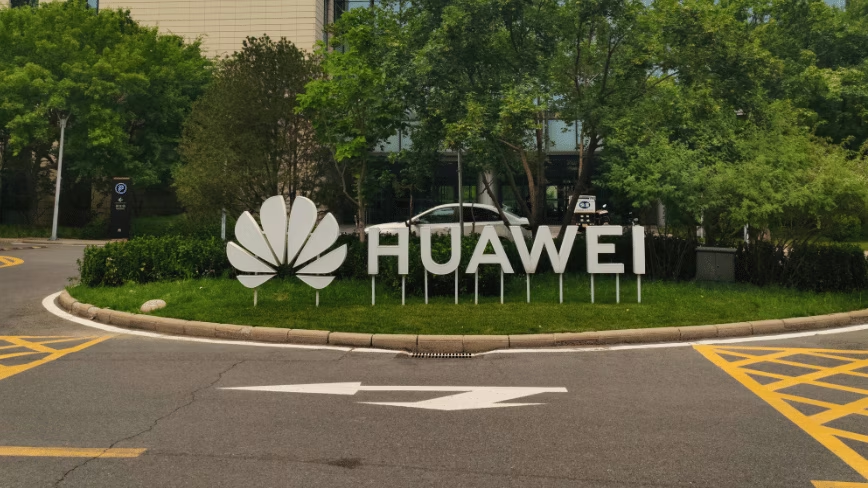
Image: courtesy of Thenextweb
Malaysia's Huawei AI Chip Deliberation: A Test Case for Tech Independence Amid Geopolitical Pressure
Malaysia is reportedly weighing a significant move to adopt Huawei Technologies' AI chips for a RM2 billion ($494 million) national sovereign AI project, a decision that could set a new precedent for technological independence in Southeast Asia. The deliberation comes despite explicit warnings from the United States regarding the use of Chinese hardware. If confirmed, this would mark the first time a foreign government has openly chosen Chinese AI accelerators over American alternatives for a project of this scale, signaling a potential shift in how nations balance national data control with global geopolitical alliances.
Outlook
Background
The concept of "sovereign AI" has gained traction globally, driven by nations seeking greater control over their sensitive data and critical infrastructure. For Malaysia, this initiative, valued at RM2 billion (approximately $494 million), aims to establish a national AI cloud that keeps government, military, and citizen data entirely within its borders. This approach is a direct response to concerns about data privacy, national security, and the potential for foreign interference, particularly as AI capabilities become central to economic growth and defense.
The choice of Huawei's Ascend 910C accelerators, as reported by Bloomberg yesterday, is particularly contentious. Huawei, a Chinese technology giant, has been under stringent sanctions from the United States since 2019, with Washington citing national security risks. These restrictions have severely limited Huawei's access to advanced American chip technologies and software. The US has actively urged allies and partners to avoid using Huawei equipment in their critical infrastructure, including 5G networks and, by extension, advanced AI systems.
Telekom Malaysia, a state-linked telecommunications company, has been identified as the potential key operator for this project. Its involvement suggests a strong government backing and a strategic intent to integrate this AI capability deeply into national digital services. The current global environment sees a fierce competition between the US and China for technological dominance, especially in cutting-edge fields like artificial intelligence and advanced semiconductors. Nations like Malaysia are increasingly finding themselves in a difficult position, needing to develop advanced capabilities while navigating these complex geopolitical currents.
Precedents
This isn't the first time nations have grappled with the implications of choosing technology vendors from geopolitical rivals. The most direct parallel lies in the global rollout of 5G networks over the past decade. Many countries, particularly in Europe and Asia, faced immense pressure from the United States to exclude Huawei from their 5G infrastructure, citing security concerns. Some nations, like the UK, eventually reversed earlier decisions to include Huawei, while others, such as Germany, adopted a more cautious, diversified approach.
Historically, countries often prioritize economic benefits or technical superiority when making infrastructure decisions. However, the rise of cybersecurity threats and the increasing weaponization of technology have shifted this calculus, bringing national security and data sovereignty to the forefront. Nations like India have also pursued "digital sovereignty" initiatives, focusing on developing indigenous technology solutions or favoring non-Chinese alternatives for sensitive applications.
Furthermore, the current situation echoes past instances of technology embargoes and strategic competition, such as the Cold War era's restrictions on technology transfer. The critical difference today is the interconnectedness of the global supply chain, making complete technological independence extremely difficult. Any decision by Malaysia will be viewed through the lens of these precedents, informing how other countries, especially those in Southeast Asia with similar aspirations for digital autonomy, might approach their own AI development strategies.
Malaysia's potential decision to use Huawei AI chips for its sovereign AI project holds significant implications, extending far beyond its national borders.
First, it represents a crucial test of technological independence for smaller nations. If Malaysia successfully implements a large-scale AI infrastructure using Chinese technology despite US pressure, it could empower other countries to pursue similar paths, seeking to diversify their tech suppliers and reduce reliance on Western firms. This could fundamentally alter the global tech supply chain and accelerate the development of alternative, non-Western technology ecosystems.
Second, the move directly challenges the United States' efforts to contain China's technological influence. Washington has invested considerable diplomatic capital in convincing allies to shun Huawei. A public endorsement of Huawei's advanced AI chips by a sovereign nation would be seen as a setback for US policy and could signal a weakening of its tech dominance narrative. This could prompt the US to re-evaluate its strategies for technological competition and potentially intensify its warnings or introduce new measures.
Third, for Malaysian citizens, the project promises enhanced data security and privacy, as sensitive national data would remain within the country's borders, processed on infrastructure controlled by the government. This could build public trust in digital government services and foster local AI talent and innovation. However, it also raises questions about the long-term maintainability and upgrade paths for a system potentially reliant on a single, geopolitically constrained vendor.
Finally, the decision carries economic weight. A RM2 billion investment in AI infrastructure could spur significant growth in Malaysia's digital economy, creating jobs and fostering local expertise. It also positions Malaysia as a potential leader in sovereign AI initiatives within the ASEAN region, potentially attracting further investment and collaboration in the tech sector. The choice, therefore, is not merely technical; it is a complex calculation involving national security, economic ambition, and geopolitical alignment.
Scenarios
Analysis{
"Outcome 1: Malaysia Proceeds with Huawei Chips.": "Malaysia makes a formal announcement to move forward with Huawei's Ascend 910C chips as the backbone for its sovereign AI project. This would involve signing definitive agreements with Huawei and Telekom Malaysia initiating the procurement and deployment phase. This would be a significant geopolitical statement, demonstrating Malaysia's commitment to technological independence and willingness to challenge US influence. It could encourage other nations in Southeast Asia and beyond, particularly those with strong economic ties to China, to consider similar partnerships for their AI infrastructure. The US might respond with diplomatic pressure, review of existing trade agreements, or potentially the expansion of sanctions to entities involved in the project, though direct sanctions on Malaysia are less likely initially. For Huawei, it would represent a major win, showcasing the viability and competitiveness of its advanced AI hardware outside of China.",
"Outcome 2: Malaysia Opts for Non-Huawei Alternatives.": "After further evaluation, Malaysia decides to pursue its sovereign AI project using AI chips from alternative vendors, likely from US-allied countries (e.g., Nvidia, Intel) or developing indigenous solutions. This would signal Malaysia's sensitivity to US warnings and its desire to maintain strong ties with Western technology partners. It would avoid potential diplomatic friction with the US but might be seen by some as a compromise on full technological independence. The project might face different technical or cost considerations depending on the chosen vendor and the availability of suitable alternatives that meet the \"sovereign\" requirement. This outcome would reinforce the existing tech supply chain dynamics, where US-based companies largely dominate the high-end AI chip market.",
"Outcome 3: Project Delays or Re-evaluation.": "The Malaysian government, facing the complexities of the decision and potential geopolitical fallout, opts to delay the project, conduct further feasibility studies, or re-evaluate the entire scope and vendor selection process. This would indicate significant internal debate and external pressure. A delay could be a tactic to buy time, allowing for a clearer understanding of the evolving US-China tech rivalry or to negotiate better terms with potential vendors. It might also reflect a lack of consensus within the Malaysian government on the best strategic path forward. Such a delay could slow Malaysia's AI development timeline but might also allow for a more robust, long-term solution that better balances national interests with geopolitical realities."
}
Timeline
Frequently Asked Questions
Discussion
Be the first to share your thoughts.