
Veridact
TechSportsFinanceGaming🎯 PredictionsAbout
Sign InSign Up
Veridact

AI-powered anticipation analysis. We cover tech, sports, finance, and gaming events before they happen — with historical context, scenario modeling, and evolving coverage.

Stay ahead of the story

Analysis delivered before events unfold.

Coverage

  • Tech
  • Sports
  • Finance
  • Gaming

Company

  • About Us
  • Privacy Policy

© 2026 Veridact. AI-assisted analysis platform.

Analysis is AI-generated and not professional financial, legal, or medical advice.

Tech
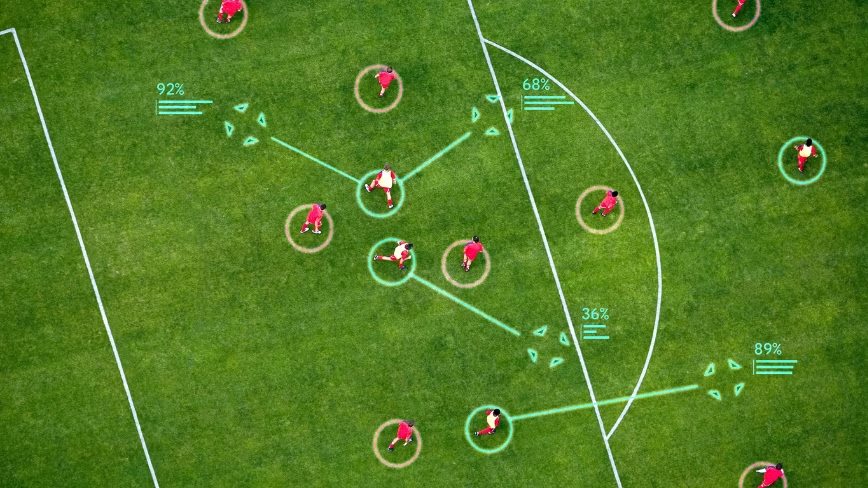
Google DeepMind’s TacticAI can predict football plays 8 seconds before they happen. Palmeiras is the first to use it.

Image: courtesy of Thenextweb

techJune 12, 2026By Veridact EditorialUpdated Jun 12

Google DeepMind's TacticAI: How Predicting Football Plays Eight Seconds Ahead Could Reshape the Game for Palmeiras

Football, often called the beautiful game, is facing a quiet revolution. Google DeepMind, the company known for its cutting-edge artificial intelligence, has introduced a new tool called TacticAI. This advanced computer program can look at a football play, specifically a corner kick, and predict what might happen up to eight seconds before it unfolds. The Brazilian powerhouse club, Palmeiras, became the very first team to officially use this technology, a move that could give them a significant edge on the field. This isn't about robots playing football; it's about giving coaches and players a deeper understanding of the game's hidden patterns, allowing them to make smarter decisions and react faster than ever before. It's a peek into a future where data and AI become as crucial as dribbling and shooting.

What to Expect

With TacticAI in its arsenal, Palmeiras is now equipped to analyze its own strategies and those of its opponents with unprecedented detail. Coaches will be able to review thousands of past corner kicks, not just to see what happened, but to understand why certain outcomes were more likely. This means training sessions could change drastically. Instead of just practicing set plays, players might drill specific reactions based on TacticAI's predictions, learning to anticipate opponent movements or exploit weaknesses identified by the AI.

Fans might not see TacticAI directly on the pitch during a match, but its influence will be felt. Better-executed corner kicks, more efficient defensive setups, and quicker adjustments during a game could become a hallmark of Palmeiras's play. Opposing teams will be forced to adapt, either by developing their own AI strategies or by finding new ways to counter an opponent that seems to know their next move. This move by Palmeiras is not just about one club; it is a test case for how quickly top-tier football will embrace, or be forced to embrace, advanced AI tools to stay competitive.

Key Context

To understand TacticAI, we first need to look at Google DeepMind. This is a British artificial intelligence company, a part of Alphabet (Google's parent company), famous for creating AI programs that can master complex games and solve scientific puzzles. They developed AlphaGo, an AI that beat the world champion in the ancient game of Go, and more recently, AlphaFold, which predicts how proteins fold, a huge step for biology. TacticAI is their latest venture into a new domain: sports.

At its core, TacticAI is a sophisticated machine learning model. Think of it like a super-smart student who has watched every football game ever played, paying attention to every single detail. When it comes to corner kicks, the AI has studied millions of these moments. It looks at where players stand, how they move, how the ball is kicked, and what happens in the seconds that follow. By learning from all this past data, TacticAI can then predict the most likely outcomes of new corner kicks, identifying patterns that even the most experienced human coaches might miss. It is not about telling a coach exactly what to do, but rather offering a range of the most probable scenarios and suggesting optimal player positions to either score or defend.

Palmeiras, the first club to adopt this technology, is one of Brazil's most successful and popular football teams. Based in São Paulo, the club has a rich history, winning numerous national and international titles, including multiple Copa Libertadores trophies. Their decision to partner with DeepMind shows a clear ambition to maintain their winning edge and explore new frontiers in sports science and strategy. This partnership brings together cutting-edge AI research with real-world, high-stakes athletic competition, creating a fascinating laboratory for the future of football.

Related Coverage

We tried Google’s AI glasses and they’re almost there→Talkdesk wants its AI agents to call your customers before they call you→SpaceX launches Starship V3 for the first time, but loses booster on return→

Historical Patterns

The idea of using advanced technology to gain an advantage in sports is not new. From the very beginning, sports have evolved with technological leaps. Think about better running shoes, lighter tennis rackets, or more aerodynamic swimsuits. Each innovation aimed to push the boundaries of human performance.

In more recent times, data analytics has transformed how sports teams operate. Baseball famously saw the 'Moneyball' revolution, where teams used statistical analysis to find undervalued players and strategies. Basketball teams now use complex tracking data to analyze player movements, shot selections, and defensive efficiency. In football, video analysis has been a standard tool for decades, allowing coaches to break down games and scout opponents.

What makes TacticAI different is its predictive power. Traditional data analytics tells you what has happened. TacticAI aims to tell you what will happen. This moves beyond simply identifying trends to actively foreseeing future events on the pitch. It's a significant jump from descriptive analytics to prescriptive analytics. While AI has been used in sports for things like player scouting, fitness monitoring, and even referee assistance (like VAR), TacticAI's real-time predictive capability during live-action scenarios like corner kicks represents a new frontier. It echoes earlier moments in sports history where a new technology or analytical approach gave an early adopter a temporary, but often crucial, advantage, before the rest of the league caught up.

The introduction of TacticAI into professional football is more than just a technical update; it represents a fundamental shift in how the game might be played, coached, and even perceived. The real stakes here touch on the very essence of competitive sport.

For Palmeiras, the immediate benefit is obvious: a potential competitive advantage. If TacticAI can consistently improve their corner kick success rate or their defensive solidity against them, it could translate directly into more goals, fewer conceded goals, and ultimately, more wins and trophies. This could mean more prize money, more fan engagement, and a stronger position in the global football hierarchy. But what does this mean for the competitive balance of the sport? Will only the wealthiest clubs be able to afford such advanced AI, potentially widening the gap between the elite and the rest?

Then there's the question of the human element. Football is celebrated for its unpredictability, its moments of individual brilliance, and the raw emotion of human strategy and instinct. If AI can predict plays eight seconds in advance, does it diminish the role of a coach's intuition or a player's split-second decision-making? Will players become automatons executing AI-generated instructions, or will the AI simply empower them to make better human decisions? This technology forces a conversation about the soul of the sport: where does human skill end and algorithmic optimization begin?

Finally, this development could push football's governing bodies, like FIFA, to consider new regulations. How much AI assistance is too much? Should coaches be allowed real-time AI feedback during a match? These questions will need answers, shaping the rules of the game for generations to come. The stakes are high, not just for Palmeiras, but for the entire ecosystem of global football.

Potential Outcomes

Analysis

The adoption of TacticAI by Palmeiras sets several potential paths in motion, each with significant consequences for football:

1. Palmeiras Secures a Temporary, Measurable Advantage: In the short term, Palmeiras is highly likely to see an improvement in their performance related to corner kicks. This could manifest as a higher percentage of goals scored from corners, or a more effective defense against opponent's corner kicks. This early success could fuel their quest for more titles and solidify their reputation as innovators in the sport. Other teams will study Palmeiras's corner kick strategies more intensely, trying to reverse-engineer their advantage without the AI itself. This outcome would put immense pressure on rival clubs to find similar technological solutions or risk falling behind.

2. Rapid AI Arms Race in Global Football: As Palmeiras's potential gains become evident, top clubs across Europe, Asia, and other South American leagues will scramble to develop or acquire similar AI capabilities. The competition for AI talent and the investment in sports tech will skyrocket. This could lead to a new era where a club's analytical department becomes as important as its scouting network, and AI strategists become key figures alongside traditional coaches. The sport could see a rapid acceleration in tactical complexity, as teams constantly refine their AI models to counter their opponents' AI-informed strategies.

3. Regulatory Scrutiny and Potential Rule Changes: The introduction of such powerful predictive AI will inevitably draw the attention of football's governing bodies. Questions around fairness, competitive balance, and the spirit of the game will emerge. These organizations might consider new regulations regarding the use of AI in training, strategy, and even during live match situations. For example, rules might be introduced about how much real-time information coaches can receive, or whether AI-generated tactical suggestions can be communicated to players during a game. This could lead to a debate about what constitutes 'human skill' versus 'technological assistance' in football, potentially reshaping the very rules under which the game is played.

Timeline

2016-03-09
AlphaGo Defeats Lee Sedol
Google DeepMind's AI program, AlphaGo, beats Go world champion Lee Sedol, marking a major milestone for artificial intelligence in complex strategic games.
2020-11-30
AlphaFold Solves Protein Folding
DeepMind's AlphaFold AI makes a breakthrough in predicting protein structures, demonstrating AI's power in scientific discovery.
2023-01-01
Growing Use of Data in Football
Top football clubs increasingly invest in advanced data analytics for player scouting, performance tracking, and tactical analysis, laying groundwork for AI adoption.
2026-06-11
DeepMind Announces TacticAI, Palmeiras First User
Google DeepMind officially reveals TacticAI, an AI capable of predicting football plays 8 seconds in advance, with Brazilian club Palmeiras announced as its initial partner.
2026-07-01
Palmeiras Integrates TacticAI into Training
Palmeiras is expected to fully integrate TacticAI into its daily training routines and strategic planning for upcoming matches and tournaments.

Frequently Asked Questions

TacticAI is an advanced artificial intelligence program developed by Google DeepMind. It is designed to analyze football plays, particularly corner kicks, and predict potential outcomes and player movements up to eight seconds before they happen, based on vast amounts of historical game data.

Discussion

0/100
0/1000

Be the first to share your thoughts.

Related Coverage

tech

SpaceX Rents Giant Colossus AI Supercomputer to Anthropic After Grok Setup Fails

Jun 13
tech

China Lights Up New Tech Race With First Photonic Computing Lab, Challenging US Chip Curbs

Jun 13
tech

Grok Still Shows Fake Sexual Images of Famous Women, Sparking Worry

Jun 12
tech

Microsoft Faces Security Crisis as Angry Researcher Leaks Seventh Windows Zero-Day Right After Patch Tuesday

Jun 11

Stay ahead of the story

AI analysis delivered before events unfold. No spam.

ⓘ

Disclosure: This article contains AI-assisted analysis based on publicly available information.