
The recent job cuts and researcher exits at Google suggest a period of strategic re-evaluation within the company's AI division. Investors and industry observers will be watching closely for how Google addresses the perception of a talent drain, particularly as competitors like Anthropic and OpenAI absorb some of its former key personnel. Expect increased scrutiny on Google's upcoming AI product announcements and its ability to demonstrate continued leadership and innovation, especially with the Gemini models. The company may also face internal pressure to clearly articulate its long-term vision for AI development and talent management to reassure remaining staff.
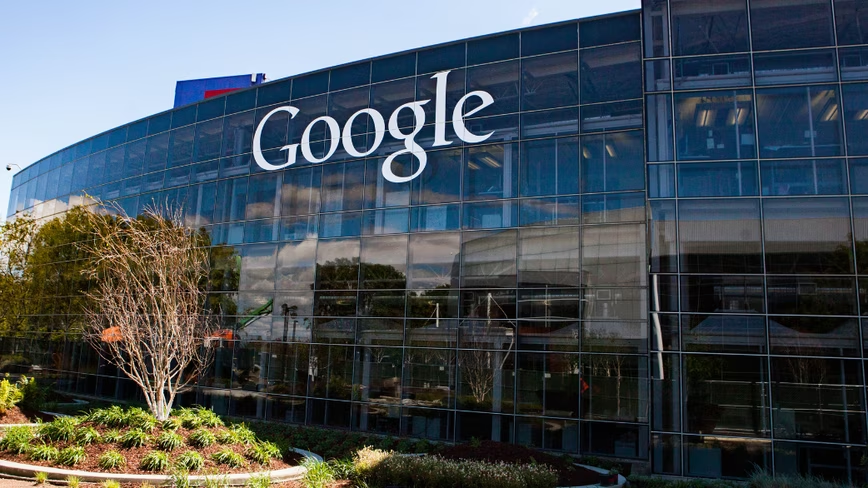
Image: courtesy of Thenextweb
Google's AI Brain Drain and Job Cuts: What the Double Blow Signals for Its Future
Google confirmed 52 job cuts in Washington state on Wednesday, August 5, 2026, marking its first significant local reduction since 2023. These layoffs, affecting roles from software engineers to UX designers across Kirkland, Redmond, and Seattle, coincided with the high-profile departures of four senior AI researchers, including Chief Scientist Jeff Dean and Gemini AI co-lead Noam Shazeer. The news triggered a 5% drop in Alphabet's stock, wiping out an estimated $270 billion in market value, as investors weighed the implications for Google's standing in the fiercely competitive artificial intelligence sector.
Outlook
Background
The tech industry, and particularly the artificial intelligence sector, is currently locked in a fierce battle for top talent and market dominance. Google, through its DeepMind and Google AI divisions, has historically been a leader in fundamental AI research, producing many of the foundational papers and models that underpin today's generative AI boom. However, the rise of well-funded startups like OpenAI and Anthropic, often led by former Google employees, has intensified competition for researchers, engineers, and market share. These newer players offer different cultural environments, often with higher equity stakes and a singular focus on AI development, which can appeal to top talent.
The layoffs in Washington state, while not directly tied to AI research departures in official statements, occur against a backdrop where tech giants are re-evaluating their workforce needs amidst economic pressures and a shifting technological focus towards AI. The simultaneous nature of these events at Google has led to market speculation about the company's ability to maintain its competitive edge.
See also
Precedents
Talent migration from established tech giants to nimble startups is a well-documented pattern in Silicon Valley, particularly during periods of rapid technological advancement. Companies like Fairchild Semiconductor in the 1960s, and later Microsoft and Apple, saw key personnel leave to found or join new ventures, often creating entirely new industries or disrupting existing ones. More recently, the 'PayPal Mafia' phenomenon illustrated how a concentration of talent at one company could disperse to found numerous successful enterprises.
In the AI space specifically, a similar dynamic has been observed, with many prominent researchers from Google, Meta, and other large firms moving to startups like OpenAI and Anthropic. These movements are often driven by a desire for greater autonomy, a more focused mission, or the potential for larger financial rewards tied to early-stage equity. Large companies sometimes respond with increased internal incentives, strategic acquisitions, or by streamlining operations to focus resources, which can sometimes involve layoffs in non-core areas or areas deemed less critical to future growth. The challenge for incumbents like Google is to balance their vast resources and existing product portfolios with the agility and focused innovation of smaller rivals.
The confluence of job cuts in a key engineering hub and the departure of highly influential AI researchers strikes at the heart of Google's long-term strategic positioning. Google's market value, which saw an estimated $270 billion wiped out on Wednesday, August 5, 2026, reflects immediate investor concern over its ability to lead the AI race. Losing individuals like Jeff Dean, a 27-year veteran and chief scientist, and Noam Shazeer, a co-lead on the flagship Gemini AI models, is not merely a loss of personnel; it represents a potential erosion of institutional knowledge, research momentum, and the intellectual capital critical for developing next-generation AI products.
For consumers, this could translate into slower innovation or less competitive products from Google down the line. For the broader tech ecosystem, it signals the continued decentralization of AI talent and the increasing viability of startups to attract and retain the brightest minds, potentially reshaping the competitive landscape for years to come. This isn't just about 52 jobs or four researchers; it's about the future trajectory of a tech titan and its capacity to define the next era of computing.
Scenarios
AnalysisThe simultaneous job cuts and high-profile researcher departures at Google open several paths for the company's immediate future:
1. Google Reasserts AI Dominance Through Internal Restructuring: The job cuts in Washington, while coinciding with researcher exits, could be part of a broader internal restructuring aimed at streamlining operations and re-allocating resources towards specific, high-priority AI initiatives. This suggests Google might be consolidating its AI efforts, perhaps focusing on fewer, but more impactful, projects. This strategy could involve centralizing more AI talent in specific hubs or under unified leadership, potentially leading to more efficient development cycles and a stronger competitive response against rivals. If successful, Google could demonstrate that its vast resources and remaining talent pool are sufficient to maintain its leading position, eventually calming investor fears.
2. Accelerated Erosion of Google's AI Talent and Market Share: The departure of multiple senior researchers to direct competitors like Anthropic and OpenAI indicates a strong pull factor from these startups, possibly due to cultural fit, autonomy, or significant equity opportunities. This implies Google faces a significant challenge in retaining its top-tier AI talent. Should this trend continue, Google might find it increasingly difficult to attract new top-tier talent, potentially slowing down its research and development pipeline. This could lead to a scenario where Google's AI products, like its Gemini models, fall behind those of more agile, AI-focused competitors, resulting in further market value erosion and a loss of market share in critical areas like search, cloud, and consumer AI applications.
3. A Hybrid Approach of Strategic Acquisitions and Internal Development: Facing pressure from both internal restructuring needs and external talent competition, Google may pursue a two-pronged strategy. This suggests the company understands the need to both optimize its existing workforce and inject new talent and innovation. This could involve targeted acquisitions of promising AI startups or research teams to quickly bolster its capabilities, alongside continued internal development efforts. Such a move would allow Google to regain lost ground in specific AI domains and signal to the market its commitment to remaining a dominant force, even if it means buying rather than solely building some of its future AI components. This approach might partially mitigate the impact of talent departures by bringing in fresh perspectives and technologies.
Timeline
August 5, 2026
Google Announces Washington State Job Cuts
Google confirmed 52 job cuts in Washington state through a state filing on Wednesday, August 5, 2026. These layoffs affected a range of roles, including software engineers, engineering and product managers, mechatronics engineers, and UX designers, across its Kirkland, Redmond, and Seattle offices.
Earlier the same week (leading up to Aug 5, 2026)
Four Senior AI Researchers Depart Google
Four of Google's most senior AI researchers, including Chief Scientist Jeff Dean, left the company within days of each other. These high-profile exits coincided with the Washington state layoffs.
August 5, 2026
Alphabet Stock Drops 5%
Alphabet (GOOG) stock fell as much as 5% on Wednesday, August 5, 2026, following the news of the researcher departures and job cuts. This decline wiped out an estimated $270 billion in market value.
Late Friday (prior to Aug 5, 2026)
Nobel Laureate John Jumper Exits DeepMind for Anthropic
Senior research scientist and Nobel Prize winner John Jumper announced his departure from Google's DeepMind AI lab, revealing he was taking a role at competitor Anthropic.
Days before Jumper's exit
Gemini AI Co-lead Noam Shazeer Joins OpenAI
Noam Shazeer, who served as a co-lead on Google's flagship Gemini AI models, left the company to join OpenAI, another prominent rival in the artificial intelligence space.
2023
Last Significant Washington Layoffs
Google's most recent significant job reduction in Washington state prior to the August 2026 cuts occurred in 2023.
Frequently Asked Questions
Google confirmed 52 job cuts in Washington state on Wednesday, August 5, 2026, according to a state filing.
Discussion
Be the first to share your thoughts.