
Do not expect to see steel being cut or dry docks being cleared for this gargantuan vessel anytime soon. The promoters of the project periodically revive the concept with updated digital animations and optimistic press releases, but the underlying financial and technical hurdles remain unchanged. Major global shipyards in South Korea and Europe are currently experiencing historic backlogs, fully booked for years with highly profitable container ships, LNG carriers, and conventional cruise liners. These shipbuilders have zero economic incentive to risk their valuable slipways on a highly speculative, multi-billion-dollar project that lacks institutional banking support. Instead, the public will likely see continued marketing campaigns aimed at securing niche private investments, while the actual physical vessel remains entirely on paper. Any future announcements of imminent construction should be treated with deep skepticism, as the gap between conceptual design and maritime execution is wider than ever.
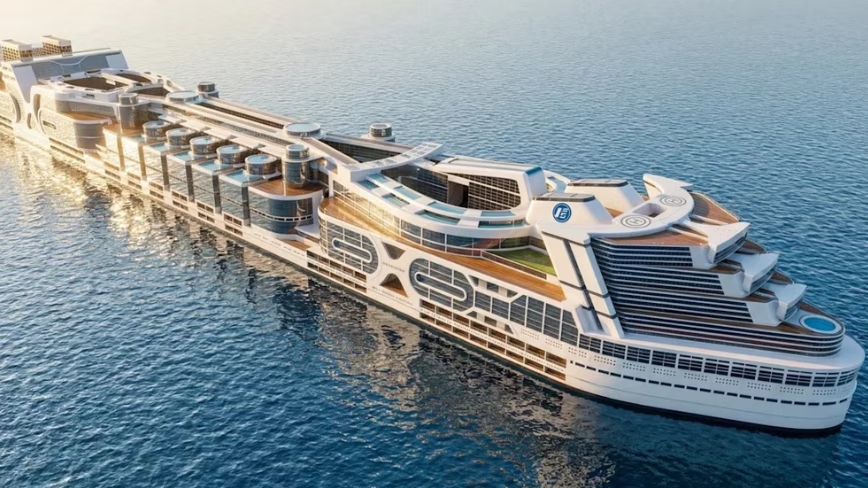
Image: courtesy of Thenextweb
The Eternal Mirage of the Mile-Long Floating City
For nearly thirty decades, the concept of the Freedom Ship—a massive, nuclear-powered floating city designed to house 80,000 residents—has captured the public imagination. Despite repeated claims that construction is just around the corner, the project remains confined to digital renderings and pitch decks. The dream of a tax-free, mobile sovereign state in international waters continues to crash against the harsh realities of maritime engineering, global finance, and international law.
Outlook
Background
The original design of the Freedom Ship is mind-boggling in its scale, stretching 4,500 feet long and rising 25 stories above the water. It was envisioned not as a cruise ship, but as a continuous-motion floating community that would circle the globe once every two years, anchoring outside major coastal cities. The plans include a massive top-deck airport capable of landing small commercial turboprops, a large hospital, schools, shopping malls, and light manufacturing districts. Residents would purchase luxury condominiums, living in a self-contained society that operates outside the tax jurisdictions of traditional nation-states. However, the engineering challenges of such a structure are unprecedented. A vessel of this length would be subjected to immense torsional stress from ocean swells, meaning it could literally snap in half if it encountered mismatched wave crests without an incredibly complex, unproven modular joint system. Furthermore, because the ship is too wide and deep to enter any existing port in the world, all supply chains, waste management, and passenger transfers would have to be handled entirely by air or smaller shuttle boats, creating a logistical nightmare.
Precedents
The history of oceanic megaprojects is littered with grand ambitions that failed to survive the transition from drawing board to open water. In the late 2000s, the seasteading movement promised to build autonomous, politically independent communities in international waters, backed by prominent Silicon Valley investors who dreamed of escaping government regulation. Those efforts eventually stalled as the realities of salt-water corrosion, extreme weather, and diplomatic isolation became apparent. Similarly, land-based megaprojects like Saudi Arabia's NEOM have recently had to scale back their initial, sci-fi-inspired dimensions due to soaring costs and physical constraints. The cruise industry, by contrast, has achieved massive scale through slow, disciplined evolution rather than sudden leaps. Vessels like Royal Caribbean's Icon of the Seas are engineering marvels, but they are the product of fifty years of incremental shipyard learning, built within the strict safety and regulatory frameworks that the Freedom Ship seeks to bypass.
Scenarios
AnalysisOne highly likely outcome is that the project remains a permanent fixture of digital folklore, serving as a periodic viral internet curiosity while actual cruise lines slowly close the size gap with increasingly massive, but highly regulated, traditional vessels. Another distinct possibility is that the organizing group eventually pivots away from a mobile, mile-long ship and instead attempts to build smaller, static, modular floating platforms anchored near friendly, low-tax coastal jurisdictions, sacrificing the dream of global travel for physical stability and easier logistics. A third, darker outcome could involve a speculative investment group raising significant retail capital for initial engineering phases, only for the project to collapse into bankruptcy and litigation before any physical construction begins, mirroring the fates of several ambitious offshore real estate ventures of the past.
Timeline
Frequently Asked Questions
Discussion
Be the first to share your thoughts.