
Deezer's Remix Lab is a direct challenge to the growing presence of AI in music creation and distribution. By focusing on human-powered remixing and ensuring direct artist compensation, the company is positioning itself as an artist-friendly platform. This approach may put pressure on other streaming services to clarify their own stances on AI-generated content and artist remuneration, particularly as the debate around fair compensation for creators intensifies. The feature is currently available in France, indicating a phased rollout that could expand to other markets, depending on initial reception and artist participation.
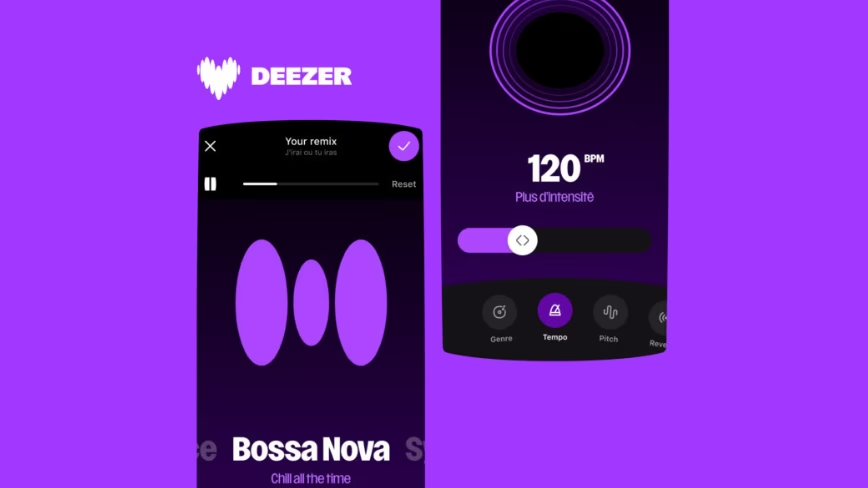
Image: courtesy of Thenextweb
Deezer Goes Against the AI Grain With New Remix Lab, Promises Artists Payment Per Stream
Deezer has launched 'Remix Lab,' a new feature that allows music fans to create their own remixes using in-app tools, explicitly without artificial intelligence. The move stands out in a music industry increasingly grappling with AI-generated content, as Deezer has confirmed that artists will receive payment for every stream of their remixed tracks, provided they give their consent. This initiative comes as the French streaming service also intensifies its efforts to detect and demonetize fraudulent AI music on its platform.
Outlook
Background
The music streaming industry is in a complex period, caught between technological advancement and artist rights. Deezer's launch of Remix Lab on June 24, 2026, is not an isolated event; it arrives amidst a broader effort by the company to address the proliferation of AI-generated music. Deezer has stated that a significant 44% of all new music uploaded to its platform is now AI-generated. Furthermore, the company has found that up to 70% of streams generated by fully AI-generated tracks are fraudulent, leading them to demonetize 85% of such content. This suggests a concerted strategy to combat what it views as a growing integrity problem within its catalog.
Traditionally, music streaming royalties operate on a 'market share' model. Under this system, all subscription and advertising revenue is pooled, and artists are paid a proportion based on their total streams relative to the platform's overall stream count. This model often favors popular artists and genres, creating challenges for smaller acts. Deezer's explicit commitment to pay artists for every stream of their remixed tracks through Remix Lab indicates a departure from this standard model, at least for this specific feature, and aligns with calls from some artists for more transparent and equitable payment structures.
Precedents
The tension between technological innovation and artist compensation is a recurring theme in music history. From the advent of radio and phonographs to digital downloads and early streaming, each new format has brought debates over how creators are paid. The current wave of AI-generated content is simply the latest iteration of this struggle.
Platforms like Bandcamp have already taken a firm stance against AI-generated music, banning it earlier this year. This indicates a precedent for streaming services to implement strict content policies in response to ethical and economic concerns. Deezer's move with Remix Lab, coupled with its AI detection and demonetization efforts, mirrors these historical patterns of platforms adapting to new technologies while attempting to protect artist interests. The 'per stream' payment model for remixes, while specific, echoes earlier discussions around 'user-centric' payment systems, where royalties are distributed based on what each individual subscriber actually listens to, rather than a market-wide pool. While Deezer's overall model remains market-share based, this specific feature introduces a more direct compensation mechanism for a subset of content.
Deezer's Remix Lab and its associated payment model matter because they directly address some of the most pressing concerns facing the music industry today: artist compensation, creative control, and the ethical use of artificial intelligence. By explicitly disavowing AI for its remix tool and committing to pay artists for each remixed stream, Deezer is attempting to build trust with creators at a time when many feel their work is being devalued or exploited by AI. This could become a significant differentiator for Deezer in a crowded streaming market, potentially attracting artists and fans who prioritize ethical practices.
For artists, the promise of direct payment per stream for remixes offers a clearer, potentially more equitable revenue stream than the opaque market-share model. It also gives them explicit control over how their music is used in a creative, fan-driven context. For the broader industry, Deezer's aggressive stance against fraudulent AI content, including its AI tagging system and demonetization policies, sets a precedent. It suggests that platforms can and will take active measures to police their catalogs, which could influence how other major streaming services approach the challenge of AI-generated music and its impact on royalty pools.
Scenarios
AnalysisOne possible outcome is that Deezer's artist-centric approach with Remix Lab could enhance its reputation among musicians and rights holders. If the feature proves popular and artists see tangible compensation, it could attract more exclusive content and foster a stronger creator community around the platform. This increased artist loyalty could, in turn, draw more subscribers who value supporting ethical streaming practices.
Another scenario suggests that while the initiative is commendable, its impact might remain limited if other major streaming platforms do not follow suit. The 'per stream' payment for remixes, while significant, applies only to a specific type of content. If the broader market-share royalty model for original tracks remains unchanged across the industry, the overall economic challenges for most artists could persist. Competitors might observe Deezer's experiment, but could hesitate to adopt similar 'no-AI' or 'per stream' models if they perceive a significant cost or operational complexity.
A third possibility is that Deezer's aggressive stance on AI detection and demonetization could lead to a cleaner, more trustworthy catalog over time. As the company continues to refine its AI tagging system and remove fraudulent tracks, it may improve the quality of its music library and ensure that royalty payments are directed to legitimate creators. This could prompt other platforms to accelerate their own efforts in AI content moderation, potentially leading to industry-wide standards for identifying and managing AI-generated music.
Timeline
2026-06-24
Deezer Launches Remix Lab
Deezer officially launched 'Remix Lab' in France, allowing fans to remix songs using in-app tools without AI, with artist consent and payment per stream for remixed tracks.
Earlier 2026
Bandcamp Bans AI Music
Bandcamp implemented a policy banning AI-generated music from its platform, setting an early precedent for streaming services to take a stance against such content.
Prior to 2026-06-24
Deezer Reveals AI Music Data
Deezer announced that 44% of new music uploads are AI-generated and up to 70% of streams from fully AI-generated tracks are fraudulent, leading to the demonetization of 85% of such content.
Frequently Asked Questions
Remix Lab is a new feature from Deezer that allows users to remix existing songs directly within the Deezer app using specific in-app tools. It is designed for human creativity and explicitly does not use artificial intelligence.
Discussion
Be the first to share your thoughts.