
The immediate consequence of the fundraising pause is that DeepSeek will not secure the additional capital it sought in the short term, potentially impacting its growth trajectory and competitive position. Investors and analysts will be closely watching for DeepSeek's next steps, particularly whether it will resume the paused round, seek alternative private funding, or accelerate its plans for an IPO. The incident may also prompt Chinese tech companies and authorities to re-evaluate the sensitivity of internal discussions, especially those touching on strategic national vulnerabilities in technology.
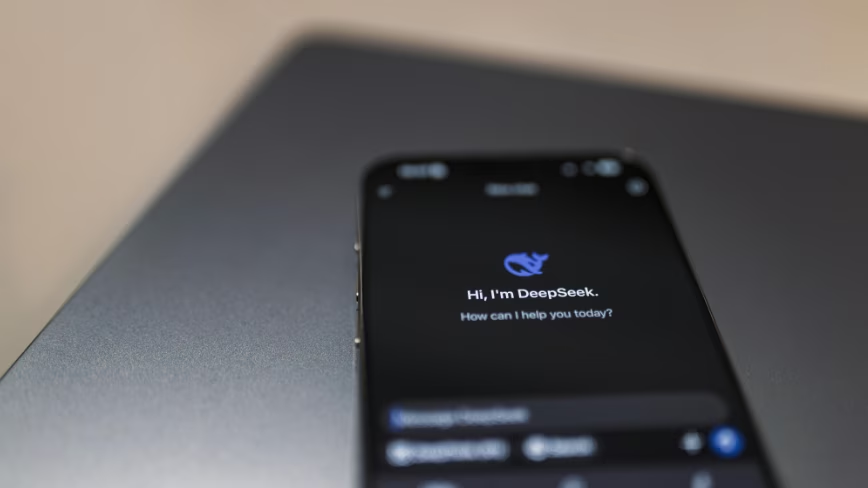
Image: courtesy of Thenextweb
DeepSeek's $74 Billion Funding Halt Exposes China's AI Vulnerabilities and Geopolitical Tensions
Chinese artificial intelligence startup DeepSeek has abruptly suspended its second fundraising round, which aimed for a pre-money valuation of roughly $71 billion to $74 billion. The decision, conveyed verbally to prospective investors on July 26, 2026, followed the viral spread of private comments made by founder Liang Wenfeng. Liang's remarks, reportedly discussing China's significant AI gap with the United States and its heavy reliance on Nvidia chips, caused considerable frustration for the company. DeepSeek, which previously secured $7.4 billion in June 2026, has indicated it remains open to future fundraising and is actively preparing for an initial public offering (IPO). The incident highlights the sensitive intersection of private corporate discussions, national technological aspirations, and the geopolitical pressures shaping the global AI industry.
Outlook
Background
DeepSeek, founded in 2023, emerged as a significant player in China's rapidly expanding artificial intelligence sector, attracting substantial capital with its initial $7.4 billion funding round in June 2026. This rapid ascent placed it at the forefront of China's ambition to rival the United States in AI development. However, the industry operates under intense scrutiny and geopolitical pressure, particularly concerning the supply of advanced semiconductors.
Founder Liang Wenfeng’s leaked comments reportedly centered on two critical points: China's perceived technological gap with the US in AI and its substantial dependence on Nvidia chips. This reliance is a well-known, yet politically sensitive, vulnerability for Chinese tech firms. US export controls have increasingly restricted China’s access to high-end chips, including those from Nvidia, which are crucial for training sophisticated AI models. Any public acknowledgment of this dependency, especially from a prominent industry leader, can be seen as undermining national efforts towards technological self-sufficiency.
The viral spread of these private remarks on Chinese social media suggests a highly reactive public and regulatory environment. In China, corporate speech, particularly on matters of national strategic importance, is often subject to unofficial and official censorship or pressure. Such leaks can quickly escalate into public relations crises, making a fundraising pause a pragmatic move to allow the controversy to dissipate and re-evaluate strategic communications.
See also
Precedents
The history of China's technology sector is replete with instances where public comments or corporate actions have drawn official scrutiny or public backlash, often with significant financial consequences. High-profile examples include regulatory crackdowns on internet giants over data security, antitrust concerns, and public statements perceived as misaligned with national interests. Companies like Alibaba and Tencent have faced intense pressure, leading to shifts in business strategy, leadership changes, and substantial market value corrections.
In the context of fundraising, investor confidence in Chinese tech companies has always been sensitive to the domestic political climate and US-China relations. Periods of heightened geopolitical tension or increased regulatory uncertainty have historically led to delays or reductions in funding rounds, particularly from international investors. The current environment, marked by ongoing US technology sanctions and China's push for indigenous innovation, amplifies these sensitivities.
Furthermore, the issue of reliance on foreign technology, especially in critical sectors like semiconductors, has been a recurring theme. China has invested heavily in domestic chip development for years, but the progress has been slow and challenging. Publicly acknowledging a significant gap, even if privately understood, can be seen as an unhelpful admission that complicates national policy narratives and investor sentiment around domestic innovation capabilities.
The halt of DeepSeek's funding round is more than a setback for a single company; it is a stark illustration of the deep fault lines in China's ambitious drive for AI supremacy.
First, it exposes the profound tension between the private realities of technological development and the public narrative of national progress. While China invests heavily in AI, its foundational reliance on advanced chips, largely from US companies like Nvidia, remains a critical bottleneck. Liang's comments, however accurate, brought this uncomfortable truth into the public domain, creating a difficult environment for securing capital, particularly from domestic sources sensitive to national pride.
Second, the incident highlights the chilling effect of public scrutiny and potential censorship on corporate leaders in China. The fact that private investor remarks could go viral and derail a major funding round suggests a climate where transparency, even in closed-door discussions, carries significant risk. This could lead to more guarded communications from Chinese tech executives, making it harder for investors to gauge genuine sentiment and operational challenges.
Finally, for the global AI landscape, DeepSeek's pause signals the enduring impact of geopolitical competition. The US-China tech rivalry is not merely about trade balances; it is about access to foundational technologies and the freedom to innovate. When a company's funding is disrupted over comments about chip dependency, it underscores how deeply national security concerns are now intertwined with the commercial realities of the tech industry, affecting everything from capital allocation to talent acquisition.
Scenarios
AnalysisOne immediate outcome is that DeepSeek may re-evaluate its communication strategy, particularly regarding sensitive topics like technological dependencies and international competition. The company might adopt a more cautious approach to public and private statements to avoid similar incidents.
Another possible outcome is that DeepSeek could pivot towards an initial public offering (IPO) as an alternative route to capital. Given the company's stated intent to prepare for an IPO, this incident might accelerate those plans, allowing it to bypass the immediate sensitivities of private fundraising rounds. However, an IPO would subject the company to even greater public scrutiny and regulatory requirements, potentially forcing it to address the issues raised by Liang's comments in a more formal setting.
Alternatively, DeepSeek could resume its fundraising efforts at a later date, once the immediate public backlash has subsided and the company has had time to recalibrate its message. This might involve adjusting the targeted valuation or focusing on a different pool of investors less sensitive to the specific geopolitical nuances.
From a broader industry perspective, the incident could prompt other Chinese AI companies and venture capital firms to become more circumspect in their internal discussions and public disclosures, especially concerning technological gaps and foreign dependencies. This might lead to a more opaque investment environment in the short term, as companies try to shield themselves from similar public relations challenges.
Finally, the controversy could inadvertently reinforce China's long-term push for greater technological self-reliance, particularly in advanced semiconductor manufacturing. The public exposure of a leading AI firm's reliance on foreign chips might intensify government and industry efforts to fast-track domestic alternatives, even if such efforts are costly and technically challenging.
Timeline
2023
DeepSeek Founded
DeepSeek, a Chinese artificial intelligence startup, is founded.
June 2026
Initial Funding Round Completed
DeepSeek successfully raises approximately $7.4 billion in its first fundraising round.
July 26, 2026
Founder's Comments Leaked, Funding Paused
Private comments made by DeepSeek founder Liang Wenfeng during investor meetings, discussing China's AI gap with the US and reliance on Nvidia chips, are leaked and go viral on Chinese social media. DeepSeek verbally informs prospective backers that its second fundraising round, targeting a $71 billion to $74 billion valuation, is suspended.
Frequently Asked Questions
DeepSeek is a Chinese artificial intelligence startup founded in 2023. It operates in the rapidly growing AI sector, developing advanced AI models and technologies, and has attracted significant investor interest, raising billions in its initial funding round.
Discussion
Be the first to share your thoughts.