
The lawsuit will force the U.S. Department of Defense to articulate and defend its legal basis and evidentiary standards for designating companies as 'Chinese military companies' in a public court setting. This process could lead to greater transparency in how these lists are compiled and maintained, or it could expose the inherent difficulties in proving such connections in a legally robust manner. For CXMT, the immediate goal is removal from the Section 1260H list, which carries significant commercial penalties, particularly in access to U.S. government contracts and investment. The legal proceedings are likely to be lengthy, and the outcome could set a precedent for how other Chinese companies might challenge similar U.S. government designations in the future, potentially shaping the future of economic statecraft.
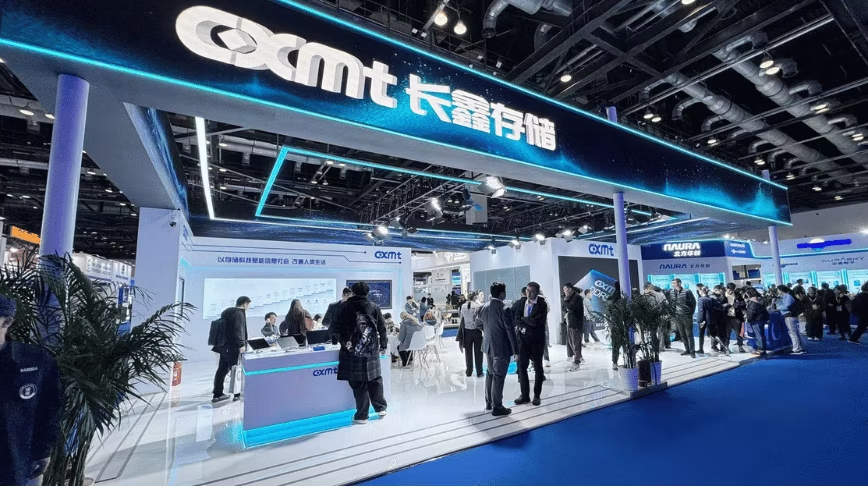
Image: courtesy of Thenextweb
Chinese Chipmaker CXMT's Lawsuit Against Pentagon Tests Limits of US Blacklisting Power
China's leading memory chipmaker, ChangXin Memory Technologies (CXMT), has launched a legal challenge against the U.S. Department of Defense, seeking to overturn its designation as a 'Chinese military company.' The lawsuit, filed on August 28, 2026, in a Washington D.C. federal court, argues that the Pentagon's decision to place CXMT on its Section 1260H list was arbitrary, lacked sufficient evidence, and violated the company's rights. This legal action marks a significant escalation in the ongoing technology tensions between the U.S. and China, forcing the Pentagon to publicly defend the criteria and process it uses to identify companies with alleged ties to the Chinese military.
Outlook
Background
The lawsuit filed by ChangXin Memory Technologies (CXMT) on August 28, 2026, is a direct response to its inclusion on the Pentagon's list of 'Chinese military companies,' officially known as the Section 1260H list. This designation, initially applied in January 2025 and reaffirmed in June 2026, carries substantial commercial implications. Companies on this list face restrictions on U.S. government contracts and are often viewed with skepticism by international investors, even if direct investment bans are not immediately in place. For CXMT, one of China's most significant players in the dynamic random-access memory (DRAM) sector, the label is a direct assault on its business model and global aspirations. The company contends that the Pentagon's decision-making process has been inconsistent and opaque, citing a brief period in February 2026 when the Pentagon issued a removal notice for CXMT, only to withdraw it on the same day before relisting the company four months later. This legal challenge arrives amidst a broader geopolitical climate where the United States has increasingly used economic and trade sanctions, export controls, and blacklisting as tools to counter what it perceives as national security threats from China, particularly in critical technology sectors like semiconductors. The case also follows a similar legal action initiated by Alibaba in June 2026, indicating a growing willingness among Chinese firms to contest these U.S. government actions in American courts.
Precedents
The use of blacklists and economic restrictions by the United States against foreign entities, particularly those perceived as national security threats, has a long history, though its application to technology companies on such a broad scale is a more recent development. Historically, similar lists, like the Specially Designated Nationals (SDN) list maintained by the Treasury Department, have targeted individuals and entities linked to terrorism, drug trafficking, or rogue states. The Section 1260H list, however, emerged from the 1999 National Defense Authorization Act, initially designed to identify companies operating in the U.S. that were owned or controlled by the Chinese military. Its enforcement and scope have expanded significantly in recent years as U.S.-China strategic competition intensified, particularly under the Biden administration.
Past challenges to U.S. government designations have seen mixed results. In some instances, companies have successfully argued for removal from lists by demonstrating a lack of direct ties or by implementing structural changes. However, such victories are rare and often require extensive legal battles and significant public relations efforts. For example, some Chinese companies challenged their inclusion on the Treasury Department's investment blacklist in prior years, with varying degrees of success. The legal standard for overturning a government designation is often high, requiring plaintiffs to prove that the government acted arbitrarily, capriciously, or beyond its statutory authority. This legal framework means CXMT faces an uphill battle, but the very act of suing signals a strategic shift among some Chinese firms, moving beyond lobbying efforts to direct judicial confrontation. The outcome of this case could establish new precedents for how these challenges are waged and how the U.S. government must substantiate its claims.
CXMT's lawsuit against the Pentagon is more than a single company's fight against a label; it represents a critical test of the legal limits of U.S. executive power in an era of intense geopolitical competition. If CXMT were to succeed, it could force the Pentagon to significantly revise its criteria and processes for designating 'Chinese military companies,' potentially weakening a key tool in Washington's economic statecraft. Such an outcome might embolden other Chinese tech firms to pursue similar legal avenues, creating a cascade of challenges that could dilute the impact of these blacklists. Conversely, a victory for the Pentagon would validate its current approach, potentially solidifying its authority to use these designations with fewer immediate legal repercussions, even if the reputational damage from a lengthy court battle remains.
For the global semiconductor industry, this case introduces a layer of legal uncertainty. The Section 1260H designation, while not a direct trade ban, acts as a powerful signal to U.S. and allied companies and investors about perceived risks. The legal battle could influence investment decisions, supply chain partnerships, and the overall trajectory of China's domestic chip development. CXMT is a national champion in China's drive for memory chip self-sufficiency, and its ability to access global markets and technology is vital to that ambition. The lawsuit highlights the increasing entanglement of legal systems with geopolitical strategies, where courtrooms become a new arena for international competition, shifting the focus from purely economic or diplomatic pressure to judicial scrutiny.
Scenarios
Analysis1. CXMT Wins and Designation is Overturned (Speculative): Should CXMT successfully argue that the Pentagon's designation was arbitrary or lacked sufficient evidence, a U.S. federal court could order the company's removal from the Section 1260H list. This outcome would significantly bolster CXMT's international standing, potentially restoring its access to certain U.S. government contracts and easing concerns among foreign investors and partners. It would also set a powerful precedent, suggesting that U.S. government entities must meet a higher evidentiary bar when blacklisting foreign companies, potentially inviting more legal challenges from other designated firms. This scenario could force the Pentagon to refine its designation process, making it more transparent and legally defensible.
2. Pentagon Wins and Designation is Upheld (Speculative): If the court finds the Pentagon's designation process and evidence to be sound, CXMT's lawsuit would fail, and the company would remain on the 'Chinese military company' list. This outcome would validate the Pentagon's authority and methodology, potentially deterring future legal challenges from other Chinese entities. For CXMT, it would cement the commercial and reputational restrictions associated with the designation, making it harder to attract international investment, secure U.S. government contracts, and participate fully in the global technology supply chain. It could also force CXMT to re-evaluate its global strategy, potentially focusing more on domestic Chinese markets or seeking partnerships with non-U.S. entities.
3. Settlement Reached (Speculative): It is possible that both parties could agree to an out-of-court settlement. Such an agreement might involve CXMT making certain concessions, perhaps related to corporate governance or transparency, in exchange for its removal from the list or a commitment from the Pentagon to review its status under new criteria. A settlement could allow both sides to avoid a protracted and potentially damaging public legal battle, offering a quicker resolution than a full court case. However, the terms of any settlement would be closely watched for what they imply about the strength of the Pentagon's evidence or CXMT's willingness to make significant operational changes.
4. Protracted Legal Battle and Lingering Uncertainty (Speculative): The lawsuit could drag on for years, involving appeals and complex legal maneuvers. During this period, CXMT would continue to operate under the cloud of the 'Chinese military company' designation, facing ongoing commercial disadvantages and reputational challenges. The prolonged legal uncertainty itself could deter potential partners and investors, regardless of the eventual outcome. This scenario would demonstrate the difficulty of challenging such designations and the long-term impact of U.S. economic restrictions, even without a definitive legal ruling.
Timeline
Frequently Asked Questions
Discussion
Be the first to share your thoughts.