
The immediate expectation is increased competition in the high-performance mobile memory sector. CXMT's potential entry into LPDDR6 production means smartphone manufacturers could soon have a third major supplier for these crucial components, which power next-generation devices. This shift could influence pricing strategies, accelerate innovation, and offer a more diversified supply chain. For consumers, this might translate into more efficient and powerful smartphones, potentially at more competitive prices, as manufacturers gain leverage with multiple suppliers.
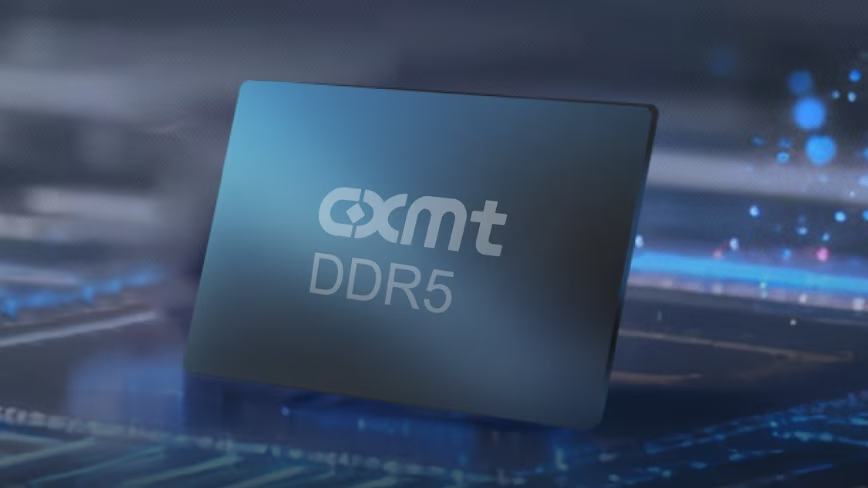
Image: courtesy of Thenextweb
CXMT's LPDDR6 Push: How China Could Reshape the Next-Gen Phone Memory Race
China's ChangXin Memory Technologies (CXMT) is nearing production of LPDDR6 mobile memory chips, a development that could shake up a market long dominated by South Korean giants Samsung and SK Hynix. The news comes after CXMT's recent initial public offering saw its shares surge by 470%, signaling strong investor confidence in its potential. If CXMT can bring LPDDR6 to market soon, it would mark a significant step in China's ambition to achieve greater self-sufficiency in critical semiconductor technologies.
Outlook
Background
LPDDR6 (Low Power Double Data Rate 6) represents the next generation of memory technology designed specifically for mobile devices, offering substantial improvements over its predecessors like LPDDR5X. These advancements typically include higher data processing speeds and reduced power consumption, which are critical for enhancing smartphone performance, extending battery life, and supporting demanding applications like advanced AI features and high-resolution gaming.
The global market for mobile memory has historically been a stronghold for South Korean firms, primarily Samsung Electronics and SK Hynix. These companies have invested heavily in research and development, establishing themselves as leaders in both technology and manufacturing capacity. However, a recent surge in LPDDR5X prices, which jumped by 78-83% in the second quarter of 2026, highlights the market's sensitivity to supply and demand dynamics, and the leverage held by dominant players.
CXMT's R&D verification for LPDDR6 at 12.8Gbps is reportedly nearing completion. Trial production could begin before the end of 2026, with mass production potentially following in the second half of the year. This timeline positions CXMT to potentially be among the first manufacturers to bring LPDDR6 to market, alongside SK Hynix, which announced in March 2026 that it had completed development and customer certification of a 16-gigabit LPDDR6 chip, claiming a 33% gain in data-processing speed and a 20% cut in power use over LPDDR5X, with plans to begin supply in H2 2026. Samsung is also reportedly reconsidering LPDDR6 for its future devices, such as the Galaxy S27 Ultra, suggesting the market is poised for this upgrade.
See also
Precedents
China has long pursued a strategy of developing its domestic semiconductor industry to reduce reliance on foreign technology, a drive that has intensified amid geopolitical tensions and supply chain disruptions. Companies like CXMT have received significant state backing and investment to close the technology gap with established global leaders. While previous attempts to challenge incumbents in certain chip segments have faced hurdles related to technology maturity, production scale, and market acceptance, the memory sector has seen consistent, albeit gradual, progress from Chinese players.
Historically, the introduction of new memory standards has often led to intense competition, initial price volatility, and a subsequent push for market share. Early movers who can reliably produce high-quality, high-performance chips often gain a significant advantage. However, scaling up advanced semiconductor manufacturing is capital-intensive and fraught with technical challenges, meaning even successful R&D doesn't guarantee immediate market dominance. The 470% surge in CXMT's IPO reflects a market belief that this time, China's efforts in advanced memory could yield a tangible competitive force.
CXMT's emergence as a viable LPDDR6 producer carries significant implications across several fronts. For smartphone manufacturers, it offers a crucial alternative source for advanced mobile memory, potentially easing supply constraints and providing more negotiating power on pricing. This could lead to a more resilient global supply chain, less vulnerable to disruptions from a limited number of suppliers.
From a competitive standpoint, a strong Chinese player could force Samsung and SK Hynix to innovate faster and potentially adjust their pricing strategies to maintain market share. This dynamic benefits the broader tech ecosystem by fostering greater innovation and efficiency.
Crucially, this development represents a strategic win for China's semiconductor ambitions. Successfully competing in next-generation memory chips like LPDDR6 would demonstrate a growing capability to produce cutting-edge components, moving beyond commodity chips. This aligns with national goals of technological self-reliance and could reshape the geopolitical balance in the global technology sector. It also signals that while export controls and geopolitical pressures aim to slow China's chip progress, domestic companies continue to push forward, backed by substantial investment and a clear strategic imperative.
Scenarios
AnalysisOne potential outcome is that CXMT successfully ramps up LPDDR6 production by the second half of 2026, establishing itself as a significant third player in the market. This scenario could lead to increased price competition, benefiting smartphone manufacturers and ultimately consumers through more affordable or feature-rich devices. It would also solidify China's position as a more capable player in advanced semiconductor manufacturing.
Another possibility is that despite nearing verification, CXMT faces unforeseen technical or scaling challenges that delay mass production or limit its output. This would allow Samsung and SK Hynix to maintain their dominant market positions in the short to medium term, potentially leading to continued high prices for LPDDR6 as demand outstrips supply, at least initially. In this case, CXMT might secure niche contracts but struggle to become a broad market challenger.
A third scenario involves a strategic response from existing market leaders. Samsung and SK Hynix could accelerate their own LPDDR6 production and development, possibly by leveraging their scale and experience to push even more advanced versions or offer more aggressive pricing, making it harder for CXMT to gain significant traction. They might also explore partnerships or exclusive supply deals with major smartphone makers to lock in demand, thus limiting CXMT's market entry opportunities.
Timeline
2026-03-01T00:00:00.000Z
SK Hynix LPDDR6 Development
SK Hynix announced the completed development and customer certification of a 16-gigabit LPDDR6 chip, built on its most advanced 1c process.
2026-06-30T23:59:59.000Z
LPDDR5X Price Surge
LPDDR5X prices jumped by 78-83% in the second quarter of 2026, indicating strong market demand and limited supply.
2026-08-03T19:00:47.000Z
CXMT Nears LPDDR6 Production
Reports emerged that CXMT's R&D verification for LPDDR6 at 12.8Gbps is nearly complete, with trial production potentially starting this year.
2026-08-04T00:00:00.000Z
CXMT IPO Surge
Following news of its LPDDR6 progress, CXMT's shares surged 470% during its blockbuster trading debut on the Shanghai Stock Exchange.
2026-12-31T23:59:59.000Z
Potential CXMT Trial Production
Trial production of LPDDR6 by CXMT could begin this year, positioning the company for mass production.
Frequently Asked Questions
LPDDR6 is the latest standard for Low Power Double Data Rate memory, specifically designed for mobile devices like smartphones and tablets. It's important because it delivers significantly faster data processing speeds and uses less power than previous generations, which means better performance, longer battery life, and support for more advanced features in mobile devices.
Discussion
Be the first to share your thoughts.