
The market will be watching closely to see if Kunlunxin can successfully navigate investor appetite for a major tech IPO while simultaneously imposing a product purchase requirement. This strategy could either de-risk the offering by guaranteeing early revenue and market penetration, or it could deter potential investors who prefer pure financial exposure without operational commitments. The success of this approach may influence future IPOs from Chinese tech firms operating in strategically important, yet globally constrained, sectors.
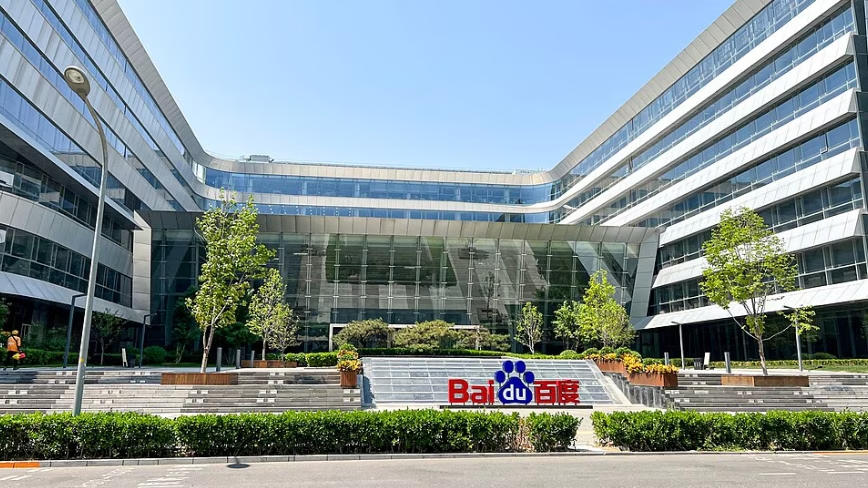
Image: courtesy of Thenextweb
The Unusual Demand Behind Kunlunxin's $50 Billion Hong Kong IPO Target
Baidu's artificial intelligence chip unit, Kunlunxin, is reportedly planning a $50 billion initial public offering in Hong Kong, a valuation significantly higher than previous estimates. The proposed listing comes with an unusual condition: prospective investors are being asked to commit to purchasing Kunlunxin's semiconductors as part of their investment. This move, reported by The Information on Sunday, June 28, 2026, and acknowledged by Reuters as unverified, suggests a complex strategy to secure both capital and market adoption in a highly competitive and geopolitically sensitive industry. The news sent Baidu's Hong Kong-listed shares up more than 7% on Monday, June 29, 2026.
Outlook
Background
Kunlunxin, established in 2012 as an internal project within Baidu, has evolved into a critical component of the Chinese tech giant’s broader artificial intelligence ecosystem. Its chips power various Baidu services, including its autonomous driving platform Apollo and its large language model, Ernie Bot. The unit's reported target valuation of $50 billion for a Hong Kong IPO would position it among the largest technology listings in recent years, reflecting significant investor confidence in the AI chip sector despite global economic headwinds and geopolitical tensions.
The Information, citing two sources, first reported on Sunday, June 28, 2026, that Kunlunxin had approached investors with this ambitious valuation. Crucially, the report also detailed an unusual request: potential IPO investors were asked to commit to purchasing the company's semiconductors. While Reuters could not independently confirm these specific details, the news was enough to trigger a more than 7% surge in Baidu's Hong Kong-listed shares on Monday, June 29, 2026, indicating the market's positive initial reaction to the prospect of unlocking value from the chip unit. Reports suggest Kunlunxin has already filed confidentially for the IPO, signaling that the process is well underway.
See also
Precedents
The practice of tying an investment to a product purchase is not entirely new in the broader capital markets, though it is rare for a public offering of this magnitude. In private equity or venture capital rounds, strategic investors, particularly corporate entities, sometimes commit to commercial agreements alongside their financial stake. For instance, an automaker might invest in a battery startup and simultaneously sign a long-term supply deal. Similarly, in the early days of certain hardware-dependent industries, or during times of extreme supply chain uncertainty, such arrangements have been observed.
However, for a $50 billion initial public offering, particularly one targeting a diverse pool of public market investors, this kind of explicit product purchase commitment is highly unorthodox. Traditional IPOs prioritize liquidity and broad investor access, with valuation based on projected financial performance and market comparables. The closest historical parallels might be found in highly specialized sectors where securing a foundational customer base is paramount, or in times of acute resource scarcity. Yet, even in those cases, the condition is usually structured through separate commercial contracts rather than being embedded directly into the IPO investment terms.
Chinese tech companies have increasingly looked to Hong Kong for listings amid tightened regulatory scrutiny in the U.S. and a desire to retain closer ties to mainland capital. This trend has seen several major tech firms, including Baidu itself, pursue secondary listings or spin-offs in Hong Kong. The move by Kunlunxin, therefore, aligns with a broader pattern of Chinese firms seeking capital closer to home, but the specific terms of its offering introduce a new variable into this established dynamic.
The proposed Kunlunxin IPO, particularly with its unusual investor demands, carries significant implications for several key stakeholders and the broader technology landscape.
For Baidu, the listing represents a strategic move to unlock the substantial value embedded within its AI chip development arm. A successful $50 billion IPO would provide a massive capital injection, allowing Baidu to fund further research and development in its core AI initiatives, expand its cloud services, and strengthen its competitive position against rivals like Alibaba and Tencent. It also offers a clear valuation metric for a business unit that has largely operated as an internal cost center, potentially boosting Baidu's overall market capitalization and shareholder value.
For Kunlunxin, the IPO proceeds would be transformative. It would gain significant financial independence from Baidu, enabling it to scale up production, invest in next-generation chip designs, and potentially attract top-tier talent in a fiercely competitive global semiconductor market. The mandated chip purchases, if successful, could provide a stable, foundational revenue stream, de-risking its market entry and validating its technology in the eyes of other potential customers. This could be particularly critical for a company operating in a sector heavily influenced by geopolitical dynamics and the ongoing push for domestic self-sufficiency in China's semiconductor industry.
For investors, the situation presents a complex calculation. The $50 billion valuation reflects the high growth potential of AI chips, especially those developed in China. However, the requirement to purchase semiconductors adds a layer of operational complexity and market risk that is atypical for a public equity investment. It forces investors to become not just financial stakeholders but also commercial partners, potentially limiting the pool of interested parties to those with a direct need for Kunlunxin's products or a willingness to engage in such a hybrid investment model. This could influence the final valuation or the speed of the IPO process.
More broadly, the IPO could set a precedent for how strategically important technology companies, especially those in sectors vital to national technological independence, seek capital. If Kunlunxin's approach proves successful, it might usher in a new era of 'strategic IPOs' where capital investment is explicitly linked to market adoption and supply chain commitments, blurring the lines between financial and commercial transactions in public markets. This could have ripple effects on how other Chinese chipmakers or critical tech firms structure their future fundraising efforts, particularly given the ongoing global competition and trade restrictions in the semiconductor space.
Scenarios
Analysis1. Successful IPO with Conditions Met (Inferred/Speculative): Kunlunxin successfully lists at or near its $50 billion target valuation, with enough investors agreeing to the chip purchase commitments. This would provide significant capital and a guaranteed customer base, validating Kunlunxin's unique IPO strategy and potentially setting a new precedent for how strategic tech assets in China seek public funding. It would signal strong investor confidence in China's domestic AI chip capabilities.
2. Valuation Adjustment or Delayed IPO (Speculative): The unusual condition of mandated chip purchases proves to be a significant hurdle for a broad range of institutional investors. As a result, Kunlunxin may be forced to either lower its target valuation to attract sufficient interest or delay the IPO to re-evaluate its terms. This outcome could reflect market resistance to hybrid investment-commercial agreements in public offerings.
3. Hybrid Investment Model Emergence (Speculative): While the IPO proceeds, the investor pool might be heavily skewed towards strategic corporate investors or state-backed funds that have a direct commercial interest in Kunlunxin's semiconductors. This could lead to a less diversified shareholder base than a typical public offering, but still provide the necessary capital and market adoption.
4. Increased Scrutiny and Regulatory Pushback (Speculative): The unique structure of the IPO could draw additional scrutiny from Hong Kong regulators or international financial bodies, particularly concerning fairness to all investors or potential market manipulation if the chip purchase commitments are seen as distorting market dynamics. This could lead to delays or modifications to the offering terms.
Timeline
2012
Kunlunxin Founded
Baidu establishes Kunlunxin as an internal unit focused on artificial intelligence chip development.
2026-06-28
IPO Plan Reported
The Information reports that Baidu's AI chip unit Kunlunxin is targeting a $50 billion Hong Kong IPO and asking investors to commit to purchasing its semiconductors. Reuters notes it could not independently verify the report.
2026-06-29
Baidu Shares React
Hong Kong-listed shares of Baidu surge more than 7% following reports of Kunlunxin's ambitious IPO plans.
Frequently Asked Questions
Kunlunxin is the artificial intelligence chip unit of Chinese tech giant Baidu. It designs and develops semiconductors primarily for AI applications, powering key Baidu services like autonomous driving and large language models.
Discussion
Be the first to share your thoughts.