
Aseon Labs is expected to use the newly secured capital to accelerate the development of its robotic micro-depot prototypes. This involves refining the AI and computer vision systems that will allow these pods to autonomously handle maintenance tasks. The company will also expand its engineering and operational teams to support these efforts. Over the coming months, the focus will likely be on rigorous testing of these initial units, potentially in controlled environments or through early pilot programs with robotaxi operators. The challenge will be to prove the technology's reliability and efficiency in real-world conditions, validating the core premise that localized servicing can significantly reduce operational costs for autonomous fleets.
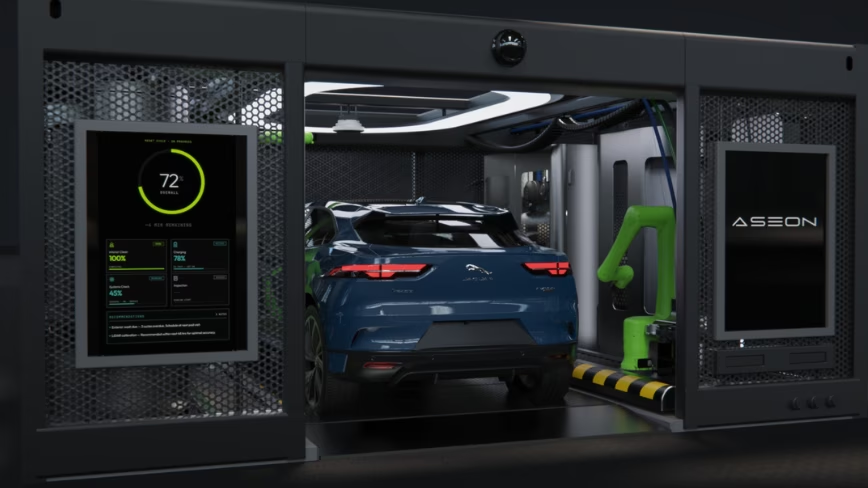
Image: courtesy of Thenextweb
Aseon Labs Secures $10 Million to Tackle Robotaxi's 'Deadhead' Problem
Aseon Labs, a Redwood City startup, has raised $10 million in seed funding to develop automated, parking-space-sized pods designed to charge, clean, and inspect robotaxis directly within their operating zones. The investment, led by Crane Venture Partners and including Y Combinator and Uber co-founder Garrett Camp's firm Expa, aims to cut down on the significant amount of time autonomous vehicles spend driving empty to distant service depots, a major drag on the industry's path to profitability.
Outlook
Background
The autonomous vehicle industry, particularly the robotaxi segment, has attracted billions in investment over the past decade. Companies like Waymo and Cruise have made significant strides in deploying driverless services in select cities. However, the path to widespread profitability has been slower than many initially anticipated. One of the persistent operational bottlenecks is vehicle utilization. Unlike human-driven taxis, robotaxis require frequent, specialized servicing—charging, cleaning, and software updates—that often necessitates them driving considerable distances to centralized depots. These 'deadhead miles,' or empty trips, represent lost revenue opportunities and add substantially to operational expenses. They also keep vehicles out of service for longer periods, directly impacting the fleet's ability to generate income. Aseon Labs' solution directly addresses this inefficiency, proposing a distributed network of automated service points that could fundamentally alter the economic model of robotaxi operations. The involvement of investors like Y Combinator and Uber co-founder Garrett Camp's firm, Expa, signals a belief that this 'back-end' infrastructure is critical for the front-end robotaxi services to truly scale.
See also
Precedents
The history of transportation infrastructure shows a clear pattern: as vehicles evolve, so too must the systems that support them. Early automobiles required extensive networks of gas stations and repair shops. The rise of electric vehicles necessitated a completely new charging infrastructure. For autonomous fleets, the challenge is not just fuel or power, but also maintenance, cleanliness, and software updates, all without human intervention. The concept of localized, automated servicing is not entirely new; automated car washes exist, and some large logistics companies use automated systems for fleet maintenance. However, integrating these functions into a compact, deployable, and fully autonomous 'micro-depot' specifically for robotaxis represents a significant leap. Past attempts to scale complex automated systems have often run into issues with reliability, cost, and regulatory hurdles. The success of Aseon Labs will depend on overcoming these familiar challenges while proving the economic benefit outweighs the investment in new infrastructure. The funding model, starting with a seed round from prominent tech investors, mirrors the early stages of many successful tech infrastructure plays that eventually became critical enablers for broader industry growth.
The real stakes for robotaxi operators are clear: profitability and scalability. The allure of autonomous vehicles has always been the promise of drastically reduced operating costs by removing the human driver. Yet, the hidden costs of managing and maintaining these fleets have proven substantial. If robotaxis spend a significant portion of their operational day driving empty to service depots, the economic advantage is eroded. Aseon Labs' approach aims to unlock the next phase of efficiency. By decentralizing charging and cleaning, they could dramatically increase the 'uptime' of robotaxis, meaning more hours spent carrying paying passengers and fewer hours in transit to a depot. This directly translates to higher revenue potential per vehicle and a faster path to return on the enormous capital invested in autonomous technology. For consumers, this could eventually mean more available robotaxis, shorter wait times, and potentially lower fares as operational costs come down. For the broader autonomous vehicle industry, Aseon Labs represents a crucial piece of the puzzle: proving that the necessary support infrastructure can be built and scaled efficiently, moving robotaxis from an expensive novelty to a truly viable and profitable transportation service.
Scenarios
AnalysisOne immediate outcome is that Aseon Labs will likely accelerate its hiring efforts, particularly for engineers specializing in robotics, AI, and computer vision, given the stated use of the seed funding for team expansion. This influx of talent would be critical for moving their prototype development forward rapidly.
A second potential outcome is that the success of Aseon's early prototypes could attract further investment from venture capital firms or even strategic investments from existing robotaxi operators. If the concept proves viable in initial testing, major players in the autonomous vehicle space might see these 'robotic pit stops' as essential infrastructure, leading to partnerships or even acquisition discussions. This would validate the market need and potentially accelerate the deployment of these pods on a larger scale.
Conversely, a less favorable outcome could see Aseon Labs encounter significant technical hurdles during prototype development or face unexpected regulatory resistance. Deploying automated infrastructure in public or semi-public spaces often involves complex permitting, safety standards, and local zoning laws that can slow down or even halt expansion plans. If these challenges prove too costly or time-consuming, it could delay market entry and force a re-evaluation of their business model, potentially impacting their ability to secure subsequent funding rounds.
Timeline
Frequently Asked Questions
Discussion
Be the first to share your thoughts.