
Readers can expect a detailed examination of the creative and commercial drivers behind adapting a non-narrative, abstract video game like Tetris into a children's animated series. The article will explore the inherent challenges of building a story around falling blocks, the strategic importance of integrating STEAM education, and what this project signifies for the broader trend of intellectual property (IP) management in the gaming and entertainment sectors. It will also look at the potential market impact and the creative team tasked with bringing this vision to life.
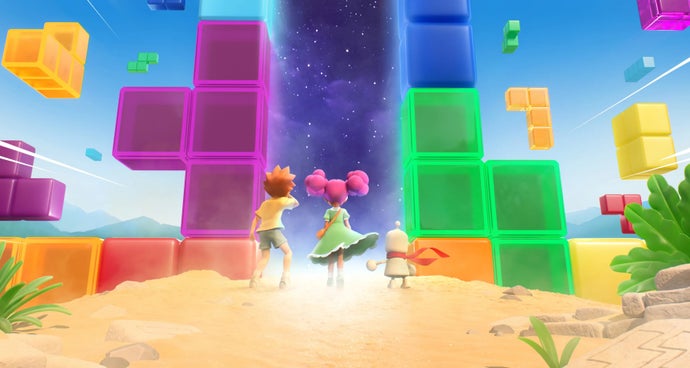
Image: courtesy of EuroGamer
Tetris: World Builders — The Strategy Behind Turning Abstract Blocks Into a Children's Animated Series
TeamTO and The Tetris Company have announced "Tetris: World Builders," a new CG-animated adventure series for children aged six and up. The series, which will consist of 52 eleven-minute episodes, aims to translate the iconic puzzle game's geometric language into a narrative focused on creativity, engineering, teamwork, and discovery. Currently in early development, the project represents a strategic move to extend the Tetris brand into educational entertainment, blending imaginative storytelling with core STEAM (Science, Technology, Engineering, Arts, and Mathematics) concepts.
Outlook
Background
The announcement of "Tetris: World Builders" was made by French animation studio TeamTO and The Tetris Company on June 23, 2026, at the Annecy International Animation Film Festival. This event is a significant platform for unveiling new animated projects, drawing industry attention and potential partners. The series is being developed as a CG-animated adventure for children over six years old, with a confirmed order of 52 episodes, each lasting 11 minutes. The core concept involves a team of young 'World Builders' who use the familiar Tetrimino blocks, which mysteriously fall from the sky, to reshape their environment and solve various problems. This approach directly integrates the spatial reasoning and problem-solving mechanics central to the original Tetris game. The project is currently in early development, led by TeamTO producers Marco Balsamo and Tara Sibel Demren, alongside veteran executive producer Chuck Williams, known for his work on the 2020 'Sonic the Hedgehog' movie. The stated goal is to blend imaginative storytelling with STEAM-inspired problem-solving, aiming to introduce foundational concepts of engineering, creativity, and teamwork through a character-driven narrative.
Precedents
The adaptation of video game intellectual property (IP) into other media, particularly film and television, is a long-standing practice with a mixed record of success. Early attempts often struggled to capture the essence of the games, leading to critical and commercial disappointments. However, recent years have seen a resurgence of successful adaptations, driven by a deeper understanding of source material and a willingness to invest in high-quality production. The 'Sonic the Hedgehog' films, for instance, demonstrated that a beloved gaming character could translate well to the big screen, particularly with careful attention to fan expectations and accessible storytelling. Similarly, 'The Super Mario Bros. Movie' achieved significant box office success by leaning into the game's vibrant world and iconic characters.
For non-narrative games like Tetris, the challenge is considerably greater. Unlike character-driven franchises such as Pokémon or Mario, Tetris has no inherent plot, dialogue, or protagonists. Its appeal lies purely in its mechanics: the addictive challenge of fitting geometric shapes to clear lines. This makes it an outlier in the adaptation landscape, more akin to abstract concepts or traditional board games rather than story-rich RPGs or platformers. Previous attempts to extend the Tetris brand have largely focused on merchandise, spin-off games, or even a feature film adaptation that, while announced, has yet to materialize in a concrete form.
However, the move to a children's animated series, specifically incorporating STEAM elements, aligns with another growing trend in children's media. Educational programming that subtly integrates scientific, technological, engineering, arts, and mathematical concepts has gained traction with parents and educators. Shows like 'Paw Patrol' (which features problem-solving and engineering through its various rescue vehicles) or 'Blaze and the Monster Machines' (explicitly focused on STEM) demonstrate the commercial viability of this approach. This suggests a strategic pivot for the Tetris IP, moving beyond direct gameplay adaptations to embrace a broader educational and creative mandate, leveraging the game's inherent logic for a new audience. The involvement of Chuck Williams, who has experience in successful game-to-film adaptations, provides a degree of institutional realism and suggests a focus on production quality and audience engagement.
This venture into children's animated programming for Tetris carries significant implications for several sectors: the gaming industry, children's entertainment, and the broader intellectual property market. For The Tetris Company, it represents a calculated effort to future-proof one of the most enduring, yet abstract, gaming brands in history. By creating a narrative around the game's core mechanics, the company aims to introduce Tetris to a new generation of children who may not otherwise encounter the classic puzzle game. This could extend the brand's lifespan and relevance, securing its legacy beyond traditional gaming platforms.
From a creative standpoint, the project is a fascinating case study in adaptation. How do you extract compelling stories and characters from something as fundamentally non-narrative as falling blocks? The success or failure of 'Tetris: World Builders' could set a precedent for how other abstract or mechanics-driven game IPs are viewed for future media expansions. If TeamTO can successfully weave engaging stories and relatable characters into the geometric constraints of Tetris, it might open doors for other developers to consider similar, unconventional adaptations.
Furthermore, the explicit integration of STEAM concepts is crucial. In an educational environment increasingly focused on these areas, linking a globally recognized brand like Tetris to problem-solving, engineering, and creativity creates a powerful educational hook. This could attract parents and educators, positioning the series not just as entertainment, but as a valuable learning tool. This blending of entertainment with education is a growing trend in children's media, and a successful Tetris series could further validate this model, encouraging more IP holders to explore educational angles for their content. The financial incentives are also clear: a successful animated series can generate substantial revenue through licensing, merchandising, and global distribution, creating new revenue streams far beyond game sales.
Scenarios
AnalysisThe launch and reception of "Tetris: World Builders" could unfold in several distinct ways, each with different consequences for The Tetris Company, TeamTO, and the broader entertainment landscape.
One possible outcome is that the series achieves significant success, establishing itself as a popular and critically acclaimed children's program. This would validate the strategy of adapting abstract gaming IPs for narrative purposes, particularly when infused with educational elements. A strong viewership could lead to further seasons, extensive merchandising opportunities, and potentially inspire other classic, non-narrative game brands to explore similar media expansions. The educational focus on STEAM concepts could resonate strongly with parents and educators, leading to endorsements and a perception of the series as both entertaining and beneficial for child development. This success would significantly enhance the Tetris brand's value and cultural relevance for a new generation.
Alternatively, the series might struggle to find a broad audience or critical acclaim. The inherent challenge of building a compelling narrative around the simple mechanics of Tetris could prove too difficult, leading to a show that feels forced or lacks the dynamic appeal of more character-driven children's programming. While the educational intent is clear, if the storytelling isn't engaging enough, children may not connect with the characters or the problem-solving scenarios. This could result in a niche viewership, failing to achieve the widespread impact and commercial returns that The Tetris Company and TeamTO are likely aiming for. Such a scenario would temper enthusiasm for adapting highly abstract gaming IPs in the future, prompting a re-evaluation of creative approaches.
A third outcome could see the series achieving moderate success, finding a loyal, albeit smaller, audience. It might be praised for its educational value and creative approach to problem-solving, but perhaps not break through into the mainstream popularity of franchises like Pokémon or Paw Patrol. In this scenario, the series might run for a few seasons, fulfilling its initial mandate, but without becoming a tentpole property. This would still represent a success in diversifying the Tetris brand and reaching a new demographic, but without the transformative impact of a major hit. It would demonstrate the viability of the concept, but also highlight the difficulties inherent in translating such a unique game into a different medium.
Timeline
2026-06-23
Series Announcement
TeamTO and The Tetris Company officially announced "Tetris: World Builders," a new CG-animated series for children, at the Annecy International Animation Film Festival in Annecy, France.
2026
Target Release Year
While currently in early development, the series is targeting a release within 2026, as indicated in a recent news summary. This timeframe suggests an ambitious production schedule for a 52-episode series.
Frequently Asked Questions
'Tetris: World Builders' is a new CG-animated adventure series for children aged 6 and up, inspired by the classic Tetris puzzle game. It aims to blend imaginative storytelling with STEAM-inspired problem-solving.
Discussion
Be the first to share your thoughts.