
The bond market is currently caught in a tension between present inflationary pressures and future expectations shaped by the Federal Reserve's leadership. Investors can expect continued scrutiny of the Fed's communications, particularly any shifts in tone or policy signals from Chair Warsh. The market will be watching for concrete evidence that inflation is indeed decelerating, rather than just relying on verbal assurances. Any sustained uptick in inflation figures, or a perceived softening of the Fed's resolve, could quickly reverse the current trend in bond yields. Conversely, if inflation data begins to show consistent declines, it would reinforce the market's current confidence in Warsh's strategy.
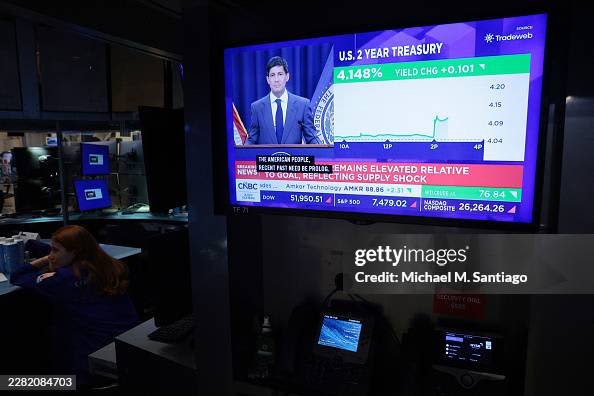
Image: courtesy of Market Watch
Fed Chair Warsh's Hard Line Calms Bond Markets Amid Rising Inflation
Federal Reserve Chair Kevin Warsh's aggressive stance on price stability has led to a counterintuitive market reaction: falling bond yields even as inflation continues to rise. This dynamic suggests that investors are, for now, placing significant trust in the Fed's commitment to bring inflation back to its 2% target, despite immediate economic pressures.
Outlook
Background
On June 26, 2026, bond yields continued their decline, a move that might seem unusual given the concurrent rise in inflation. This situation points directly to the influence of Federal Reserve Chair Kevin Warsh. Since taking the helm, Warsh has adopted a notably hawkish posture, repeatedly emphasizing the central bank's dedication to price stability.
His first press conference as chair set the tone, where he reportedly mentioned 'price stability' a dozen times, making it clear the Federal Open Market Committee was 'unanimous and unambiguous' in its inflation fight. This tough rhetoric appears to be a key factor in steadying market expectations. When a central bank leader projects strong resolve, it can anchor long-term inflation expectations, even if current inflation data is elevated. Investors, believing the Fed will eventually bring inflation under control, may demand less of an inflation premium on their long-term bond holdings, leading to lower yields.
However, this market interpretation is not entirely uniform. While many see Warsh's talk as 'helping' to stabilize markets, some parts of the bond market are signaling concerns that the Federal Reserve may already be 'behind' the curve in managing inflation. This indicates a divergence in investor confidence, with some still skeptical about the Fed's ability to tackle inflation purely through communication without more aggressive action.
Another layer of complexity stems from Warsh's long-held views on the Fed's balance sheet. He has previously argued that the central bank's massive balance sheet, accumulated through years of bond buying, has pulled the Fed too deeply into government financing. This philosophical stance suggests he may favor a more conventional, less interventionist approach to monetary policy, which could include balance sheet reduction alongside interest rate adjustments, if verbal guidance proves insufficient.
Precedents
The relationship between central bank rhetoric, inflation, and bond yields has a rich history. Periods where the market perceives a central bank as credible in its commitment to price stability often see long-term yields remain relatively contained, even during inflationary spikes. Conversely, when central bank credibility wavers, or if policy is seen as reactive rather than proactive, bond yields can rise sharply as investors demand higher compensation for inflation risk.
One significant historical parallel is the Federal Reserve under Paul Volcker in the late 1970s and early 1980s. Volcker famously took aggressive action to tame runaway inflation, enduring a sharp economic downturn to restore price stability. His unwavering commitment, initially met with skepticism, eventually re-anchored inflation expectations and restored the Fed's credibility. While Warsh's current actions are primarily verbal, the market's reaction suggests an attempt to replicate that sense of strong, pre-emptive resolve.
More recently, periods of quantitative easing (QE) and quantitative tightening (QT) have shown how the Fed's balance sheet operations directly influence bond markets. The 'massive balance sheet' Warsh refers to is a legacy of these policies. The market has learned that the Fed's actions, and even its stated intentions, have profound effects on the cost of borrowing across the economy.
The current dynamic in bond markets is more than just a technical detail for traders; it reflects a fundamental tension in the economy that touches everyone. For consumers, falling bond yields can translate into lower borrowing costs for mortgages, auto loans, and other forms of credit. This could provide some relief against the backdrop of rising inflation, potentially supporting consumer spending and economic activity.
However, if the market's confidence in Warsh's 'tough talk' proves misplaced and inflation persists, the situation could quickly unravel. Bond yields could then rise sharply as investors demand greater compensation for future price increases, leading to higher borrowing costs across the board. This would squeeze household budgets and could stifle business investment, creating a difficult environment for economic growth.
For businesses, stable or falling yields mean cheaper access to capital, which can encourage investment, expansion, and job creation. But the underlying inflation still erodes purchasing power and increases operational costs, creating a profit squeeze if companies cannot pass on those costs. The Fed's ability to manage this delicate balance — taming inflation without choking off growth — will dictate the economic trajectory for the coming year.
For investors, the direction of bond yields is a critical signal for asset allocation. Lower yields can make equities relatively more attractive, but a sudden shift due to inflation concerns could trigger broader market volatility. The credibility of the Federal Reserve under Warsh, therefore, is not merely an academic point; it has tangible consequences for the cost of living, business viability, and investment returns.
Scenarios
AnalysisThe current market environment, characterized by falling bond yields and rising inflation under Warsh's firm hand, presents several distinct paths forward:
One possible outcome is that Warsh's strategy successfully re-anchors inflation expectations and, combined with broader economic forces, leads to a gradual deceleration of inflation. In this scenario, the market's initial trust in his verbal commitment is validated, allowing the economy to achieve a 'soft landing' where inflation cools without a significant economic downturn. Bond yields would likely stabilize or continue their moderate decline, reflecting sustained confidence in the Fed's ability to manage price stability over the long term.
Alternatively, inflation could prove more persistent than anticipated, challenging the market's faith in the Fed's verbal interventions. If inflation continues to 'pop' or accelerate despite Warsh's tough talk, investors may conclude that more aggressive monetary policy actions are needed. This could force the Federal Reserve to implement significant interest rate hikes or accelerate balance sheet reduction. Such a shift would likely cause bond yields to rise sharply, potentially triggering a broader repricing across financial markets and increasing the risk of an economic recession.
Another scenario involves a period of prolonged uncertainty and volatility. The bond market could remain highly sensitive to incoming economic data, oscillating between periods of reassurance and skepticism regarding the Fed's effectiveness. This would mean bond yields experience greater fluctuations, reflecting the market's ongoing struggle to reconcile current inflation with future policy expectations. Such an environment would create significant execution risk for businesses and heighten uncertainty for investors, as the path to price stability remains unclear.
Timeline
2026-06-26
Bond Yields Continue Decline
Long-term bond yields fall, despite ongoing inflation, as markets react to Federal Reserve Chair Kevin Warsh's hawkish rhetoric.
2026-06-26
Inflation 'Pops' Persist
Economic data indicates continued inflationary pressures, creating a paradoxical market environment where yields are falling despite rising prices.
2026-06-26
Warsh Reinforces Price Stability Commitment
Federal Reserve Chair Kevin Warsh's 'tough talk' on inflation, including repeated emphasis on price stability, is widely cited as a key factor influencing market expectations.
Frequently Asked Questions
This counterintuitive situation suggests that investors believe the Federal Reserve, under Chair Kevin Warsh, is serious about fighting inflation. His 'tough talk' on price stability is anchoring long-term inflation expectations. If investors believe the Fed will eventually succeed, they demand less compensation for future inflation risk in their long-term bond investments, which can push yields down.
Discussion
Be the first to share your thoughts.