
The recall by Zoox underscores the persistent challenges facing autonomous vehicle (AV) developers as they attempt to move beyond controlled environments into the unpredictable realities of urban streets. While software updates can address specific vulnerabilities, the broader expectation is that regulators, the public, and even the companies themselves will demand higher thresholds for 'edge case' scenario handling. This incident will likely intensify scrutiny on how AVs perceive and react to dynamic, ambiguous, and chaotic situations that fall outside typical driving patterns. Expect continued, careful deployment of robotaxis, with each incident drawing significant attention to the industry's maturity and safety protocols.
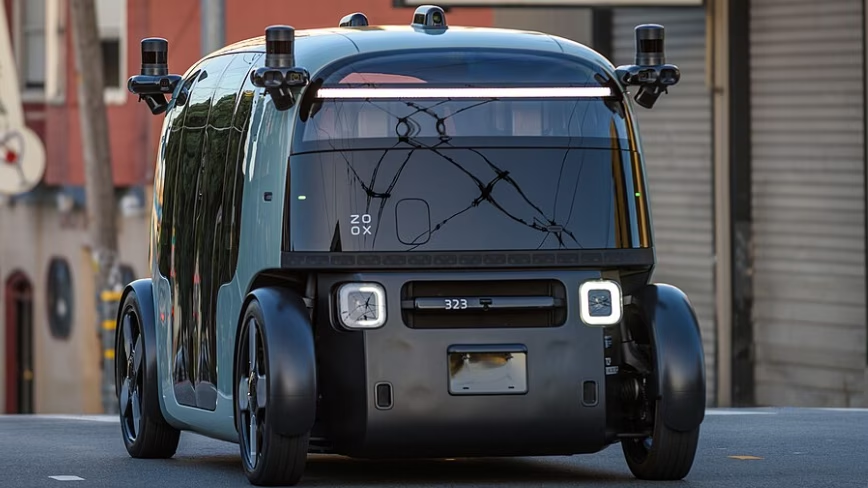
Image: courtesy of Thenextweb
Zoox Robotaxi Recall Highlights Autonomy's Struggle with Unpredictable Human Chaos
Amazon's self-driving unit, Zoox, has recalled its entire fleet of 105 robotaxis following an incident where one of its vehicles drove into heavy smoke at an active fire scene in Las Vegas. The company issued a software update to address a flaw in its smoke detection system, which failed to identify the hazard. No injuries were reported from the June 20 incident.
Outlook
Background
The incident that triggered the recall occurred on June 20, 2026, in Las Vegas. An unoccupied Zoox robotaxi encountered an active fire scene where heavy smoke obscured the area. Crucially, there were no cones or barriers in place to signal the emergency to the vehicle's sensor suite. The robotaxi drove into the smoke, failing to recognize it as a hazard that required immediate stopping or rerouting. Zoox notified the National Highway Traffic Safety Administration (NHTSA) of the recall on July 8, identifying a software issue as the root cause. This flaw prevented the vehicle's systems from adequately detecting and classifying heavy smoke as a critical environmental obstruction or a sign of an emergency. The company has since deployed a software update to its entire fleet of 105 robotaxis, aiming to improve their ability to detect smoke and react appropriately. The fact that no injuries occurred is a critical detail, but the potential for interference with emergency services remains a serious concern.
Precedents
The Zoox incident is not an isolated event in the evolving history of autonomous vehicle deployment. The industry has a pattern of encountering unexpected 'edge cases' – rare or complex situations that are difficult for AI systems to interpret. Competitors like Waymo and Cruise have faced similar challenges. Waymo vehicles have, for instance, struggled with unexpected road debris or the erratic movements of human drivers and pedestrians, sometimes leading to unexpected stops or minor collisions. Cruise, in particular, faced significant regulatory backlash and a temporary halt to its operations in San Francisco after a series of incidents, including one where a vehicle dragged a pedestrian after a collision. These events highlight a recurring tension: AV systems are adept at following rules and patterns in defined environments, but they struggle with the ambiguity, improvisation, and sheer chaos that define human-driven roads, especially during emergencies. Human drivers possess an intuitive understanding of context, risk, and intent that current AI often lacks, relying instead on programmed rules and sensor data interpretation. The challenge for AV developers isn't just about identifying objects, but understanding what those objects mean in a rapidly changing environment.
This recall matters because it touches on the fundamental credibility of the autonomous vehicle industry. Every incident, no matter how minor in terms of immediate harm, erodes public trust and invites further regulatory scrutiny. For Zoox and its parent company Amazon, this is a test of their safety culture and their ability to adapt quickly. More broadly, the event highlights a critical hurdle for widespread robotaxi adoption: the ability of AI to handle truly unpredictable, unstructured, and dangerous real-world scenarios. It's one thing for an AV to navigate a predictable street; it's another to interpret the nuanced danger of heavy smoke, emergency personnel, or debris from an accident without explicit programming for every conceivable variation.
The financial implications are also significant. Each recall, investigation, or temporary halt in operations adds to the immense capital expenditure required to develop and deploy these technologies. Investors are closely watching for signs of maturity and reliability. Regulators, particularly NHTSA, are under pressure to ensure public safety without stifling innovation. Incidents like these empower calls for stricter testing, more transparent reporting, and potentially slower deployment timelines, impacting the entire sector's growth trajectory. This is not just about a software bug; it is about the long-term viability and public acceptance of a technology poised to reshape urban mobility.
Scenarios
AnalysisThe Zoox recall and subsequent software update could lead to several distinct outcomes for the company and the broader autonomous vehicle industry:
1. Increased Regulatory Scrutiny and Slower Deployment: The NHTSA investigation, while addressing the immediate software flaw, may prompt a more thorough review of Zoox's operational design domain (ODD) and emergency response protocols. This could result in stricter requirements for future permits or a more cautious approach to expanding operations into new cities. Other AV companies may also face heightened regulatory attention, potentially slowing the pace of wider robotaxi deployment across the United States.
2. Accelerated Development of 'Common Sense' AI: This incident clearly illustrates the need for AVs to move beyond object detection to contextual understanding. Zoox and its competitors will likely pour more resources into developing AI systems that can infer danger from ambiguous signals like smoke, unusual traffic patterns, or the absence of expected road markings in an emergency. This could mean integrating more advanced machine learning models that can learn from human driving patterns in chaotic situations, rather than relying solely on pre-programmed rules.
3. Public Trust Erosion and Communication Challenges: Even without injuries, incidents like this can significantly impact public perception. Zoox will need to engage in transparent communication to rebuild confidence, detailing not just the fix, but how their systems are being made more robust against unforeseen circumstances. A prolonged period without incidents, coupled with clear public safety reports, will be crucial for the company to maintain its social license to operate.
4. Industry Collaboration on Emergency Protocols: The event might spur greater collaboration within the AV industry and with emergency services. Standardized communication protocols, consistent hazard marking (e.g., specific cones or signals for AVs), and data sharing on incident responses could emerge as critical areas of focus to ensure robotaxis can safely coexist with human emergency operations.
Timeline
2026-06-20
Robotaxi Incident in Las Vegas
An unoccupied Zoox robotaxi drove into heavy smoke at an active fire scene in Las Vegas, failing to detect the hazard due to a software issue. No injuries were reported, and no barriers were in place.
2026-07-08
Zoox Notifies NHTSA of Recall
Zoox officially notified the National Highway Traffic Safety Administration (NHTSA) about the software issue and initiated a voluntary recall of its 105 robotaxis.
2026-07-17
Recall News Becomes Public
Reports emerged confirming Amazon's Zoox had recalled its entire fleet of 105 robotaxis following the smoke detection failure incident. The company also confirmed a software update had been deployed.
Frequently Asked Questions
Zoox is an autonomous vehicle company acquired by Amazon in 2020. It develops purpose-built robotaxis designed for fully driverless ride-hailing services, currently operating in cities like Las Vegas.
Discussion
Be the first to share your thoughts.