
The immediate focus for Xiaomi is on whether it can meet its aggressive 2026 delivery target of 550,000 total electric vehicles. This will depend heavily on the performance of its newer models, the SU7 Ultra and the YU7 SUV, which are expected to compensate for the slowdown in the core SU7 sedan sales. The company is likely to continue its strategy of leveraging its consumer electronics brand recognition and supply chain expertise to offer competitive pricing and features. Analysts will be closely watching Xiaomi's profit margins in its EV division, as expanding a product line and engaging in price wars typically strains profitability, especially for a newcomer.
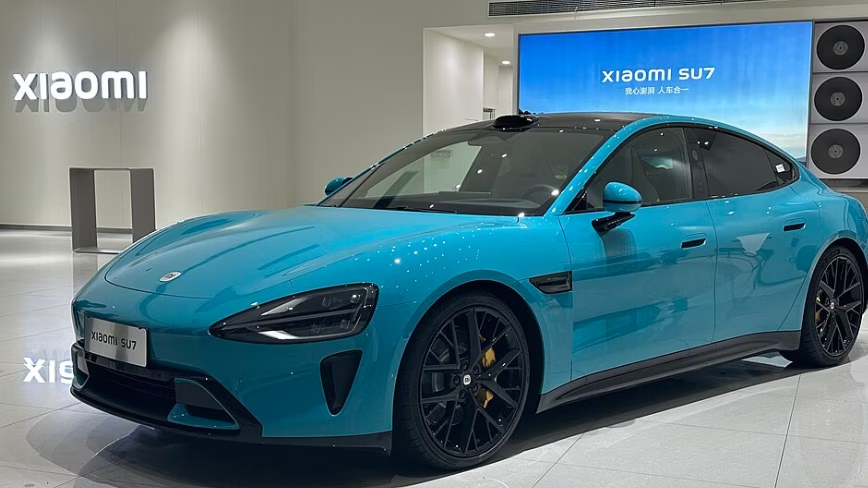
Image: courtesy of Thenextweb
Xiaomi's EV Ambitions Tested: What 500,000 SU7 Deliveries Really Say About Its Future
Xiaomi, the consumer electronics giant, has confirmed that its first electric vehicle, the SU7 sedan, surpassed half a million deliveries by mid-2026, just 28.5 months after its launch. This rapid ascent into the highly competitive automotive sector marks a significant milestone for the company's diversification strategy. However, the achievement comes alongside mixed signals: while overall Xiaomi EV deliveries rose 15% in 2026, sales of the SU7 model itself saw a notable decline of 43.6% during the same year. The company is now pursuing an ambitious target of 550,000 total EV deliveries for 2026, relying on a broader portfolio that includes the SU7 Ultra and YU7 SUV to offset the flagship sedan's cooling demand.
Outlook
Background
Xiaomi officially declared its intent to enter the electric vehicle market on March 30, 2021. The speed with which it moved from concept to production has been a defining characteristic of its automotive venture. The sleek SU7 electric sedan, its inaugural model, was formally launched on March 28, 2024, with customer deliveries beginning just days later on April 3, 2024.
By February 2026, Xiaomi had already reached a milestone of 600,000 total EV deliveries across its nascent vehicle division, within 22 months of the SU7's debut. This figure included the initial SU7 production as well as other models like the SU7 Ultra and the YU7 SUV, which were introduced to broaden the company's market appeal. The first-generation SU7 sedan concluded its production in February 2026 after delivering over 381,000 units. A refreshed version of the SU7, featuring a higher starting price and LiDAR as standard, launched in April 2026, quickly securing 15,000 orders in its first 34 minutes and exceeding 80,000 by early May 2026.
Despite the success of new model introductions and an overall 15% rise in its EV division's deliveries in 2026, the SU7 model experienced a 43.6% decline in sales during the same year. This indicates a shift in market dynamics or consumer preference within Xiaomi's own product line, possibly influenced by the refreshed model launch or the availability of the SUV. The company's cumulative SU7 deliveries, encompassing both original and refreshed versions, officially surpassed 500,000 units in July or August 2026, approximately 28.5 months after the model's initial market entry. Xiaomi has set an aggressive target of 550,000 total vehicle deliveries by the end of 2026.
See also
Precedents
The transition of major tech companies into the automotive sector is a recurring theme, often driven by the convergence of software, hardware, and connectivity. Companies like Apple have explored EV ventures for years, while Huawei has partnered extensively with traditional automakers. What distinguishes Xiaomi's approach is its full-scale, direct entry into manufacturing and sales, rather than solely focusing on software or component supply.
Historically, the automotive industry has proven to be a formidable barrier for new entrants, demanding immense capital, complex supply chains, stringent regulatory compliance, and extensive after-sales service networks. Tesla's success in disrupting this space set a precedent, but many other startups have struggled. China's EV market, in particular, is characterised by intense competition, frequent price wars, and rapidly evolving consumer preferences. New players often achieve initial sales momentum through novelty and aggressive pricing, but sustaining growth and profitability in the long term requires robust product pipelines, efficient manufacturing, and brand loyalty, elements that take years to build.
Xiaomi's strategy of leveraging its existing brand recognition and fan base from consumer electronics mirrors a pattern seen with other Chinese tech giants expanding into new hardware categories. However, the lifecycle and customer expectations for a vehicle are vastly different from those for a smartphone, requiring a deeper institutional commitment and a different kind of operational excellence.
Xiaomi's journey into electric vehicles represents more than just a product diversification; it is a high-stakes test of whether a consumer electronics brand can successfully transplant its operational model into the notoriously complex and capital-intensive automotive industry. Reaching half a million SU7 deliveries in under two and a half years is a significant validation of its initial market entry and product appeal, proving that the company can design, manufacture, and sell cars at scale.
However, the simultaneous decline in SU7 sales during 2026, even as overall EV deliveries grew, highlights the inherent challenges of managing product lifecycles and market demand in a competitive environment. This indicates that initial hype and novelty can fade, forcing a brand to rely on a broader portfolio and continuous innovation. For investors, Xiaomi's EV venture carries substantial financial implications, impacting its overall revenue and profitability as it allocates significant resources to this new division. For the broader automotive industry, Xiaomi's performance is a case study in how a tech-native company attempts to disrupt established norms, potentially influencing other tech firms considering similar pivots and intensifying competition in key markets like China.
Scenarios
Analysis1. Sustained Growth Through Diversification: Xiaomi could successfully leverage its expanded EV portfolio, including the SU7 Ultra and YU7 SUV, to meet or even exceed its 2026 delivery target of 550,000 vehicles. This outcome would solidify its position as a credible, large-scale player in the EV market, proving its ability to manage multiple product lines and adapt to shifting consumer demands. Success here could lead to further investment in R&D, potentially accelerating its global expansion plans beyond China and challenging traditional automakers more directly.
2. Profitability Pressures Amidst Sales Volatility: The decline in SU7 sales, despite the launch of a refreshed model, suggests that maintaining momentum for individual models will be difficult. While overall deliveries may grow, intense competition and ongoing price wars in China's EV market could severely compress Xiaomi's profit margins. This scenario might force the company to re-evaluate its pricing strategies, scale back some of its aggressive expansion plans, or seek external partnerships to share the financial burden and technical expertise required to sustain an automotive division. It could also lead to a slower-than-anticipated path to profitability for its EV business, impacting investor confidence.
3. Market Share Consolidation Through Aggressive Pricing: Faced with a declining flagship model and fierce competition, Xiaomi might intensify its pricing strategies, potentially initiating or participating in further price wars to gain market share. While this could boost delivery numbers in the short term, it risks further eroding profitability and could trigger a reactive cycle among competitors. This approach could lead to a more consolidated market in China, where only manufacturers with deep pockets and extreme efficiency can survive, but it would come at a significant cost to all players involved.
Timeline
2021-03-30
Xiaomi Announces EV Intentions
Xiaomi formally declared its intention to enter the electric vehicle manufacturing sector.
2024-03-28
SU7 Sedan Launch
The Xiaomi SU7 electric sedan, the company's first EV model, was officially launched.
2024-04-03
First SU7 Deliveries Begin
Customer deliveries for the Xiaomi SU7 electric sedan commenced shortly after its launch.
2025-12-01
Record Monthly Deliveries (2025)
Xiaomi's EV division recorded over 50,000 deliveries in December 2025, marking its highest single-month volume to date.
2026-02-01
600,000 Total EV Deliveries Milestone
Xiaomi reached 600,000 total EV deliveries across its vehicle division within 22 months of the SU7's launch, including SU7 Ultra and YU7 SUV models.
2026-02-01
First-Gen SU7 Production Ends
Production of the first-generation Xiaomi SU7 sedan concluded after more than 381,000 deliveries.
2026-04-01
Refreshed SU7 Model Launched
Xiaomi introduced a refreshed version of the SU7, featuring LiDAR as standard and a slightly higher starting price.
2026-05-01
Refreshed SU7 Orders Exceed 80,000
Orders for the refreshed SU7 model surpassed 80,000 units by early May, following strong initial demand.
2026-08-01
SU7 Crosses 500,000 Deliveries
The Xiaomi SU7, encompassing both original and refreshed models, surpassed 500,000 cumulative deliveries approximately 28.5 months after its initial launch.
Frequently Asked Questions
The Xiaomi SU7 is the first electric vehicle model produced by the Chinese consumer electronics company Xiaomi. It is a sleek electric sedan designed to compete in the premium EV market, leveraging Xiaomi's brand recognition and technological expertise.
Discussion
Be the first to share your thoughts.