
The loss of the Twitter bird logo trademark for X, and the subsequent launch of 'Twitter.now,' signals a significant realignment in the social media landscape. Users and advertisers, long accustomed to the Twitter brand, will now confront two distinct platforms: the re-engineered X, and a new entity attempting to reclaim the original brand's legacy. This situation is likely to intensify competition for user attention and advertising revenue, forcing both platforms to articulate clear value propositions. For X, it means a complete break from the visual and nominal history of Twitter, potentially accelerating its pivot towards an 'everything app' vision. For 'Twitter.now,' the challenge will be to translate brand recognition into active user engagement and sustainable growth, while differentiating itself from X's established user base and features. The legal precedent set by the abandonment ruling could also prompt other companies considering radical rebrands to reassess their trademark strategies.
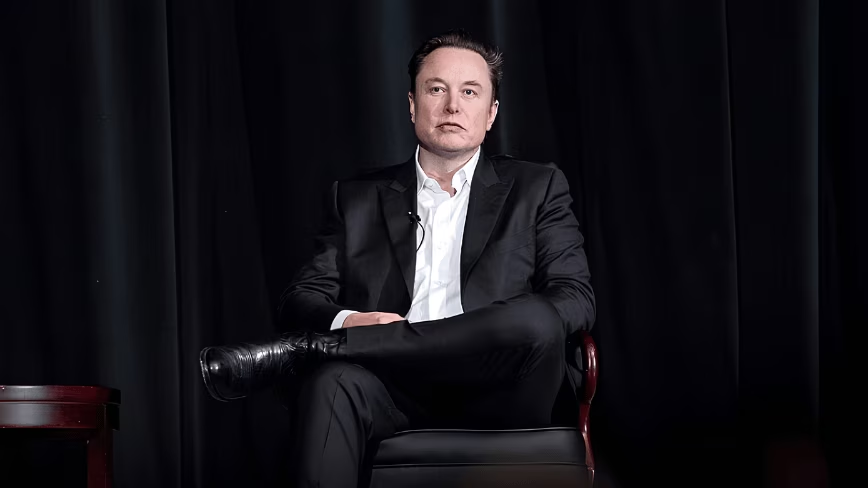
Image: courtesy of Thenextweb
Elon Musk's 'Blowtorch' Post: How X Lost the Twitter Bird Trademark and Paved the Way for 'Twitter.now'
Elon Musk's company, X, has officially lost the trademark rights to the iconic Twitter bird logo, a decision handed down by a judge in 2026. The ruling cited X's abandonment of its rights, with Musk's public statements and actions, including a memorable 'blow torch' post, playing a critical role in demonstrating an intent to discard the brand. This legal defeat has cleared the path for a new platform, 'Twitter.now,' to launch under the original, now unencumbered, brand identity. The outcome highlights the complex interplay between a CEO's public persona, brand strategy, and the stringent requirements of trademark law, particularly the Lanham Act's emphasis on active use.
Outlook
Background
The saga began in 2023 when Elon Musk, then owner of Twitter, initiated a dramatic rebranding, changing the platform's name to 'X' and replacing its world-renowned blue bird logo with an 'X' symbol. This move was part of Musk's broader vision to transform the social media platform into an 'everything app.' While the company retained the Twitter.com domain and initially faced legal challenges over the 'X' name, the core of the rebranding — the removal of the bird logo — was a central element.
Critically, despite the public rebrand, X never formally withdrew the trademark applications it had inherited for the 'TWITTER FLIGHT' marks, which were granted in August 2023, and the 'TWEET' mark, granted on April 30, 2024. These grants occurred months after Musk publicly announced the brand's overhaul. However, under the Lanham Act, a fundamental principle of trademark law in the United States, mere registration is not sufficient to maintain a trademark; continuous and active 'use in commerce' is required to keep a mark alive.
The judge's ruling in 2026, which stripped X of the bird logo trademark, hinged on this principle of abandonment. Evidence presented during the proceedings included a specific 'blow torch' post by Musk, which was interpreted as a clear and public declaration of intent to destroy and move away from the old Twitter brand identity. This, combined with limited evidence of continued use of the bird logo or 'tweet' mark (only 12 web pages were cited as evidence, with 4 of them containing neither mark), led the court to conclude that X had abandoned its rights. The immediate consequence was the launch of 'Twitter.now,' a new platform now legally entitled to operate under the original Twitter brand identity.
Precedents
The history of corporate rebranding is replete with examples of both success and failure, often demonstrating the profound value, or fragility, of established brand equity. Companies like Apple, which successfully transitioned from 'Apple Computer, Inc.' to simply 'Apple Inc.' to reflect its broader product range, illustrate effective brand evolution. Conversely, moves like 'New Coke' in 1985 show how deeply ingrained consumer attachment to a brand can be, leading to swift backlash and a return to the original.
More recently, dramatic rebrands in the tech sector have met mixed receptions. Facebook's shift to 'Meta' aimed to signal a pivot towards the metaverse but has struggled to fully resonate with the public, often still being referred to by its original product names. The key differentiator in the X/Twitter situation is not merely a name change but the legal abandonment of a core visual identifier. While companies often acquire and sunset brands, the public nature of Twitter's rebrand, driven by a highly visible CEO, created a unique legal vulnerability.
This outcome also echoes earlier disputes over abandoned brand elements. In the past, when companies have ceased using a particular logo or name, others have stepped in to claim those rights, sometimes leading to new ventures capitalizing on residual brand recognition. The challenge for these new entrants, like 'Twitter.now,' is to capture not just the name but the essence and community that made the original brand successful, a task that historical precedent suggests is far from guaranteed.
The loss of the Twitter bird logo trademark by X, and the emergence of 'Twitter.now,' holds significant implications across several dimensions. For X, it represents a definitive severing of its last tangible link to the global brand recognition of Twitter. While Elon Musk's vision for X has always aimed for a radical departure, the legal inability to prevent others from using the 'Twitter' identity could dilute its perceived uniqueness and create a direct competitor leveraging decades of established brand equity. This makes X's task of building a new, distinct identity and 'everything app' ecosystem even more challenging, as it will now operate alongside a platform actively invoking its past.
For the newly launched 'Twitter.now,' this ruling provides an extraordinary opportunity. It gains the ability to use a name and associated imagery that are instantly recognizable to billions worldwide, without the burden of building brand awareness from scratch. This could allow it to attract users and advertisers who were alienated by X's changes or who simply prefer the familiar 'Twitter' experience. However, it also faces the immense task of rebuilding trust, features, and a community that has significantly evolved since the original Twitter.
More broadly, the case serves as a stark reminder for corporate leaders and brand strategists about the critical importance of intellectual property management, especially during periods of radical transformation. A CEO's public pronouncements, even those intended to signal a decisive break, can have unintended legal consequences, particularly under trademark laws designed to protect consumers from confusion and ensure active brand use. It underscores that brand equity is not just a marketing asset but a legal one, whose maintenance requires careful consideration of both public perception and statutory requirements.
Scenarios
Analysis1. Increased Competition and User Fragmentation: The social media landscape could become more fragmented. 'Twitter.now' may attract users and advertisers nostalgic for the original platform or dissatisfied with X's current direction. This could lead to a split in the user base, forcing X to double down on its 'everything app' strategy to retain and grow its audience. The success of 'Twitter.now' will depend on its ability to replicate or improve upon the core functionalities that defined Twitter.
2. Legal Battles Over Brand Confusion: While 'Twitter.now' has secured the bird logo trademark, future disputes over potential brand confusion could arise. X may argue that 'Twitter.now' is attempting to mislead users into believing it is the original platform, leading to further legal skirmishes over user acquisition tactics, advertising claims, or even app store listings. This could force both entities to spend significant resources on legal defense and brand differentiation.
3. X Accelerates its 'Everything App' Pivot: Facing direct competition under its former name, X may intensify its efforts to transform into a multi-faceted platform beyond social media. This could involve faster integration of payments, e-commerce, or other services, aiming to create a distinct ecosystem that offers more than what a 'Twitter.now' could provide. The pressure to differentiate will be immense, potentially driving innovation or leading to a less focused product.
4. A Test Case for Trademark Abandonment: This ruling could become a significant precedent for trademark law, particularly concerning high-profile rebrands and the impact of a CEO's public statements. Other companies considering drastic brand changes may implement more rigorous internal processes to formally abandon old marks or ensure continued nominal use to avoid similar legal vulnerabilities. The case highlights the fine line between strategic rebranding and legal abandonment.
Timeline
Frequently Asked Questions
Discussion
Be the first to share your thoughts.