
Walden Robotics is expected to scale its deployment beyond Toyota's initial plant, targeting broader manufacturing and logistics sectors. The significant capital infusion and high valuation position the company to rapidly develop and refine its AI models and hardware. We can anticipate an increased focus on demonstrating the robots' adaptability across various factory layouts and task requirements, proving the efficiency and safety benefits of their legless design. The involvement of major investors like Nvidia and Boeing suggests a strategic interest in applying this technology to diverse industrial challenges, potentially leading to partnerships that extend Walden's reach into new verticals. The company will likely face pressure to show a clear return on investment for its early adopters, which could involve detailed case studies on improved throughput, reduced operational costs, and enhanced worker safety.
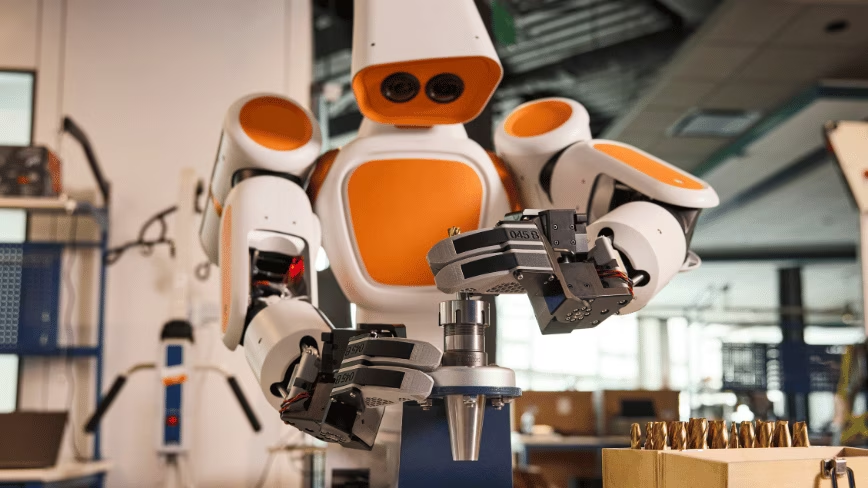
Image: courtesy of Thenextweb
Walden Robotics Secures $300 Million for Legless Factory Humanoids: A Pragmatic Shift in Industrial Automation
Walden Robotics, a spin-off from Toyota, has emerged from stealth with $300 million in funding and a $1.1 billion valuation. The company is deploying general-purpose AI robots designed for factory environments, notably without legs. Instead, these robots utilize a wheeled base, performing tasks such as handling car parts, cleaning machinery, and preparing components within Toyota's production facilities. This design choice represents a deliberate move towards practicality and safety in busy industrial settings.
Outlook
Background
Walden Robotics formally launched on July 15, 2026, announcing it had secured $300 million in seed funding, pushing its valuation to $1.1 billion and immediately earning it 'unicorn' status. The funding round was co-led by a consortium of Toyota entities, including Toyota Motor Corp., Toyota Invention Partners, and Toyota Ventures, alongside Deviation Capital. Other notable investors include Nvidia, Boeing, and AE Ventures.
The company spun out of the Toyota Research Institute, leveraging foundational work by MIT professor Russ Tedrake, who is also a co-founder. Tedrake, despite having taught courses on robotic legs, opted for a wheeled design for Walden's industrial robots. These machines feature an upper body with arms and a head equipped with sensors, mounted on a mobile, wheeled base.
Walden Robotics has confirmed its systems are already operational within a Toyota production facility. Here, they are performing a range of tasks vital to manufacturing, including transporting car parts, cleaning machinery, assembling kits, tending to machines, setting tools, and preparing parts. The company emphasizes the robots' 'general-purpose' nature, meaning their AI allows them to adapt to changing tasks throughout the day in dynamic factory environments. This initial deployment provides a crucial real-world testing ground for their technology.
Precedents
The history of industrial automation is largely a story of purpose-built, often stationary, robotic arms and guided vehicles. Early factory robots, introduced in the 1960s, were typically fixed to the floor, performing repetitive tasks like welding or painting with high precision. Mobile robotics, while not new, often manifested as Automated Guided Vehicles (AGVs) or, more recently, Autonomous Mobile Robots (AMRs) that transport materials along predefined paths or within mapped areas. These systems prioritize stability, payload capacity, and efficient movement over varied terrain.
The concept of 'humanoid' robotics, popularized by companies like Boston Dynamics, has largely focused on bipedal or quadrupedal designs, aiming for robots that can navigate complex, human-centric environments. These robots are engineered to mimic human locomotion, often with the implicit goal of operating in spaces designed for people, including stairs and uneven terrain. However, the complexity, energy consumption, and cost associated with dynamic bipedal balance have historically limited their widespread industrial deployment, especially for continuous, heavy-duty factory work.
Walden Robotics' approach appears to draw from both these legacies. It integrates advanced AI, often associated with more complex humanoid research, into a pragmatic, wheeled mobile platform. This echoes a pattern seen in other successful industrial robotics firms like Locus Robotics or Fetch Robotics, which focused on wheeled solutions for warehouse logistics. The decision to forgo legs for industrial applications suggests a recognition of the specific demands of factory floors, where smooth, predictable movement and stability often trump the need for bipedal dexterity.
Walden Robotics' launch, particularly its unconventional decision to build 'humanoids' without legs for factories, represents a significant inflection point for the industrial robotics sector. The substantial $300 million funding and $1.1 billion valuation signal strong investor confidence not just in the company, but in a specific vision for factory automation.
First, it challenges the prevailing narrative that the future of general-purpose robotics, even in industrial settings, must inherently involve bipedal locomotion. While legged robots excel in unstructured environments or over varied terrain, factory floors are often flat, controlled spaces. Walden's approach suggests that for these environments, the complexity and energy demands of legs are an unnecessary overhead, perhaps even a liability. By prioritizing wheels, they are likely aiming for greater stability, payload capacity, energy efficiency, and potentially lower manufacturing and maintenance costs, which are critical factors for industrial adoption.
Second, the 'general-purpose' AI aspect is crucial. Traditional industrial robots are often programmed for a single, repetitive task. Walden's robots, by contrast, are designed to adapt to changing tasks throughout a day, which could unlock unprecedented flexibility in manufacturing lines. This capability addresses a key pain point for factories that need to rapidly reconfigure for new products or fluctuating demand, moving beyond rigid, single-function automation.
Finally, the spin-off from Toyota and its subsequent investment lends immense credibility. Toyota is a global leader in manufacturing efficiency and has a deep understanding of factory operations. Their backing suggests that Walden's approach aligns with a practical, scalable solution to long-standing challenges in production and logistics, potentially reshaping how other manufacturers view their automation strategies and capital allocation.
Scenarios
AnalysisThe trajectory of Walden Robotics and its impact on the industrial sector could unfold in several distinct ways:
One potential outcome is that Walden Robotics establishes itself as a dominant player in a new segment of industrial automation. If its wheeled, general-purpose robots can consistently demonstrate superior cost-effectiveness, adaptability, and safety compared to both traditional fixed automation and more complex legged humanoids, other manufacturers will likely follow suit. This could lead to a rapid shift in factory design and workflow, with more companies adopting flexible, mobile AI-driven systems for a wider array of tasks. The early deployment at Toyota provides a strong proof point, and if successful, could trigger a wave of wider industry adoption and partnerships.
Alternatively, Walden's legless design, while pragmatic for current factory floors, may face limitations as industrial environments evolve. If future factories incorporate more varied terrain, stairs, or highly unstructured spaces, the lack of bipedal capability could become a constraint. In this scenario, Walden might need to diversify its product line to include legged variants or focus on niche applications where its current design is optimal, potentially ceding market share in more complex environments to competitors developing advanced legged or hybrid solutions. The company's AI capabilities would still be valuable, but its hardware platform might need significant adaptation.
A third possibility involves a competitive response from existing robotics giants and other AI startups. The success of Walden's model could prompt established industrial automation companies to accelerate their own development of AI-powered, wheeled general-purpose robots. This could lead to a crowded market where Walden, despite its early lead and significant funding, faces intense competition on features, price, and ecosystem integration. Smaller, nimbler startups might also emerge with similar pragmatic designs, potentially driving down margins and accelerating innovation across the board, but making it harder for any single player to achieve market dominance.
Finally, the integration of Walden's robots could have a notable impact on the labor market within manufacturing. If these robots prove highly effective at tasks traditionally performed by humans, it could lead to shifts in workforce requirements, emphasizing roles that involve supervising, maintaining, and programming robots, rather than performing repetitive manual labor. This would necessitate new training programs and a re-evaluation of human-robot collaboration models within factories.
Timeline
Frequently Asked Questions
Discussion
Be the first to share your thoughts.