
The audacious marketing stunt, combined with competitive pricing and advanced technology, positions Voyah as a potent challenger in the global electric vehicle market. This move suggests an intent to directly compete with established luxury brands, not just on price, but on engineering prowess and brand perception. Expect increased attention on Voyah's performance in China and its planned expansion into Europe, where it will test the waters against deeply entrenched European automakers.
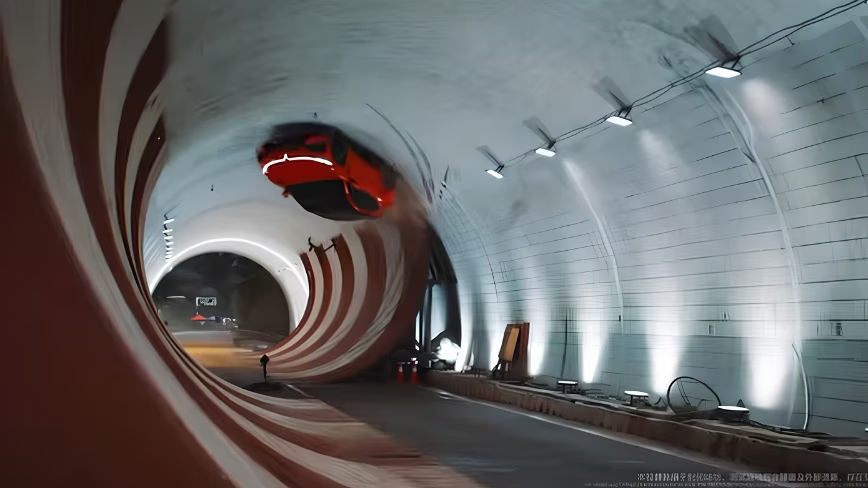
Image: courtesy of Thenextweb
Beyond the Stunt: What Voyah's $33,800 EV and Daring Ad Say About China's Global Car Ambitions
Chinese electric vehicle maker Voyah has launched its new Passion S electric SUV in China, priced from approximately $33,800. The launch follows a high-profile marketing stunt where the company recreated Mercedes-Benz's famous upside-down tunnel advertisement, completing a full 360-degree loop with a production vehicle. Voyah released uncut footage to counter skepticism, marking a bold statement about its engineering capabilities and challenging perceptions of Chinese automotive innovation. The Passion S also features an 800V electrical architecture and Huawei's latest lidar system, signaling advanced technology. Stellantis has also confirmed plans to bring the Voyah brand to Europe, suggesting a broader international push.
Outlook
Background
The Voyah Passion S, a mid-to-large pure electric FUV (presumably 'Family Utility Vehicle' or similar, given the context), officially launched in China with three trim levels ranging from 229,900 yuan ($33,800 USD) to 279,900 yuan ($41,200 USD). This pricing is significantly lower than many comparable electric SUVs from Western brands. Central to its market introduction was a highly publicized event where a production version of the Passion S successfully completed a 360-degree tunnel loop at a closed test facility in Wuhan, China.
The stunt was a direct homage to a controversial 2010 Mercedes-Benz SLS AMG advertisement, which featured Formula 1 driver Michael Schumacher supposedly driving upside down in a tunnel. That original Mercedes ad faced considerable skepticism, with many viewers believing it was computer-generated or performed by a stunt double rather than Schumacher himself, leading to a re-release with altered footage. Voyah, aware of this historical context, took the unusual step of releasing uncut video of its own stunt to explicitly prove its authenticity and showcase the vehicle's capabilities.
Beyond the marketing spectacle, the Passion S boasts significant technical specifications. It is built on an 800-volt (800V) electrical platform, which allows for faster charging times and more efficient power delivery compared to the more common 400V systems. The vehicle also integrates Huawei's latest lidar system, a sophisticated sensor technology that uses pulsed laser light to measure distances and create detailed 3D maps of the surrounding environment, crucial for advanced driver-assistance systems (ADAS) and future autonomous driving features.
Precedents
For decades, Chinese automotive manufacturers were often perceived as producers of less expensive, sometimes derivative, vehicles. The narrative frequently centered on reverse-engineering or direct copying of foreign designs and technologies, rather than groundbreaking innovation. However, this perception has been undergoing a rapid transformation, particularly within the electric vehicle segment. Chinese companies like BYD, Nio, Xpeng, and now Voyah, have invested heavily in research and development, pushing boundaries in battery technology, software integration, and advanced manufacturing processes.
This shift challenges the traditional hierarchy where Western and Japanese brands were seen as the sole arbiters of automotive excellence. The Voyah stunt, in particular, taps into a historical marketing moment from a venerable German luxury brand, but with a critical difference: Voyah sought to unequivocally prove its feat. This approach reflects a broader strategic pivot by Chinese brands to not only innovate but to aggressively demonstrate their engineering credibility on the global stage, directly confronting lingering doubts about their capabilities. The move from perceived imitators to credible innovators, backed by tangible feats and competitive technology, is a pattern now firmly established in the Chinese EV industry.
Voyah's launch of the Passion S and its accompanying stunt is more than just a marketing event; it represents a significant challenge to the established order of the global automotive industry. First, it directly confronts the long-held perception that Chinese vehicles lack the engineering sophistication or quality of their Western counterparts. By replicating and then proving a stunt that Mercedes-Benz struggled to authenticate, Voyah makes a powerful statement about its technical prowess and confidence. This move could accelerate a broader re-evaluation of 'Made in China' in the high-tech automotive sector.
Second, the combination of an 800V platform, Huawei lidar, and a starting price of $33,800 sets a new benchmark for value in the electric SUV market. This aggressive pricing for advanced technology will put considerable pressure on rival automakers, particularly in Europe, where Voyah is set to expand through its partnership with Stellantis. Traditional manufacturers may find themselves forced to either reduce prices, enhance their own technology offerings, or risk losing market share to these increasingly capable and cost-effective Chinese alternatives.
Finally, this move signals a more assertive global strategy from Chinese brands. It is not just about selling cars, but about building brand equity and challenging the cultural dominance of legacy automakers. The successful execution and transparent proof of such a complex stunt is designed to resonate with a global audience, reshaping expectations and potentially paving the way for wider acceptance of Chinese EVs in discerning markets.
Scenarios
AnalysisThe bold introduction of the Voyah Passion S and its attention-grabbing stunt could lead to several distinct outcomes in the global automotive market.
One likely scenario is that Voyah successfully leverages this high-profile demonstration of engineering capability and competitive pricing to gain significant traction, both in its domestic Chinese market and as it expands into Europe. The transparency around the stunt, combined with features like the 800V platform and Huawei lidar, could resonate with consumers looking for advanced technology at a more accessible price point. This could establish Voyah as a serious contender against luxury EV brands, forcing them to re-evaluate their own product and pricing strategies.
Alternatively, while the stunt generates initial buzz, it may struggle to translate into sustained sales or a substantial shift in brand perception, particularly in more mature European markets. Consumer loyalty to established brands, concerns about long-term service infrastructure, or geopolitical factors could limit its impact. In this outcome, the stunt becomes a memorable marketing moment but does not fundamentally alter the competitive landscape in the long run.
A third possibility is that Voyah's aggressive market entry, particularly with its advanced tech and transparent marketing, forces a faster pace of innovation and price competition across the entire EV industry. Other automakers, seeing the viability of high-tech features at lower price points, may accelerate their own R&D and manufacturing efficiencies to compete. This could ultimately benefit consumers through more affordable and technologically advanced electric vehicles, even if Voyah itself doesn't become a market leader.
Timeline
2010
Mercedes-Benz SLS AMG Tunnel Advertisement
Mercedes-Benz releases its now-famous advertisement featuring Michael Schumacher supposedly driving an SLS AMG upside down in a tunnel, generating both awe and controversy over its authenticity.
2026-08-13
Voyah Passion S Tunnel Loop Stunt Announced
Voyah announces the successful completion of a 360-degree tunnel loop stunt with a production version of its Passion S electric SUV at a closed test facility in Wuhan, China. The company later releases uncut footage to verify the feat.
2026-08-15
Voyah Passion S Official Launch in China
Voyah officially launches the Passion S electric SUV in China, with prices ranging from approximately $33,800 to $41,200. The vehicle features an 800V platform and Huawei's latest lidar system.
Frequently Asked Questions
Voyah is a premium electric vehicle brand owned by Dongfeng Motor Corporation, one of China's largest state-owned automakers. It focuses on producing high-end electric cars, SUVs, and MPVs, aiming to compete with established luxury brands.
Discussion
Be the first to share your thoughts.