
The deployment of Volvo's enhanced connected safety features marks a notable step toward a more integrated and proactive approach to road safety. Drivers of eligible Volvo EV models can expect to receive these new warnings through their vehicle's infotainment system, offering an earlier heads-up on potential dangers that traditional line-of-sight driving might miss. The system's reliance on data from other vehicles suggests that its effectiveness will grow as more connected cars join the network and contribute real-time hazard information. Beyond the individual driver, this initiative points to a future where vehicles from different brands could communicate seamlessly, creating a collective intelligence network for road conditions and hazards across Europe.
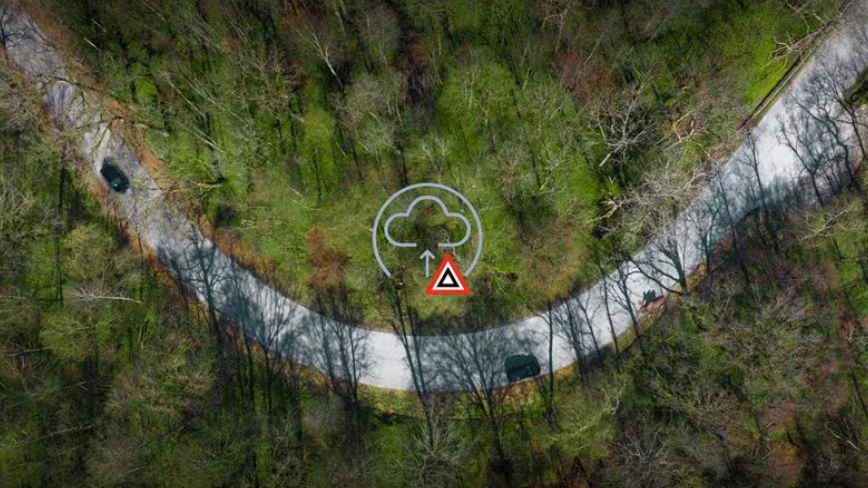
Image: courtesy of Thenextweb
Volvo's Connected Safety System: How Shared Data Is Redefining Road Hazard Warnings
Volvo has rolled out a significant over-the-air software update for its latest electric vehicle models, the EX60, EX90, and ES90. This update introduces advanced hazard alerts that can warn drivers about dangers, such as deer around a blind corner, before they are visible. The system works by collecting and sharing real-time data from connected Volvo cars, expanding its reach to include warnings for large animals, vulnerable road users like pedestrians and cyclists, upcoming roadworks, and recent accidents. Crucially, this technology is designed to integrate with the broader European Data for Road Safety ecosystem, allowing warnings to be shared not just between Volvo vehicles, but potentially with cars from other manufacturers and national traffic management centers, building on a connected safety infrastructure Volvo first established in 2016.
Outlook
Background
The core of Volvo’s new safety update lies in its cloud-connected hazard warning system, which leverages real-time data to provide predictive alerts. This is not a new concept for Volvo; the company first introduced its connected safety technology in 2016, allowing vehicles to share information about slippery road conditions and hazard lights being activated. The latest update significantly broadens the scope of these warnings, adding categories like large animals, pedestrians, cyclists, roadworks, and accidents.
What sets this expansion apart is its integration with the European Data for Road Safety ecosystem. This framework, rooted in a delegated regulation from the European Union in 2013, aims to standardize the sharing of safety-critical data between vehicles and road infrastructure. By participating in this ecosystem, Volvo is enabling its vehicles to not only contribute data but also potentially receive warnings from a much wider pool of sources, including other car brands and traffic management centers. This move shifts the paradigm from individual vehicle safety features to a collective, data-driven safety network. More than one million Volvo models already possess active connected car capabilities, forming a substantial base for this expanded data sharing.
See also
Precedents
The automotive industry has consistently moved towards greater vehicle autonomy and enhanced safety features, often in incremental steps. Early innovations focused on passive safety (seatbelts, airbags) and then active safety (ABS, traction control). The last two decades have seen a rapid acceleration in advanced driver-assistance systems (ADAS), such as automatic emergency braking, lane-keeping assist, and adaptive cruise control, all relying on sensors and onboard processing.
The concept of 'connected safety' or Vehicle-to-Everything (V2X) communication represents the next frontier. While the idea of cars talking to each other and to infrastructure has been discussed for years, widespread implementation has been slow due to technical hurdles, standardization challenges, and privacy concerns. Volvo's 2016 launch of connected safety for slippery roads and hazard lights was an early, albeit limited, step in this direction.
Historically, safety innovations often begin as proprietary features within a single brand before becoming industry standards, sometimes driven by regulatory mandates or consumer demand. Features like anti-lock brakes or electronic stability control followed this path. The current move by Volvo, leveraging an EU-backed data-sharing ecosystem, suggests a similar pattern could emerge for V2X systems, where early adopters demonstrate efficacy and push for broader, cross-manufacturer adoption. The 2013 EU regulation provides a crucial regulatory backbone, indicating a long-term vision for data-driven road safety that is now beginning to materialize through specific vehicle implementations.
This latest update from Volvo isn't just another safety feature; it represents a tangible shift in how road hazards are detected and communicated. For individual drivers, it offers a new layer of proactive protection, particularly in rural areas prone to wildlife encounters or on unfamiliar roads with hidden construction. The ability to receive a warning about a deer around a blind corner, or a pedestrian obscured by a parked truck, could directly prevent accidents, saving lives and reducing injuries.
Beyond immediate safety, the initiative holds broader implications for the automotive sector and urban planning. By actively participating in the European Data for Road Safety ecosystem, Volvo is contributing to a collective intelligence network that transcends brand loyalty. This collaborative data sharing could lead to more accurate real-time traffic information, optimized traffic flow, and quicker responses to incidents. It also sets a precedent for how vehicle manufacturers might cooperate on safety standards, potentially accelerating the development and adoption of V2X technologies across the industry. This is a critical step towards realizing the promise of fully connected and, eventually, autonomous driving systems, where environmental awareness is shared and acted upon by an entire fleet of vehicles, not just isolated units.
Scenarios
AnalysisOne possible outcome is that Volvo's expanded connected safety system will serve as a strong case study for the efficacy of V2X technology. If the system demonstrably reduces accidents involving large animals or vulnerable road users, it could encourage other manufacturers to more actively integrate with the European Data for Road Safety ecosystem or similar regional frameworks. This might lead to a more rapid standardization of data-sharing protocols across the automotive industry, moving towards a truly interoperable network where any connected vehicle can contribute to and benefit from a shared pool of hazard data.
Another outcome could involve regulatory bodies in other regions taking note of Europe's framework. The success of this system in the EU might prompt lawmakers in North America or Asia to accelerate their own efforts to mandate or incentivize similar cross-brand data-sharing initiatives for road safety. This could create a global patchwork of V2X standards, or, if coordinated effectively, a more universal approach to connected vehicle safety.
Conversely, challenges related to data privacy, cybersecurity, or the sheer complexity of integrating diverse vehicle architectures could slow wider adoption. While Volvo's commitment is clear, the willingness of competing manufacturers to share proprietary data, even for safety, remains a point of friction. Without broad participation, the full potential of a collective road intelligence system would be limited, reducing its overall impact on accident prevention.
Timeline
Frequently Asked Questions
Discussion
Be the first to share your thoughts.