
Volkswagen's Moia will likely continue to expand its autonomous shuttle pilot in Hamburg, gathering crucial data on user behavior, operational efficiency, and vehicle performance. The company's immediate focus is expected to be on refining the technology and operational logistics in preparation for US deployments with Uber and Beep by the close of 2026. The push for European regulatory approval for Level 4 driverless operations by 2027 indicates a structured, phased approach to scaling, where regulatory compliance and public acceptance are as critical as technological advancement. This suggests a gradual rollout, likely with safety drivers initially, before moving to fully unsupervised services.
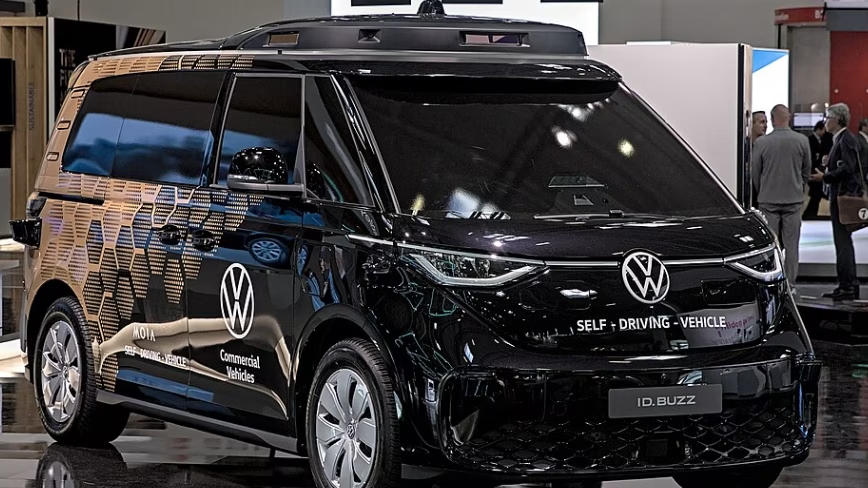
Image: courtesy of Thenextweb
Volkswagen's Moia Launches Free Robotaxi Shuttle in Hamburg, Signaling a Measured Entry into Autonomous Mobility
Volkswagen's mobility unit, Moia, has launched its first autonomous ride-sharing pilot service in Hamburg, Germany, utilizing self-driving ID. Buzz vans. The service, currently free for preregistered residents, represents a strategic initial step into the competitive robotaxi market, focusing on shared shuttles rather than private rides. Moia also has plans to expand into the US before the end of 2026 through partnerships with Uber in Los Angeles and Beep in Orlando, with a broader goal of securing European regulatory approval for fully driverless operations by 2027.
Outlook
Background
The launch of Moia's autonomous shuttle service in Hamburg marks Volkswagen's formal entry into the robotaxi sector, a field already populated by established players like Waymo and Cruise, as well as numerous startups. Unlike many competitors that initially focused on private, on-demand robotaxis, Moia is starting with a shared shuttle model. This approach aligns with broader urban mobility goals of reducing congestion and emissions, positioning Moia as a public transport augmentation rather than a direct taxi replacement. The use of the ID. Buzz van, an iconic, all-electric vehicle, also leverages Volkswagen's brand recognition and commitment to electric mobility. The decision to offer the service for free during its pilot phase is a common strategy to encourage adoption, collect user feedback, and demonstrate reliability without the pressure of immediate revenue generation. Partnerships with existing mobility providers like Uber and autonomous shuttle operators like Beep are critical for Moia's planned US expansion, providing immediate access to established networks and operational expertise, rather than building from scratch.
Precedents
The rollout of autonomous vehicle services has historically followed a pattern of cautious, incremental expansion. Initial deployments typically begin in controlled environments or limited geographic areas, often with a human safety driver present, even in what are technically 'driverless' pilots. Companies like Waymo and Cruise spent years testing and refining their technology in specific cities before expanding their services or removing safety drivers entirely. Regulatory hurdles, public perception, and the sheer complexity of operating autonomous vehicles in dynamic urban environments mean that widespread, fully driverless commercial services take time to materialize. Early services often focus on data collection and building public trust, sometimes offering free rides or discounted fares. The modular approach of partnering with existing ride-hailing or shuttle services (like Uber or Beep) is also a recognized strategy for scaling, allowing technology developers to focus on the core autonomous driving stack while leveraging partners for fleet management, customer service, and market penetration. The timeline for regulatory approval, particularly for Level 4 autonomy, has proven to be a significant bottleneck across various jurisdictions globally, often extending beyond initial company projections.
Volkswagen's entry into the robotaxi space, particularly with a shared shuttle service, carries significant implications for the future of urban mobility and the automotive industry. As one of the world's largest automakers, VW's commitment validates the long-term potential of autonomous vehicles, even as many competitors have faced setbacks and funding challenges. By focusing on shared shuttles, Moia is positioning itself not just as a technology provider but as a partner for cities seeking sustainable and efficient public transport solutions, potentially reducing private car ownership and urban congestion. The eventual success of Moia's model could influence how other legacy automakers approach autonomous services, moving beyond personal vehicles into broader mobility-as-a-service offerings. For consumers, the expansion of such services, especially if free or low-cost, could transform daily commutes and access to transport, particularly in areas underserved by traditional public transit. However, the path to profitability and widespread adoption remains complex, hinging on technological reliability, regulatory frameworks, and overcoming public skepticism.
Scenarios
AnalysisOne possible outcome is that Moia successfully navigates the regulatory landscape in Europe and the US, securing approval for fully driverless operations in Hamburg and launching its planned US services with Uber and Beep before year-end 2026. This would establish Volkswagen as a serious contender in the autonomous mobility sector, allowing Moia to gradually expand its service areas and potentially introduce a commercial pricing model in the years following 2027. The shared shuttle model could prove particularly effective in specific urban corridors or for last-mile connectivity, distinguishing it from private robotaxi services.
Conversely, Moia could face significant challenges in meeting its 2027 regulatory approval target for driverless operations in Europe, or its US expansion plans may encounter unexpected delays due to technical hurdles or market reception. The highly competitive and capital-intensive nature of the robotaxi industry means that even a well-resourced player like Volkswagen could struggle to achieve widespread scale and profitability quickly. This could lead to a more conservative, slower rollout, potentially limiting its competitive edge against more entrenched players or forcing a re-evaluation of its business model. The public's willingness to adopt shared autonomous shuttles, especially in different cultural contexts like the US, will also play a crucial role in determining the service's long-term viability.
Timeline
2026-05-15
VW and MOIA Testing Autonomous Ridepooling
VW and MOIA are testing autonomous ridepooling in Hamburg using ID. Buzz AD vans, as reported by DW.
2026-07-16
Moia Launches Autonomous Shuttle Pilot in Hamburg
Volkswagen's Moia officially launched its pilot autonomous shuttle service in Hamburg, Germany, offering free rides in ID. Buzz vans to preregistered residents via the Moia app. This marks VW's entry into the robotaxi race with a shared shuttle model.
2026-12-31
Planned US Deployments
Moia plans to deploy its autonomous services in the US via partnerships with Uber in Los Angeles and Beep in Orlando before the end of 2026.
2027-12-31
Target for European Regulatory Approval
Moia aims to secure European regulatory approval for fully driverless (Level 4) operations by 2027.
Frequently Asked Questions
Moia is primarily using autonomous ID. Buzz vans for its pilot service in Hamburg. These are fully electric vehicles from Volkswagen.
Discussion
Be the first to share your thoughts.