
The immediate consequence of the ban is that U.S. companies will need to find alternative suppliers for advanced robots and power inverters. This could prompt a scramble for domestic production or sourcing from allied nations. For the solar energy sector, which heavily relies on Chinese-made inverters, this change will likely translate into higher costs and potential delays in project development as the market adjusts. On the diplomatic front, China is expected to voice strong opposition, possibly leading to retaliatory measures that could further strain U.S.-China trade relations. Industry groups in the U.S. may also push for clearer guidelines on what constitutes an 'advanced robotic device' and how existing contracts will be affected.
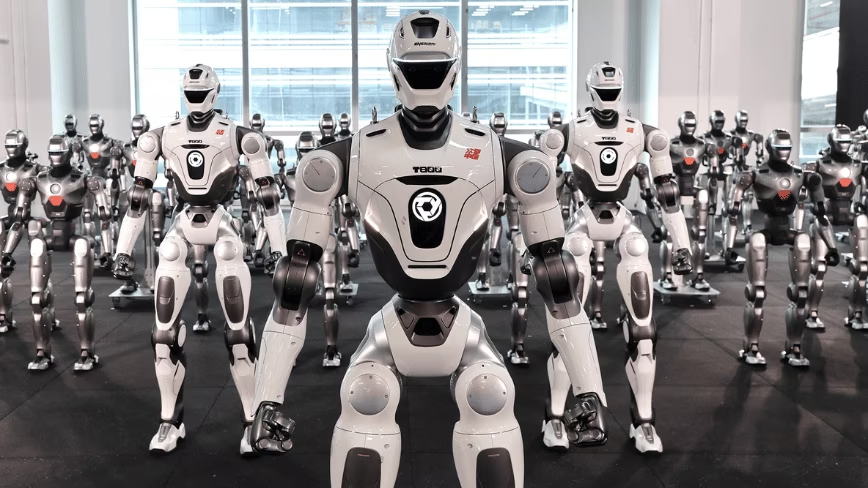
Image: courtesy of Thenextweb
Beyond the Ban: What the US Move on Chinese Robots and Inverters Means for America's AI Future
The Trump administration, through the Federal Communications Commission (FCC), has imposed a ban on the import of new 'advanced robotic devices' and connected power inverters from foreign adversaries, with China as the primary target. The stated aim is to safeguard national security, protect the burgeoning U.S. artificial intelligence (AI) sector, and reduce vulnerabilities within critical supply chains. This move, announced on July 28, 2026, extends existing efforts to curb China's influence in key technology areas.
Outlook
Background
The ban specifically targets mobile robotic devices, including humanoid and quadruped models, as well as connected power inverters. These inverters are crucial components in renewable energy systems, converting direct current (DC) from sources like solar panels into alternating current (AC) for grid use. China holds a dominant position in the global inverter market, with companies like Sungrow Power Supply and Huawei being major players. Huawei, in particular, has faced extensive U.S. sanctions in the past over national security concerns.
The rationale behind the ban, as articulated by the Trump administration, centers on several pillars: national security risks posed by potential backdoors or vulnerabilities in foreign-made technology; the need to secure supply chains for technologies vital to the U.S. AI buildout; and a broader strategy to re-shore key industries. The FCC's involvement in regulating communications equipment extends to devices that could potentially compromise U.S. networks or infrastructure. The administration views the control over these foundational technologies, especially in robotics and energy, as critical to future economic and military advantage. The move was reportedly inspired, in part, by similar actions taken by European nations regarding Chinese inverters.
See also
Precedents
This ban marks another escalation in the ongoing technology rivalry between the United States and China, a contest that has intensified over the past decade. Previous U.S. administrations have imposed restrictions on Chinese tech giants like Huawei and ZTE, primarily citing national security threats related to telecommunications infrastructure. The 'chip war,' focusing on semiconductors and advanced manufacturing equipment, has also seen the U.S. restrict China's access to crucial technology.
The pattern suggests a strategic effort by the U.S. to decouple its critical technology sectors from China, particularly in areas perceived to have dual-use (civilian and military) applications. The targeting of specific components like power inverters mirrors earlier concerns about critical infrastructure and grid security. Furthermore, the mention of Europe's prior actions on inverters indicates a potential for coordinated, or at least parallel, efforts among Western allies to reduce reliance on Chinese technology in sensitive sectors. This policy reflects a consistent belief within certain U.S. policymaking circles that economic competition and national security are intertwined, especially when it comes to emerging technologies and critical infrastructure.
This ban carries significant implications for several key sectors and the broader geopolitical landscape. For the U.S. AI industry, securing trusted hardware components is paramount. If foreign-made robots could be compromised, it poses a direct threat to the integrity and reliability of autonomous systems, which are increasingly integral to defense, logistics, and manufacturing. The ban is an attempt to insulate this critical buildout from perceived risks.
In the renewable energy sector, where power inverters are indispensable, the immediate impact could be a disruption to the supply chain. China's dominance in this market means U.S. solar installers and project developers will face higher costs and potentially longer lead times for components, which could slow the pace of renewable energy deployment. This creates a tension between national security objectives and climate goals.
More broadly, the action deepens the economic and technological fragmentation between the U.S. and China. It signals a continued push towards 'de-risking' supply chains, which could lead to a more bifurcated global technology ecosystem. For consumers and businesses, this could mean higher prices for products that incorporate these components, from smart home devices to industrial automation. The real stakes here are not just about trade balances, but about who controls the foundational technologies that will define the next generation of global power.
Scenarios
AnalysisOne possible outcome is that the ban successfully stimulates domestic U.S. production and innovation in both advanced robotics and power inverter manufacturing. This could lead to the creation of new American jobs and a more resilient, secure supply chain, aligning with the administration's stated goals of re-shoring key industries. However, building out these capabilities will require substantial investment and time, potentially leading to short-to-medium term market inefficiencies.
Another scenario involves significant retaliatory measures from Beijing. China could impose its own import restrictions on U.S. technology or agricultural products, escalating the trade tensions. This could further disrupt global supply chains, affecting multinational corporations that operate in both countries and potentially leading to a 'tech Cold War' where two distinct technological ecosystems emerge.
A third outcome could see U.S. companies, particularly those in the solar sector, face higher operational costs. Without access to lower-cost Chinese inverters, project profitability could decrease, potentially slowing the adoption of solar energy or requiring new government subsidies to offset increased hardware expenses. This could create a push-pull between national security and energy policy objectives.
Finally, the ban could inadvertently accelerate China's own drive for technological self-sufficiency. Faced with U.S. restrictions, Chinese firms may redouble efforts to develop indigenous alternatives, potentially strengthening China's domestic tech ecosystem in the long run, even as it loses access to the U.S. market. This would align with Beijing's long-term strategic goals, albeit under duress.
Timeline
2026-07-28
U.S. Announces Ban on Foreign Robots and Inverters
The Trump administration, through the Federal Communications Commission (FCC), officially announced a ban on the import of new 'advanced robotic devices' and connected power inverters from foreign adversaries, primarily targeting China. The ban cites national security and supply chain integrity concerns.
Earlier in 2026
Reuters Reports FCC Plans for Inverter Ban
Reuters previously reported that the FCC was actively working on a ban targeting Chinese-made power inverters, indicating that this policy was under development for some time.
Prior to 2026
Europe Takes Action on Chinese Inverters
Reports suggest that similar actions taken by European countries regarding Chinese inverters served as an inspiration or precedent for the U.S. ban, reflecting a broader Western concern over these technologies.
Ongoing
U.S.-China Tech Rivalry Intensifies
The ban is part of a continuing pattern of escalating competition and restrictions between the U.S. and China across various technology sectors, including semiconductors, telecommunications, and AI.
Frequently Asked Questions
The ban applies to 'advanced robotic devices,' specifically mentioning mobile robots such as humanoid and quadruped models. It is not limited to walking robots but includes a broader category of sophisticated, connected robotic systems.
Discussion
Be the first to share your thoughts.