
The rapid expansion of artificial intelligence (AI) has fueled an unprecedented demand for data center capacity, requiring vast amounts of electrical power. This growth was widely expected to drive a surge in US natural gas consumption, primarily to generate electricity for these facilities. However, resistance from local communities and the sheer difficulty of upgrading aging power grids are now creating substantial headwinds. Expect a recalibration of energy demand forecasts, particularly those tied to the tech sector's growth. For Europe, which has moved to significantly reduce its dependence on Russian gas, any disruption to US LNG supply creates immediate questions about energy security and diversification strategies. The coming months will likely see increased scrutiny on grid modernization efforts and a more nuanced public debate around the environmental and logistical costs of the AI boom.
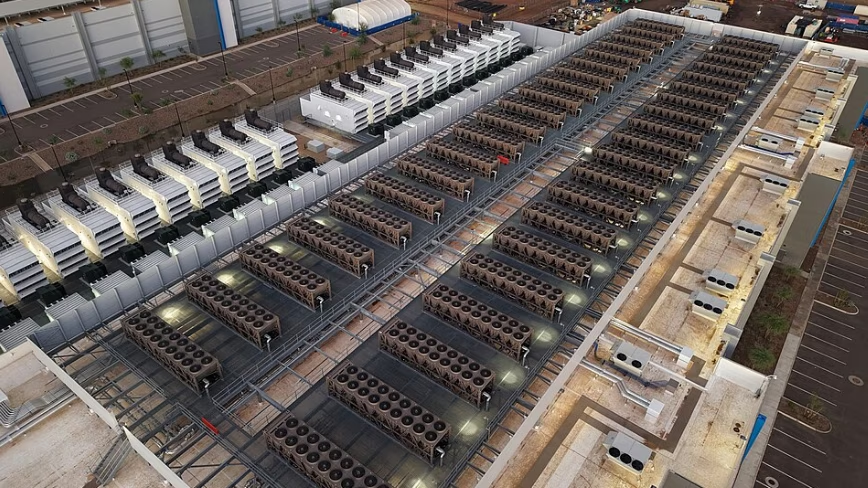
Image: courtesy of Thenextweb
Political Pushback and Grid Strain: How US Data Center Delays Could Reshape Europe's Gas Supply
Up to half of the planned data centers across the United States face significant delays or outright cancellation, according to investment firm Kimmeridge Energy Management Co. This slowdown, driven by local political opposition and mounting infrastructure challenges, is poised to alter forecasts for US natural gas demand. Crucially, this could ripple through global energy markets, impacting Europe's increasing reliance on American liquefied natural gas (LNG) exports.
Outlook
Background
The projection from Kimmeridge Energy Management Co., outlined in a report yesterday, August 26, 2026, indicates that as many as 50% of proposed US data centers are at risk. Ben Dell, a partner at Kimmeridge, specifically pointed to growing political backlash and the complex challenges of building out physical infrastructure as the core reasons. This isn't just about NIMBYism; over 500 US jurisdictions have reportedly implemented bans or significant restrictions on data center development, highlighting a widespread sentiment. The energy implications are substantial: data centers require immense amounts of electricity, much of which is generated by natural gas-fired power plants. Kimmeridge suggests these delays could reduce projected US gas demand growth by 5 to 10 billion cubic feet per day (bcf/day). This figure represents a material shift in the energy outlook, especially considering that Europe is anticipated to rely on US LNG for up to 80% of its gas needs by 2030, a direct consequence of its pivot away from Russian energy sources. The slowdown in US data center development, therefore, directly impacts Europe's energy calculus.
Precedents
Infrastructure projects, particularly those with significant environmental or community impacts, have a long history of facing delays and cancellations due to local opposition. From pipelines and transmission lines to large industrial facilities, 'Not In My Backyard' (NIMBY) movements are a consistent feature of development. The current situation with data centers echoes past struggles where the economic benefits of a project clashed with local concerns over noise, visual blight, water usage, and crucially, energy demands. The scale of energy consumption by modern data centers, particularly those serving AI, is a relatively new driver of public concern. Historically, communities have pushed back against coal plants or nuclear facilities, but the idea of a 'digital' industry consuming vast amounts of power is a newer phenomenon attracting similar scrutiny. Similarly, energy supply chains have often been subject to geopolitical shifts. Europe's reliance on Russian gas for decades created vulnerabilities that became acutely apparent in recent years. The current move towards US LNG, while diversifying sources, creates a new dependency, making any disruption to that supply a critical issue.
The stakes here are considerable, reaching beyond just the profitability of individual tech companies or energy firms. For the technology sector, particularly the burgeoning AI industry, these delays represent a significant operational bottleneck. The promised advancements in AI, which require massive computational power, could be hampered if the physical infrastructure to support them cannot be built quickly enough. This could slow innovation, impact research, and affect the deployment of AI-powered services across various industries. For energy markets, the Kimmeridge report challenges established demand forecasts. If US gas demand for data centers grows slower than expected, it could influence domestic gas prices and the profitability of producers. More critically, for Europe, this situation introduces a fresh layer of uncertainty into its energy security strategy. Having pivoted aggressively towards US LNG, any threat to that supply stream could force European nations to re-evaluate their energy mix, potentially leading to higher energy costs for consumers and businesses, and renewed efforts to accelerate renewable energy deployment or explore alternative gas sources. It underscores the interconnectedness of technological growth, energy infrastructure, and geopolitical stability.
Scenarios
AnalysisOne immediate outcome is that companies planning large-scale data center expansions in the US may need to reassess their timelines and potentially explore alternative locations. This could mean a shift towards regions with more robust grid infrastructure or less stringent local regulations, potentially even outside the United States. Such a geographical redistribution could affect regional economic development and job creation within the tech sector.
A second outcome could involve a more aggressive push for grid modernization and renewable energy integration within the US. If fossil fuel-generated electricity for data centers faces increasing opposition, both developers and utilities may accelerate investments in cleaner power sources and more efficient transmission networks to overcome infrastructure bottlenecks and appease local concerns. This could drive innovation in energy storage and distributed generation.
A third possibility is a re-evaluation of Europe's energy diversification strategy. If the reliability of future US LNG supplies becomes questionable due to domestic US issues, European policymakers might consider renewed investment in domestic gas production, explore long-term contracts with other global LNG suppliers, or intensify efforts to expand renewable energy capacity and energy efficiency programs at an even faster pace than currently planned. This could lead to a fragmented European energy policy, with different nations pursuing varied approaches based on their specific vulnerabilities and resources.
A fourth scenario involves the AI industry itself adapting its infrastructure needs. This could manifest as greater investment in 'edge computing' — processing data closer to its source rather than in massive centralized data centers — or a focus on developing more energy-efficient AI models and hardware. Such technological shifts could reduce the overall energy footprint of AI, mitigating some of the demand pressures currently facing the grid.
Timeline
Frequently Asked Questions
Discussion
Be the first to share your thoughts.