
The deployment of unmanned systems for complex, multi-domain combat operations, particularly amphibious assaults, suggests a future where human presence at the initial point of contact in high-risk zones may become less common. Militaries worldwide are likely to accelerate research and development into similar robotic capabilities, focusing on autonomy, coordination across different domains (sea, land, air), and countermeasures. This could lead to shifts in military doctrine, procurement priorities, and training regimens. We may also see increased debate around the ethical implications of fully autonomous weapons systems and the legal frameworks governing their use in conflict.
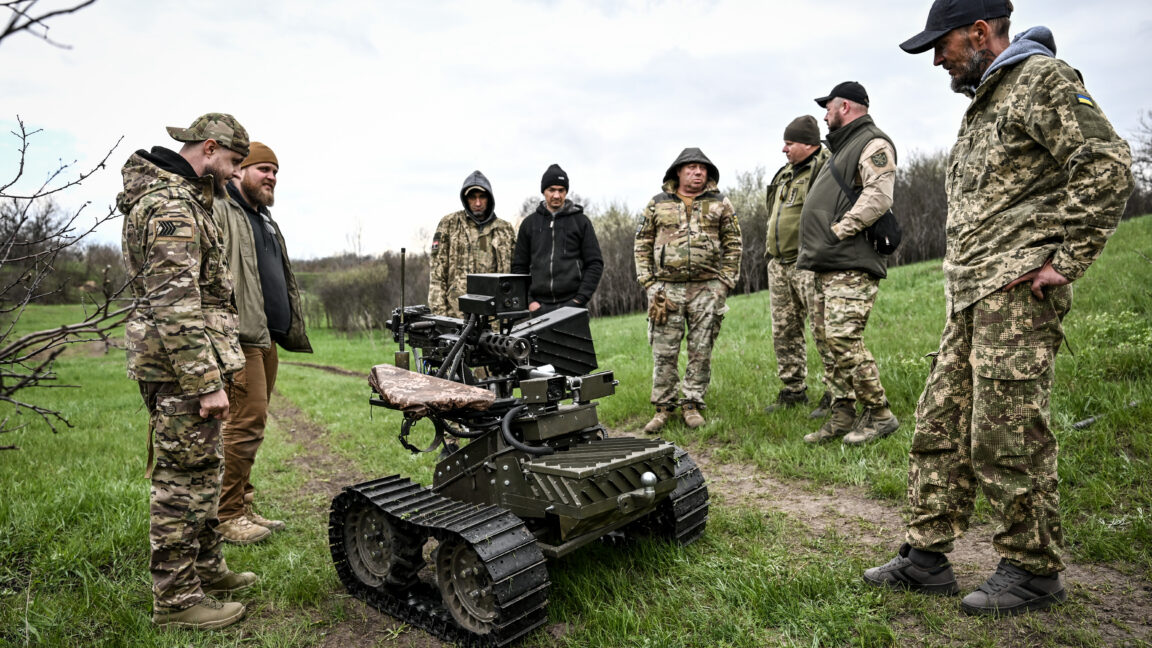
Image: courtesy of Ars Technica
Ukraine's Robotic Assaults: How Unmanned Systems Are Reshaping the Battlefield
Ukraine has deployed drones to deliver combat robots directly into battle by both sea and air, a development that signals a significant shift in modern warfare. The most notable instance is a fully unmanned amphibious assault conducted by the 123rd Separate Territorial Defense Brigade on Russian-held territory on the Kinburn Spit on July 21, 2026. This mission involved a naval drone transporting a ground combat vehicle, with an aerial drone providing reconnaissance throughout the operation. These innovations are part of a broader tactical pivot by Ukraine, which also includes using large aerial drones as 'motherships' for explosive FPV drones and deploying high-altitude balloons to drop one-way attack drones deep into Russian territory. The country has also streamlined military procurement through a platform resembling an e-commerce site, allowing direct delivery of drones and robots to the front lines.
Outlook
Background
The recent unmanned amphibious assault on the Kinburn Spit represents a tactical evolution. This strategic peninsula, directly west of Kherson, has been a contested area, with Ukrainian officials identifying it as a key Russian foothold. The operation, announced by Ukraine's 123rd Separate Territorial Defense Brigade, involved a naval drone navigating the Black Sea to deliver a combat vehicle – effectively a ground drone – behind Russian lines. An aerial drone then provided real-time intelligence and oversight for the ground assault. This multi-layered, unmanned approach minimizes risk to human personnel while allowing for precision strikes in heavily defended areas.
Beyond direct combat deployments, Ukraine has also innovated in logistics. A platform called 'Blockchain Defense,' described as an 'Amazon-like' service, allows military units to order drones and ground robots directly from manufacturers. These systems are then delivered straight to the military unit on the battlefield, bypassing traditional warehouse-based supply chains. This direct-to-frontline model reflects a rapid adaptation to the demands of modern, drone-centric warfare, where agility and speed of deployment are critical.
Ukrainian forces have also expanded their drone operations in the Black Sea, with reports on July 15 of a 'MoLoChKa' operation that struck 17 oil tankers, two gas tankers, and one tugboat. While the Kyiv Independent noted it could not independently verify these specific strikes, and Russia offered no comment, the reports highlight an aggressive and expanding use of naval drones, such as the Magura C, to target Russian assets and extend operational reach. These ongoing efforts underscore a broader strategy to leverage unmanned systems for both direct engagement and strategic disruption.
Precedents
Throughout military history, new technologies have repeatedly reshaped the battlefield, often by altering the calculus of risk, speed, and force projection. The introduction of tanks in World War I, for example, transformed land warfare by providing mobile protected firepower, overcoming the stalemate of trench warfare. Aircraft, initially used for reconnaissance, quickly evolved into offensive weapons, introducing a new dimension to conflict. Similarly, the development of precision-guided munitions in the late 20th century allowed for strikes with unprecedented accuracy, reducing collateral damage but also enabling more targeted interventions.
Drone warfare itself has followed a rapid evolutionary path. Early military drones were primarily for surveillance and reconnaissance. Over the past two decades, their role expanded to include targeted strikes, often with human operators in the loop. What Ukraine is demonstrating now, particularly with the multi-domain unmanned amphibious assault, represents a leap towards greater autonomy and coordination between robotic systems. This mirrors the historical pattern where an initial technological advantage is quickly exploited, leading to new doctrines and a subsequent arms race as adversaries develop similar capabilities or countermeasures. The shift towards reducing human exposure in high-risk zones has been a consistent driver of military innovation, from armored vehicles to remote-controlled explosives, and now to fully unmanned combat missions.
The shift towards unmanned, robotic warfare has profound implications for the future of military strategy, defense spending, and even the geopolitical balance of power. By removing humans from the immediate line of fire in high-risk operations like amphibious assaults, militaries can reduce casualties, lower the political cost of conflict, and potentially sustain operations for longer periods. This changes the risk-reward calculation for engaging in certain types of combat.
The 'Amazon-like' logistics model for drone and robot delivery also signals a move towards decentralized procurement and rapid deployment, which could significantly shorten the cycle from innovation to battlefield implementation. This agility could give a substantial advantage to nations capable of rapid technological development and flexible supply chains.
For other nations, Ukraine's tactical innovations serve as a stark warning and a blueprint. Major military powers will be compelled to accelerate their own development of sophisticated unmanned systems, not just for reconnaissance or singular strikes, but for coordinated, multi-domain combat operations. This could trigger a new arms race focused on robotic platforms and the artificial intelligence that controls them. The operational successes demonstrated by Ukraine may also influence the strategic calculus of smaller nations, potentially leveling the playing field against larger, more traditionally equipped adversaries by offering asymmetric advantages. The long-term consequence is a battlefield where the 'first contact' is increasingly made by machines, raising complex questions about command responsibility, ethical boundaries, and the very nature of human-led conflict.
Scenarios
AnalysisOne possible outcome is that these robotic tactics become standard military doctrine for high-risk operations. As the technology matures and proves effective, other nations may invest heavily in developing their own multi-domain unmanned assault capabilities, seeing it as a way to project force while minimizing human casualties. This could lead to a global proliferation of advanced combat robots and autonomous systems, fundamentally altering how wars are conceived and fought.
Another scenario suggests a rapid development of countermeasures. As unmanned systems become more prevalent, adversaries will focus on jamming communications, spoofing navigation systems, and developing defensive drones or electronic warfare capabilities specifically designed to neutralize robotic threats. This could lead to an ongoing technological arms race where offensive robotic innovations are quickly met with defensive counter-innovations, creating a dynamic and unpredictable battlefield environment.
A third outcome could involve a re-evaluation of military budgets and procurement. If unmanned systems prove to be more cost-effective and operationally efficient for certain missions than traditional manned platforms, defense spending priorities may shift significantly. This could lead to a reduction in demand for some conventional military hardware and an increased focus on robotics, AI, and related infrastructure, impacting defense contractors and national industrial bases.
Timeline
2022-02
Russia's Full-Scale Invasion
Marks the beginning of the conflict that spurred rapid Ukrainian tactical innovations, including extensive drone use.
2026
Start of Drone-Robot Deliveries
Ukraine begins deploying drones to deliver combat robots directly into battle by sea and air.
2026-07-15
Black Sea Drone Operations
Ukrainian drones reportedly strike 17 oil tankers, two gas tankers, and one tugboat as part of the 'MoLoChKa' operation, utilizing naval drones like the Magura C. Reports were not independently verified.
2026-07-21
Unmanned Amphibious Assault on Kinburn Spit
Ukraine's 123rd Separate Territorial Defense Brigade announces the execution of a fully unmanned amphibious assault using a naval drone to transport a ground combat vehicle, with aerial drone oversight. This is considered a first-of-its-kind mission.
2026-07-22
Blockchain Defense Logistics Model Discussed
Shipovich, at the Sydney Dialogue, discusses the 'Blockchain Defense' platform allowing direct-to-frontline delivery of drones and robots, bypassing traditional warehouses.
Frequently Asked Questions
An unmanned amphibious assault is a military operation where combat vehicles or forces are delivered from sea to land using only uncrewed systems, without human personnel directly participating in the initial landing or engagement. In Ukraine's case, this involved a naval drone transporting a ground combat robot to the target area, overseen by an aerial drone.
Discussion
Be the first to share your thoughts.