
The Department of Transportation's proposal, made public yesterday, specifically targets vehicles built to be driven exclusively by automated driving systems. This means a car designed from the ground up without a steering wheel, accelerator, or brake pedal for human use would no longer be forced to include a brake pedal simply to meet existing federal safety standards. The core safety objective, however, remains: these vehicles must still meet stringent stopping distance requirements. The proposal is now open for public comment, a standard regulatory step that allows industry stakeholders, safety advocates, and the public to submit feedback for 30 days. Once this period closes, the DOT will review the comments before deciding whether to adopt the rule as proposed, modify it, or withdraw it entirely. Given the administration's stated preference for fostering technological advancement, the industry expects the rule to move forward in some form.
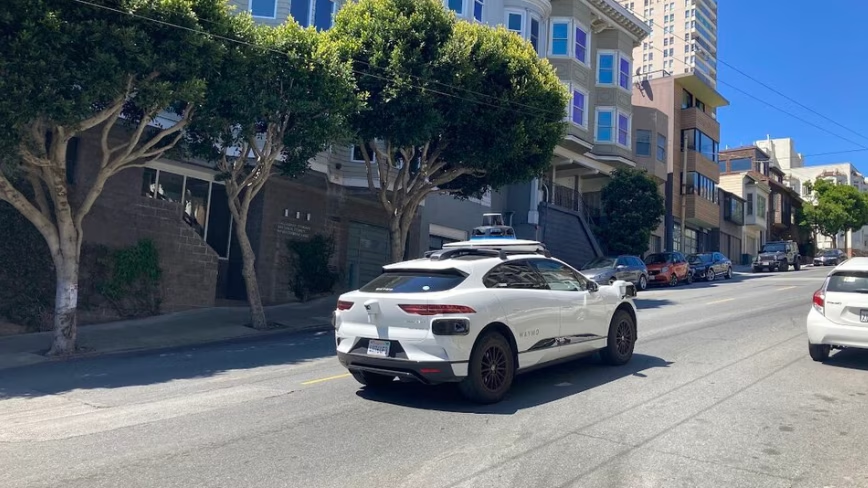
Image: courtesy of Thenextweb
Trump Administration Proposes Axing Brake Pedal Rule for Driverless Cars, Signaling Major Shift for Autonomous Tech
The Trump administration's Department of Transportation (DOT) has proposed a significant regulatory change that would remove the requirement for physical brake pedals in fully autonomous vehicles designed to operate without human intervention. The proposal, announced on June 25, 2026, aims to encourage innovation in the self-driving car industry by clearing a hurdle for companies developing vehicles explicitly engineered for automation, such as Tesla and Zoox. This move updates Federal Motor Vehicle Safety Standard No. 135, initiating a 30-day public comment period.
Outlook
Background
Current federal regulations, primarily Federal Motor Vehicle Safety Standard No. 135, were written with human drivers in mind, assuming a human would always be in control and thus require a brake pedal. As autonomous vehicle technology has matured, companies have begun designing vehicles where human interaction is either minimal or non-existent. For these truly driverless designs, the mandate for a physical brake pedal becomes an anachronism and an operational constraint, forcing manufacturers to include a redundant control that serves no practical purpose in an autonomous context. This regulatory friction has been a point of contention for years, with companies arguing that it hinders progress and adds unnecessary complexity to vehicle design and manufacturing. The Trump administration has consistently signaled a desire to reduce regulatory burdens on businesses, particularly in emerging technology sectors. This proposal aligns with that broader policy aim, seeking to create a more permissive environment for the development and deployment of advanced autonomous systems.
Precedents
The path to regulating autonomous vehicles has been fragmented and often reactive, with states and the federal government taking different approaches. Early efforts focused on testing permits and defining levels of autonomy. California, for instance, has previously allowed for demonstration projects involving autonomous vehicles without traditional driver controls, acknowledging the future direction of the technology. However, comprehensive federal standards have lagged, creating a patchwork of rules and uncertainty for manufacturers. Historically, new automotive technologies, from seatbelts to airbags, have faced a lengthy process of standardization and adoption, often balancing industry innovation with public safety concerns. The current DOT's approach, as seen in this proposal, appears to favor a more proactive removal of perceived regulatory barriers, rather than waiting for the industry to fully mature before adapting the rules. This mirrors a broader trend within the administration to use regulatory adjustments as a tool to accelerate technological adoption and market competitiveness.
This seemingly technical change carries significant implications for the future of transportation and the companies at the forefront of autonomous vehicle development. For manufacturers like Tesla, which has been vocal about its vision for a 'Cybercab' without traditional controls, and Zoox, which is building purpose-built robotaxis, the removal of the brake pedal requirement is more than symbolic. It streamlines design, potentially reduces manufacturing costs, and allows for more radical vehicle architectures optimized purely for autonomous operation. This could accelerate the transition from semi-autonomous vehicles, which still assume a human driver, to fully driverless systems deployed at scale. For consumers, this change signals a future where vehicles might look and feel very different, moving beyond the traditional car cabin layout. On the other hand, it also intensifies the debate around safety and public trust. While the DOT insists that stopping distance standards remain, the visual absence of a human-operable brake could raise public anxiety, placing a greater burden on manufacturers to demonstrate the absolute reliability and safety of their autonomous systems to a skeptical public.
Scenarios
AnalysisThe immediate outcome is a period of public scrutiny and debate, as stakeholders weigh in on the proposal. One possible outcome is that the Department of Transportation adopts the rule largely as proposed after the public comment period. This would clear a significant regulatory path for companies developing truly driverless vehicles, potentially leading to faster deployment of new designs that lack traditional human controls. This scenario would underscore the administration's commitment to fostering innovation in the autonomous vehicle sector.
Another outcome could see the proposal modified. Significant public or industry feedback, particularly concerning safety or liability, might lead the DOT to introduce caveats or additional requirements, such as enhanced testing protocols or specific fail-safe mechanisms, before allowing the removal of the brake pedal. This would represent a more cautious approach, balancing innovation with a heightened emphasis on public confidence and safety.
A less likely, but still possible, outcome is the withdrawal of the proposal. Strong opposition from safety groups, coupled with political pressure or new data, could lead the DOT to reconsider, maintaining the existing requirement or opting for a different regulatory framework. However, given the administration's consistent stance on deregulation and support for AV development, a full withdrawal without any alternative seems improbable.
Timeline
Frequently Asked Questions
Discussion
Be the first to share your thoughts.