
Expect intensified debate within Washington and Silicon Valley over the US's approach to AI development, specifically regarding regulatory burdens and immigration policies for skilled tech workers. The discourse may influence upcoming legislative proposals or executive actions aimed at bolstering American competitiveness against perceived Chinese advancements.
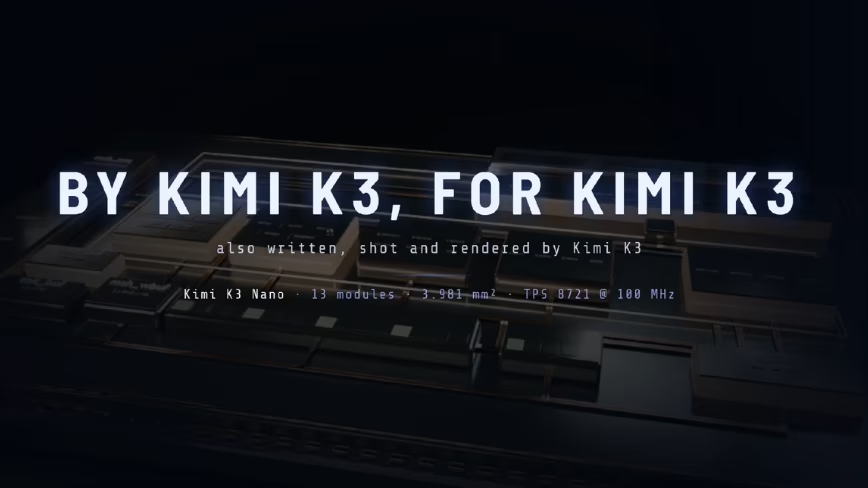
Image: courtesy of Thenextweb
Kimi K3 Prompts US AI Policy Reckoning: Immigration, Regulation at Core of 'Losing' Race Claims
A wave of concern swept through prominent US tech and political circles on July 17, 2026, after David Sacks, a key advisor to former President Donald Trump on artificial intelligence, declared that the emergence of China's Moonshot AI's Kimi K3 model signaled the US was 'losing the AI race.' Sacks attributed this perceived setback to domestic regulatory hurdles, while venture capitalist Vinod Khosla offered a contrasting view, pointing to restrictive immigration policies as the primary threat to American competitiveness. These strong reactions come despite Kimi K3 remaining officially unreleased as of mid-June 2026, with its capabilities primarily known through benchmark comparisons suggesting it rivals models like GPT-4o.
Outlook
Background
The debate over America's standing in the global artificial intelligence competition has intensified following remarks from influential figures in both politics and venture capital, sparked by the rise of a Chinese model.
The Unreleased Contender: Kimi K3
The focal point of this discussion is Kimi K3, an advanced AI model developed by Chinese startup Moonshot AI. While Kimi K3 remains officially unreleased as of mid-June 2026, early benchmark comparisons suggest it is competitive with leading Western models, including OpenAI's GPT-4o. Rumors, particularly the most headline-grabbing, claim K3 possesses a 1 million token context window. If confirmed, this would be a significant technical leap, allowing the model to process vast amounts of information – entire codebases, books, or extensive research papers – in a single interaction. The company, Moonshot AI, has also demonstrated significant financial backing, securing a $500 million Series X funding round, highlighting the substantial capital flowing into the pursuit of artificial general intelligence (AGI) within China.
David Sacks's Alarm Bell
David Sacks, who served as Trump’s former AI czar and now co-chairs the President’s Council of Advisors on Science and Technology, issued a stark warning on July 17, 2026. Sacks called the perceived emergence of Kimi K3 'concerning' and asserted that it marked the 'first time a Chinese model had taken the top coding spot.' His analysis directly linked this development to what he termed 'US regulatory self-harm.' Sacks specifically cited several domestic policies as detrimental: the blocking of new data centers, the proliferation of state-level regulations, and the push for federal pre-approval of frontier AI models. His blunt assessment – 'This is how you lose the AI race' – encapsulates a growing anxiety within certain political factions about the speed and direction of US AI policy relative to China's progress.
Vinod Khosla's Contrarian Take
Offering a distinct, yet equally urgent, perspective, venture capitalist Vinod Khosla weighed in on the issue on July 15, 2026, at the Bloomberg Green Seattle event. Khosla argued that the primary threat to America’s competitiveness in artificial intelligence and climate tech is not, as Sacks suggests, overly burdensome domestic regulation or even specific cuts to renewable power tax breaks. Instead, Khosla pointed to restrictive immigration policies. His core argument is that 'talent drives everything' in the innovation economy. This suggests a belief that the US is inadvertently hindering its own progress by making it difficult for top global AI researchers, engineers, and entrepreneurs to enter and contribute to the American ecosystem. Khosla's view positions the 'AI race' less as a battle of regulatory frameworks and more as a competition for human capital.
The Complicating Factor: Cursor and Kimi
Adding a layer of complexity to the narrative of a clear-cut US-China AI competition is the confirmed news that Cursor, a well-funded American AI startup, is basing its latest coding AI, 'Composer 2,' on Kimi, a product of China's Moonshot AI. Cursor, which raised $2.3 billion in the fall of 2025 and boasts a valuation of $29.3 billion with annual revenues exceeding $2 billion, represents a significant player in the US AI landscape. This collaboration implies that even as political rhetoric emphasizes a 'race,' practical technological development involves cross-border integration and the utilization of global advancements. Cursor's decision to leverage a Chinese foundation model suggests that, for some US companies, access to leading-edge technology outweighs national origin considerations, at least for now. This blurs the lines of who is 'winning' or 'losing' when core components of American innovation are sourced from perceived rivals.
Precedents
The current discourse around China's Kimi K3 and its implications for US AI leadership echoes historical moments when a perceived technological lead by a rival nation triggered a national reckoning. The most prominent parallel often drawn is the 'Sputnik moment' of 1957, when the Soviet Union launched the first artificial satellite. This event fundamentally reshaped US science education, space policy, and defense spending, driven by a fear of falling behind. While the current situation involves commercial technology rather than overt military hardware, the underlying anxiety about national competitiveness and security remains similar.
Beyond Sputnik, the US has faced economic and technological challenges from other nations, notably Japan's rise in manufacturing and electronics during the 1980s. That period also saw calls for industrial policy, investment in domestic R&D, and debates over trade barriers, all driven by concerns about American economic supremacy.
On the specific issue of talent and immigration, the debate is equally long-standing. Silicon Valley, in particular, has historically thrived on attracting top scientific and engineering talent from around the world. Arguments for open immigration policies for highly skilled workers have been a consistent feature of tech industry lobbying, often framed as essential for maintaining America's innovative edge. Conversely, periods of economic nationalism or security concerns have seen calls for tighter controls, reflecting a tension between securing domestic jobs and accessing global expertise.
Finally, the tension between innovation and regulation is a recurring theme in emerging technologies. From the early days of the internet to biotechnology and now AI, policymakers grapple with how to foster growth without stifling it through premature or overly restrictive rules. The arguments put forth by David Sacks about data center blocking and pre-approval reflect this perennial struggle, with proponents of lighter regulation often citing the risk of driving innovation overseas.
The intense reaction to an unreleased Chinese AI model, particularly from figures like David Sacks and Vinod Khosla, reveals the deep anxieties and strategic fissures within the US approach to the global AI race. This isn't just about a single benchmark; it's about the foundational elements of future economic power, national security, and technological supremacy.
For national security, advanced AI models like Kimi K3 have significant dual-use potential, meaning they can be applied to both civilian and military purposes. A perceived lag in AI capabilities could have profound implications for defense intelligence, autonomous systems, and cybersecurity, potentially shifting geopolitical power balances. The ability to process vast amounts of data, as a 1 million token context window suggests, could offer substantial advantages in analysis and strategic planning.
Economically, the country that leads in frontier AI development is positioned to dominate future industries, create new jobs, and capture significant global market share. If the US falls behind, it risks ceding leadership in areas from software development to scientific discovery, impacting long-term prosperity and innovation. The debate over regulation and talent directly touches on the speed at which American companies can innovate and scale.
For policymakers, the diverging views of Sacks and Khosla present a critical juncture. Do they prioritize a more protectionist stance, tightening regulations on data and frontier models while encouraging domestic-only development, as Sacks's comments might imply? Or do they lean towards a more open, talent-focused strategy, easing immigration restrictions to attract the best global minds, as Khosla advocates? The choice will shape not just the tech sector, but the broader economic and strategic direction of the country for decades. The fact that a major US AI startup like Cursor is already integrating Chinese foundation models further complicates this policy calculus, demonstrating that the 'race' is often more intertwined than the rhetoric suggests, forcing a re-evaluation of what constitutes 'winning' in an interconnected global tech ecosystem.
Scenarios
AnalysisThe heated debate over Kimi K3's capabilities and its implications for the US-China AI race points to several possible policy and industry shifts:
Outcome 1: Renewed Push for Domestic AI Deregulation and Investment.
David Sacks's arguments against US regulatory 'self-harm' may gain traction, particularly if the Trump administration returns to power. This could lead to a concerted effort to ease restrictions on data center development, streamline approvals for frontier AI models, and reduce state-level regulatory fragmentation. The underlying premise would be that less government interference allows American innovation to accelerate and compete more effectively. This approach would likely see increased public and private investment in domestic AI infrastructure, potentially through tax incentives or direct funding for US-based research and development, aimed at fostering a 'pro-innovation' environment. The goal would be to remove perceived bottlenecks that hinder American AI companies from scaling rapidly and developing advanced models.
Outcome 2: Strategic Immigration Reforms to Attract Global AI Talent.
Vinod Khosla's emphasis on 'talent drives everything' could push for significant changes in US immigration policy, especially concerning highly skilled workers in AI and related fields. This might involve expanding visa categories for AI researchers, scientists, and engineers, or creating fast-track pathways for graduates from top global universities to remain and work in the US. The argument is that America's strength has always come from its ability to attract and integrate the best minds worldwide. A more open immigration policy, specifically tailored for critical tech sectors, would be seen as a direct way to counter perceived talent gaps and ensure that the US remains a global hub for AI innovation, regardless of where the talent originates.
Outcome 3: Increased Scrutiny and Protectionism Around Foreign AI Models.
Despite the practical reality of companies like Cursor using Kimi, the political rhetoric could lead to a more protectionist stance. This might manifest as increased government scrutiny over US companies utilizing foreign-developed foundation models, potentially through new regulations or incentives favoring domestically sourced AI. There could be a push for stricter export controls on advanced AI hardware (like chips) and software to China, alongside efforts to decouple critical AI supply chains. This outcome would prioritize national security and technological sovereignty, even if it introduces operational complexities and potentially higher costs for US tech companies that currently leverage global AI advancements.
Outcome 4: A Fragmented and Inconsistent Policy Response.
Given the divergent views from influential figures like Sacks and Khosla, and the complex geopolitical landscape, a cohesive, unified US AI strategy may remain elusive. Policymakers might struggle to reconcile the need for open innovation and global talent with concerns over national security and economic competition. This could result in a piecemeal approach, where some regulations are eased while others are tightened, and immigration policies see minor adjustments rather than comprehensive reform. Such an outcome would reflect the inherent institutional limitations and conflicting incentives within the US political system, potentially leaving the US AI sector to navigate an uncertain and often contradictory policy environment.
Timeline
2025-09-01
Cursor Secures Significant Funding
US AI startup Cursor raised $2.3 billion in a funding round, achieving a valuation of $29.3 billion. The company later confirmed its latest coding AI, 'Composer 2,' is based on China's Moonshot AI's Kimi model.
2026-06-15
Kimi K3 Remains Unreleased
As of mid-June 2026, Moonshot AI's Kimi K3 model has not been officially released to the public, though benchmark comparisons suggest it is highly competitive with models like GPT-4o.
2026-07-15
Vinod Khosla Blames Immigration Policies
Speaking at the Bloomberg Green Seattle event, venture capitalist Vinod Khosla stated that restrictive immigration policies pose the biggest threat to America's competitiveness in AI and climate tech, emphasizing that 'talent drives everything.'
2026-07-17
David Sacks Declares US 'Losing' AI Race
David Sacks, former Trump AI czar and co-chair of the President's Council of Advisors on Science and Technology, criticized US regulatory 'self-harm'—including data center blocking and federal pre-approval for models—as reasons for the US 'losing the AI race,' citing Kimi K3 as evidence.
Frequently Asked Questions
Kimi K3 is an advanced artificial intelligence model developed by Chinese startup Moonshot AI. While not yet officially released, early benchmarks suggest it is highly competitive with leading Western models, such as OpenAI's GPT-4o, and is rumored to feature a 1 million token context window.
Discussion
Be the first to share your thoughts.