
Veridact
TechSportsFinanceGaming🎯 Predictions⭐ OpportunitiesAbout
Sign InSign Up
Veridact

Analysis before the headline. Veridact examines technology, finance, sports, and gaming events before they unfold through forecasting, probability modeling, historical precedent, and public prediction tracking.

Stay ahead of what's next

Forecasts, analysis, and prediction updates delivered to your inbox.

Coverage

  • Tech
  • Sports
  • Finance
  • Gaming

Company

  • About Us
  • Privacy Policy

© 2026 Veridact. Forecasting & analysis platform.

Content may include AI-assisted research and analysis. Predictions and opinions should not be considered financial, legal, medical, or investment advice.

tech
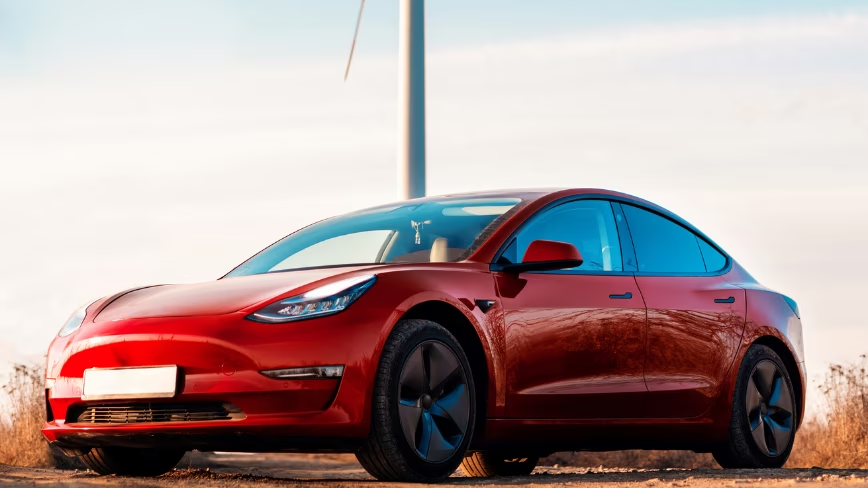
Tesla delivered 480,126 vehicles in Q2, far exceeding the 406,000 Wall Street expected

Image: courtesy of Thenextweb

techJuly 3, 2026By Veridact EditorialUpdated Jul 3

Tesla Delivered a Record Q2. Why Wall Street Still Punished the Stock.

Tesla reported 480,126 vehicle deliveries for the second quarter of 2026, significantly exceeding Wall Street's consensus estimate of approximately 406,000 units. This marked a 25% increase year-on-year and a 34% rise from the previous quarter. Despite this strong performance, Tesla's stock (TSLA) fell 7% on the news, marking its worst trading day in nearly a year, indicating investor concerns that extend beyond headline delivery figures.

Outlook

Tesla's second-quarter delivery figures offer a complex picture. The confirmed 480,126 vehicles delivered between April and June 2026 represent a substantial rebound, particularly after a period of annual sales declines. Production also showed strength, reaching 451,758 vehicles in the quarter. The Model 3 and Model Y vehicles continued to be the company's volume drivers, accounting for 467,762 deliveries, or about 97% of the total. This concentration suggests that while demand for Tesla's core, more affordable offerings remains robust, its higher-end Model S and Model X, along with the nascent Cybertruck, are not yet contributing significantly to overall delivery volume.

Reports indicate that a boost from key international markets, specifically China and Europe, played a role in pushing delivery numbers past expectations. This suggests an effective strategy in these regions, potentially leveraging local incentives or market dynamics that differ from the U.S. market. The sheer scale of the beat – roughly 74,000 vehicles above the Street's forecast – is undeniable evidence of Tesla's operational capacity to meet and exceed market demand when conditions align.

Background

The backdrop to Tesla's Q2 performance is crucial for understanding the market's nuanced reaction. The company has been working to reverse a trend of consecutive annual declines in vehicle sales. This downturn was attributed to several factors, including a perceived consumer backlash against CEO Elon Musk’s increasingly public and politically charged activities, which some analysts suggest alienated a segment of the brand's customer base.

Adding to the pressure, Tesla has also faced the loss of the U.S. federal electric vehicle (EV) tax credit for many of its models. This credit, which previously offered significant savings to buyers, helped drive adoption. Its removal effectively increased the out-of-pocket cost for consumers, potentially dampening demand in Tesla's home market.

Against this challenging environment, the Q2 delivery numbers represent a significant operational achievement. It demonstrates that Tesla can still scale production and push vehicles to customers at a high volume, particularly in markets where its brand strength and product appeal outweigh the headwinds it faces elsewhere. However, the stock's negative reaction implies that investors are looking beyond raw delivery numbers to other metrics, such as profitability per vehicle, pricing strategies, and the overall health of the demand curve without specific governmental support.

Precedents

Tesla has a history of dramatic swings in quarterly performance and equally dramatic market reactions. For years, the company's stock performance was closely tied to its ability to meet aggressive production and delivery targets, often set by CEO Elon Musk himself. Periods of significant delivery beats often led to sharp stock rallies, while misses resulted in equally steep declines.

However, in recent years, as Tesla has matured from a high-growth startup to a dominant global automaker, the market's focus has broadened. While delivery volumes remain important, investor sentiment has increasingly factored in profitability, gross margins, competitive pressures, and the sustainability of demand. This shift is evident in the Q2 2026 reaction; a substantial delivery beat, which would have historically sent the stock soaring, instead coincided with a notable decline. This indicates that the market is now scrutinizing the quality of the sales — whether they came at the expense of pricing power or increased incentives — rather than just the quantity.

Historically, Tesla has also leveraged price cuts to stimulate demand, particularly in markets like China. While effective in boosting volumes, such strategies often lead to concerns about margin compression, which can weigh heavily on investor confidence. The current market reaction suggests that some investors may be anticipating such pressure, or perhaps even inferring that the Q2 beat was achieved through measures that could impact future profitability.

The paradox of Tesla's Q2 2026 performance – record deliveries met with a 7% stock drop – reveals a critical shift in how the market evaluates the company. It's no longer enough for Tesla to simply deliver more vehicles than expected. Investors are now looking deeper, questioning the underlying health of the business model.

One primary concern is the potential impact on profit margins. While the company does not release margin data with its delivery figures, the market's reaction suggests an inference that these higher delivery volumes may have come at a cost. This could involve price reductions, increased marketing spend, or higher incentives to move inventory, all of which could compress the company's traditionally strong gross margins. For a company valued for its profitability and future growth potential, any erosion of margins is a significant red flag.

Furthermore, the stock's decline could reflect broader skepticism about the sustainability of Tesla's growth trajectory amidst increasing competition and evolving market conditions. The loss of federal tax credits in the U.S. and the ongoing 'Musk backlash' are structural headwinds that the company must navigate. While the Q2 numbers show operational resilience, investors may be pricing in the difficulty of maintaining this momentum without strong profit safeguards or renewed demand drivers beyond the Model 3 and Model Y. This implies that the market is now more focused on how Tesla plans to expand its product line, secure new revenue streams, and maintain pricing power in an increasingly crowded EV market.

Scenarios

Analysis

Tesla's strong Q2 delivery figures, despite the negative stock reaction, set the stage for several potential outcomes in the coming quarters.

One possible outcome is that the company successfully leverages this delivery momentum to stabilize or even improve its profit margins. If the Q2 surge was driven by genuine, sustainable demand rather than aggressive discounting, Tesla could demonstrate to investors that it has found a way to grow volumes without sacrificing profitability. This would likely require strong performance in its upcoming Q2 earnings report, where detailed financial metrics will be released. Should Tesla show robust margins alongside high deliveries, investor confidence could rebound, potentially leading to a recovery in its stock price.

Conversely, the market's initial skepticism could be proven right. If Tesla's Q2 earnings report reveals significant margin compression, it could signal that the company is engaged in a volume-over-profit strategy. This might lead to continued pressure on the stock, forcing Tesla to re-evaluate its pricing and production strategies. Such a scenario could also intensify concerns about the long-term impact of competition from traditional automakers and new EV entrants, particularly in key markets like China and Europe, where aggressive pricing is increasingly common.

Another scenario involves Tesla's ability to diversify its delivery mix. With the Model 3 and Model Y dominating current sales, the company faces pressure to scale deliveries of its newer offerings, such as the Cybertruck, and to introduce its next-generation vehicles. If Tesla can successfully ramp up production and demand for these newer models, it could alleviate the reliance on its existing popular vehicles and open up new avenues for growth and profitability, potentially reassuring investors about its future product pipeline and market expansion capabilities.

Timeline

2025-07-02
Q2 2025 Deliveries Announced
Tesla reported 384,122 vehicle deliveries for the second quarter of 2025, a figure that Q2 2026 deliveries will be compared against.
2026-04-02
Q1 2026 Deliveries Announced
Tesla's Q1 2026 delivery figures were reported, leading into the current quarter's performance. The 480,126 deliveries in Q2 2026 represented a 34% increase from Q1.
2026-07-02
Q2 2026 Delivery Report Release
Tesla announced it delivered 480,126 vehicles in Q2 2026, significantly surpassing Wall Street expectations of 406,000 units.
2026-07-02
Tesla Stock Drops 7%
Following the Q2 delivery announcement, Tesla's stock (TSLA) experienced a 7% decline, marking its worst trading day in nearly a year.

Frequently Asked Questions

Tesla delivered 480,126 vehicles in the second quarter of 2026, exceeding Wall Street's expectation of approximately 406,000 units.

Discussion

0/100
0/1000

Be the first to share your thoughts.

Related Coverage

tech

Meta's Pocket App: What Its Quiet Launch of AI-Generated Games Says About the Company's Future

Jul 3
tech

Boeing's Air Taxi Ambitions Hit Turbulence: What the Whistleblower Lawsuit Means for Autonomous Flight

Jul 3
tech

Anthropic's Custom Chip Talks With Samsung Signal a New Front in the AI Hardware War

Jul 3
tech

Motorola's Built-In Travel eSIM: A New Front in the Global Data Wars

Jul 2

Stay ahead of the story

AI analysis delivered before events unfold. No spam.

ⓘ

Methodology: Veridact combines public data, historical precedent, and analytical models to evaluate the likelihood of future outcomes.