
The swift depletion of Tesla's rebate allocation strongly suggests that consumer demand for its vehicles in California remains robust, even with a relatively modest state incentive. This immediate uptake will likely spark a re-evaluation among California regulators regarding the effectiveness and distribution strategy of the MyFirstEV program. Other manufacturers participating in the scheme, such as Hyundai, Lucid, Ford, Rivian, Chevrolet, and Kia, may now find themselves in a unique market position: either benefiting from a shift in demand as Tesla's rebate is gone, or facing a clearer picture of Tesla's enduring market dominance even when policy seeks to level the playing field.
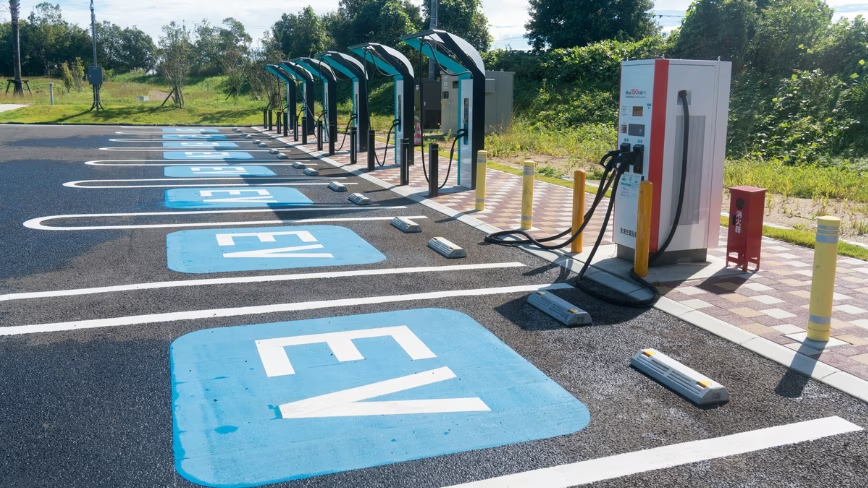
Image: courtesy of Thenextweb
Tesla's Five-Day Rebate Sweep: What It Means for California's EV Push
Tesla buyers exhausted their allocated share of California's new MyFirstEV rebate program in just five days, from August 3 to August 8, 2026. This rapid depletion occurred despite the program's design, which reportedly aimed to give an advantage to other California-based electric vehicle manufacturers. The rebate offered $3,500 for new and $1,750 for used zero-emission vehicles, applied directly at the point of sale.
Outlook
Background
The MyFirstEV scheme is a new incentive program launched by California, designed to encourage first-time buyers to switch to electric vehicles. For Tesla buyers, the rebates became available on August 3, 2026, and their entire share was depleted by August 8, 2026, according to a spokesperson for the California Air Resources Board (CARB) who confirmed the details to InsideEVs. The program is part of a broader $271 million state initiative, with California contributing $135.5 million. The funds are not a single central pot but are instead split and allocated among participating car manufacturers. The rebate offers a $3,500 discount on new zero-emission vehicles and $1,750 on used ones, a significant feature being its application at the point of sale, rather than as a tax credit months later. While Tesla, Hyundai, and Lucid dealerships went live with these instant rebates on August 7, 2026, other major manufacturers including Ford, Rivian, Chevrolet, and Kia are scheduled to begin offering the discounts later in August 2026.
Precedents
California has long been a frontrunner in electric vehicle adoption and in implementing aggressive environmental policies aimed at reducing emissions. This rapid exhaustion of EV incentives is not an isolated incident in the history of consumer-facing environmental programs. Similar patterns have emerged with previous federal and state-level rebates for solar panel installations or 'cash for clunkers' vehicle trade-in schemes, where initial demand often outstripped available funds, leading to swift depletion and subsequent calls for additional funding or program adjustments. Tesla, specifically, has consistently demonstrated exceptionally strong demand in California, its home market, frequently outpacing competitors even in the absence of direct purchase incentives. This enduring brand loyalty, coupled with its established Supercharger network, has historically given Tesla a significant advantage in the state. The company's ability to quickly absorb these funds, even when the program was reportedly structured to favor other local manufacturers, underscores a persistent market dynamic where Tesla often dictates the pace of consumer uptake in the EV sector.
Tesla's swift consumption of its allocated rebate funds sends a clear, if perhaps unsettling, signal to both the market and policymakers: consumer demand for Tesla vehicles in California remains exceptionally high, even for a relatively modest state incentive. This event raises fundamental questions about the efficacy of California's incentive strategies. If a dominant player can absorb a significant portion of the allocated funds in a matter of days, it challenges the program's ability to diversify the EV market or provide substantial support to emerging manufacturers. For California regulators, this rapid depletion suggests that the current funding levels or distribution mechanisms might not be adequately scaled to meet actual consumer enthusiasm, or that the policy's underlying assumptions about demand elasticity and brand preference need re-evaluation. The goal of such programs is typically to accelerate the broader transition to EVs, but if the incentives primarily benefit a company that already commands a substantial market share, the incremental impact on overall adoption rates for new buyers might be less than intended. For other EV manufacturers, Tesla's performance is a stark reminder of the competitive landscape. While it confirms a robust overall appetite for electric vehicles, it also highlights the challenge of competing with Tesla's brand power and market momentum, even when policy aims to create a more level playing field. Finally, for the first-time EV buyers the program targets, the fleeting availability of these incentives means that the window of opportunity for a significant discount can close quickly, potentially leading to frustration or the need to accelerate purchase decisions.
Scenarios
Analysis[{"title":"California Regulators Re-evaluate Program Structure and Funding","description":"The California Air Resources Board (CARB) and state legislators could face immediate pressure to re-evaluate the MyFirstEV program. One possible outcome is an increase in the total funding allocated to the scheme, acknowledging that initial estimates for demand were too conservative. Alternatively, regulators might adjust the allocation structure, perhaps by increasing the share for other manufacturers or implementing caps on how quickly any single brand can deplete its funds to ensure a more equitable distribution over time. Any such changes, however, would require legislative approval and additional budget allocation, suggesting that immediate adjustments might not be feasible, leading to a period where the program continues under its current, potentially underfunded, structure."},{"title":"Shifting Dynamics for Other EV Manufacturers","description":"With Tesla's portion of the MyFirstEV rebate now exhausted, demand for other participating brands, such as Hyundai, Lucid, Ford, Rivian, Chevrolet, and Kia, could see a noticeable uptick. Consumers primarily motivated by the point-of-sale discount may shift their attention to these manufacturers, providing an unexpected boost to their sales in California. Conversely, it is also possible that if the rapid Tesla uptake reflects a deeper, unaddressed brand preference, other manufacturers might find their allocated funds sitting unused for longer periods, struggling to attract buyers who were primarily seeking a Tesla. This scenario would highlight the continued dominance of Tesla's brand and the significant challenges other carmakers face in capturing market share, even with state support."},{"title":"Sustained Unincentivized Demand for Tesla","description":"Despite the depletion of its state rebate allocation, Tesla's sales in California may continue to thrive, driven by its strong brand appeal, established charging infrastructure, and product desirability. This could indicate that for many Tesla buyers, the $3,500 rebate was a welcome bonus rather than a critical factor in their purchase decision. If sales remain robust without the state incentive, it might reduce the perceived urgency for California to tailor future programs specifically for Tesla, potentially allowing regulators to focus incentive efforts more heavily on supporting other manufacturers or targeting specific consumer segments where financial incentives are more critical to drive initial EV adoption."}]
Timeline
2026-08-03
MyFirstEV Rebate Goes Live for Tesla
California's new MyFirstEV scheme opens for Tesla buyers, allowing them to claim instant rebates on zero-emission vehicles.
2026-08-07
Governor Newsom Announces Live Rebates
Governor Gavin Newsom announces that Tesla, Hyundai, and Lucid dealerships in California have gone live with instant rebates.
2026-08-08
Tesla's Allocation Depleted
Tesla's entire allocated share of the MyFirstEV rebate program is exhausted within five days of becoming available to its buyers.
Late August 2026
Other Manufacturers Join Scheme
Ford, Rivian, Chevrolet, and Kia are scheduled to begin offering the MyFirstEV rebates to their customers.
Frequently Asked Questions
The MyFirstEV program is a new California state initiative designed to encourage first-time buyers to purchase zero-emission vehicles. It offers point-of-sale rebates: $3,500 for new EVs and $1,750 for used EVs, directly reducing the purchase price.
Discussion
Be the first to share your thoughts.