
South Korea's plan to create a military force where every soldier understands drone operation marks a profound shift in national defense. Instead of a specialized unit, the drone becomes a standard piece of equipment, much like a rifle or a radio. This approach implies a future battlefield where aerial surveillance, reconnaissance, and even strike capabilities are decentralized and available at the lowest tactical levels. The immediate expectation is a massive overhaul of military training academies, a significant ramp-up in drone procurement, and a sustained investment in domestic drone technology. The program aims to ensure that by the end of the decade, a South Korean soldier's basic skill set will include piloting and utilizing unmanned aerial vehicles, fundamentally altering troop deployment and engagement strategies.
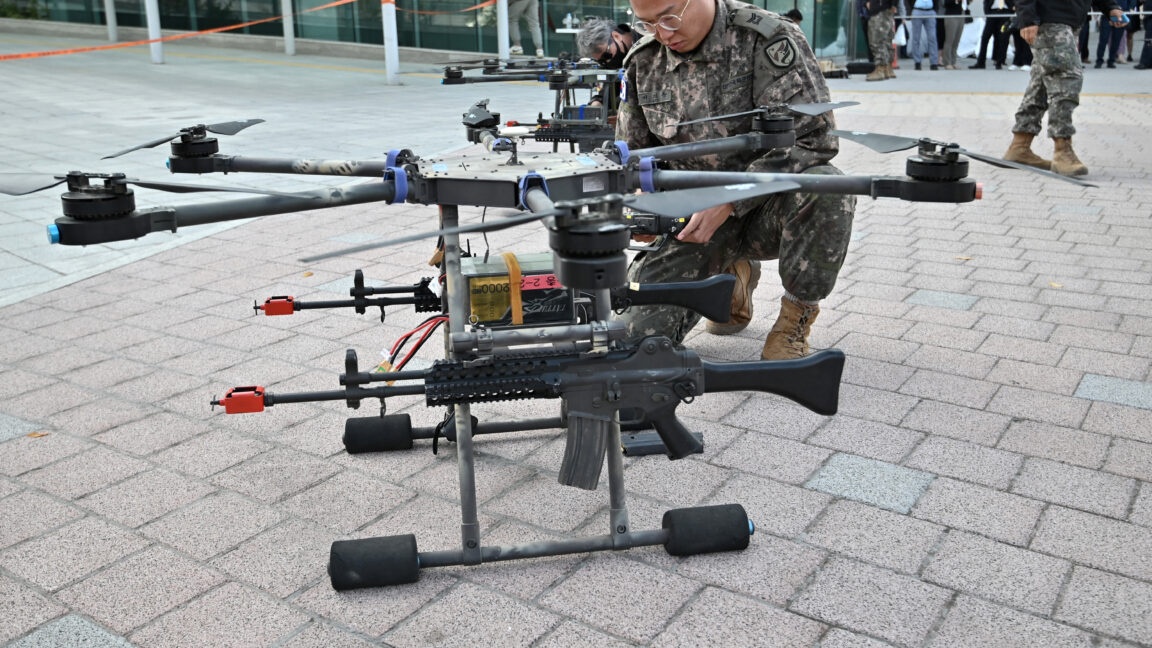
Image: courtesy of Ars Technica
South Korea's Half-Million 'Drone Warriors' Plan: Ambition Meets Battlefield Reality
South Korea is embarking on an ambitious military transformation, aiming to train 500,000 personnel as 'drone warriors' and acquire 110,000 drones by 2029. This initiative, announced in September 2025, seeks to integrate drone operation into the mandatory service of every conscript, fundamentally reshaping Seoul's defense strategy in response to evolving threats from North Korea and lessons from modern conflicts.
Outlook
Background
The genesis of South Korea's 'drone warrior' initiative lies squarely in the escalating military posture of North Korea and the stark lessons drawn from recent global conflicts. Pyongyang has steadily advanced its own drone capabilities, including the development of smaller, harder-to-detect systems and, reportedly, even weaponized drones. This creates a dual threat: North Korean drones for surveillance or attack, and the potential for swarms to overwhelm traditional air defenses.
The conflict in Ukraine, in particular, has demonstrated the transformative power of drones, from commercially available quadcopters adapted for reconnaissance and grenade drops to sophisticated military-grade systems. These unmanned platforms have proven critical for targeting, logistics disruption, and even psychological operations, often at a fraction of the cost of traditional air assets. Seoul's defense strategists have observed how drones have become indispensable tools for both offense and defense, prompting a re-evaluation of its own readiness.
Historically, South Korea has maintained a robust, technologically advanced military, often relying on a combination of mandatory conscription and high-tech weaponry to deter North Korean aggression. The 'drone warrior' program represents an evolution of this doctrine, seeking to leverage technological superiority and mass training to maintain a defensive edge. The decision to integrate drone training into mandatory service for all conscripts signals a deep institutional commitment, recognizing that the future of warfare demands universal familiarity with these systems, not just specialized units.
See also
Precedents
The idea of fundamentally re-equipping and retraining an entire military force is not new, though the speed and technological focus of South Korea's drone initiative are notable. Historically, major shifts in military doctrine have often followed periods of significant technological advancement or lessons learned from large-scale conflicts.
Consider the widespread adoption of machine guns in the early 20th century, which forced a complete rethinking of infantry tactics and trench warfare. Later, the rise of mechanized units and air power in the interwar period reshaped ground combat and strategic bombing. In each case, the integration of new technology required not just procurement, but a complete overhaul of training, logistics, and command structures.
More recently, the shift towards network-centric warfare and precision-guided munitions transformed Western militaries in the late 20th and early 21st centuries. These changes, however, often involved smaller, highly specialized units and focused on expensive, high-end systems. What sets South Korea's drone plan apart is its scale: aiming to equip every soldier with a basic drone capability, democratizing a technology that was once the domain of specialists.
This mass integration strategy echoes historical efforts to standardize basic skills across a large conscript army, such as marksmanship or basic field engineering. The challenge, historically, has been maintaining proficiency across such a large and constantly rotating force, especially with rapidly evolving technology. The success of similar large-scale military transformations has often hinged on sustained political will, consistent funding, and an adaptable training infrastructure.
The implications of South Korea transforming its entire military into 'drone warriors' extend far beyond the Korean Peninsula, touching on regional security, global military doctrine, and the future of defense technology. For South Korea, this move is a direct response to an existential threat. A digitally empowered, drone-savvy military could significantly enhance its reconnaissance capabilities along the heavily fortified border, provide real-time battlefield intelligence, and offer new options for precision strikes or swarm tactics against North Korean targets.
This strategy also seeks to level the playing field against a numerically superior North Korean army, leveraging technological advantage and individual soldier empowerment. If successful, it could create a significant deterrent, making any North Korean incursion far more costly and complex. However, failure to execute effectively could leave South Korea with a hollow capability, having invested heavily without achieving the desired operational edge.
Globally, this program serves as a critical test case for how a modern, conscript-based military can rapidly adapt to emerging technologies. Other nations facing similar demographic challenges or regional threats will be watching closely to see if South Korea can overcome the immense logistical and training hurdles. It could set a new standard for military readiness, where basic digital literacy and drone operation become as fundamental as physical fitness and rifle drills. Furthermore, the emphasis on domestic drone development could spur innovation within South Korea's defense industry, creating new export opportunities and strengthening its position in the global defense technology market.
Scenarios
AnalysisThere are several potential outcomes as South Korea pushes forward with its 'drone warrior' initiative, each carrying distinct consequences for regional stability and military innovation.
One possible outcome is that South Korea successfully integrates drone operations across its entire force, establishing a highly agile and technologically advanced military. This would significantly bolster its defensive capabilities against North Korea, potentially deterring aggression by raising the perceived cost of conflict. Such a success could also position South Korea as a global leader in integrating advanced technology into mass military training, influencing defense doctrines worldwide. This scenario would require sustained funding, effective training methodologies that account for rapid technological changes, and robust domestic drone production.
Conversely, the program could face substantial logistical and operational challenges, leading to a less effective outcome. Training 500,000 personnel in complex drone operations, maintaining equipment, and keeping pace with rapidly evolving technology presents immense hurdles. Budget constraints, technical glitches, or difficulties in integrating such a diverse range of drone capabilities into existing command structures could dilute the program's impact. In this scenario, while South Korea would still possess increased drone assets, the full vision of a universally 'drone-savvy' military might remain elusive, potentially leaving gaps in its defensive posture despite the significant investment.
A third possibility involves a technological arms race on the Korean Peninsula. If South Korea successfully deploys its drone warriors, North Korea may redouble its efforts to develop counter-drone technologies, including electronic warfare systems, anti-drone lasers, or more sophisticated air defense networks. This could lead to a constant cycle of innovation and counter-innovation, with each side seeking to nullify the other's advancements. Such a dynamic could further escalate tensions, even as it drives rapid technological development in the region.
Timeline
Frequently Asked Questions
Discussion
Be the first to share your thoughts.