
The discovery of these solar vortices marks a significant step, but it is far from the final answer to the Sun's atmospheric heating mystery. Scientists will now focus on developing more sophisticated computer models to simulate these Kelvin-Helmholtz instabilities and their role in energy transport. Further observations with the Inouye Solar Telescope, and potentially other advanced instruments, will be crucial to confirm the prevalence and behavior of these vortices across different regions of the Sun and during various phases of its activity cycle. The scientific community will likely see a surge in research papers exploring the implications for coronal heating, solar wind acceleration, and the generation of solar flares and coronal mass ejections. This is the beginning of a new chapter in solar physics, not the end.
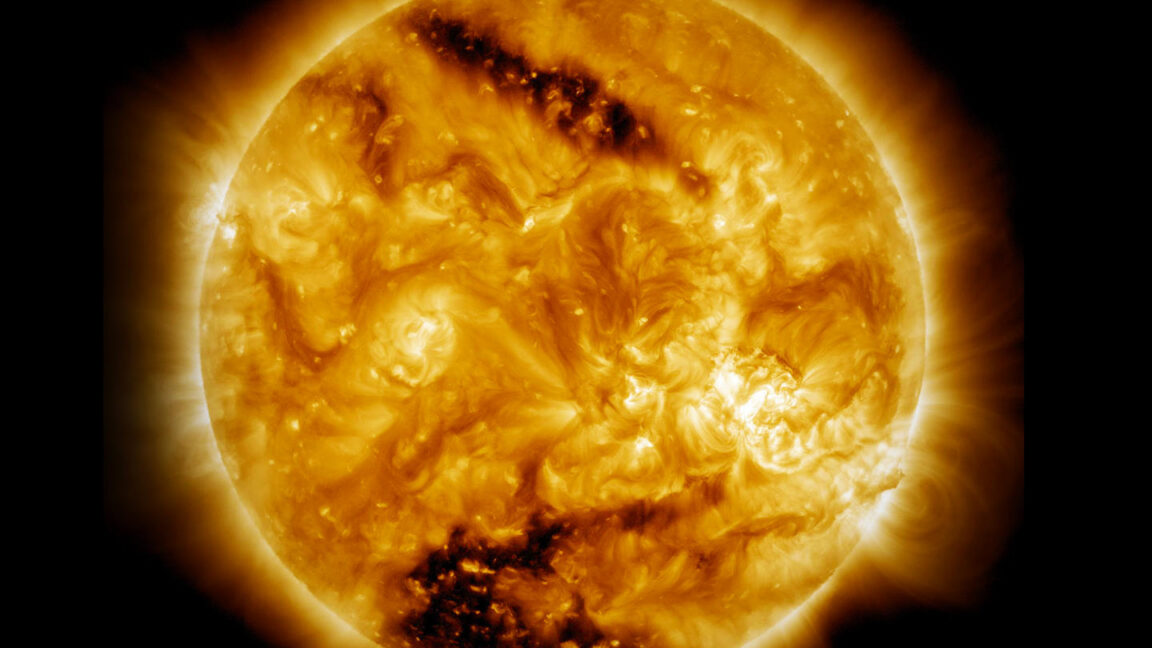
Image: courtesy of Ars Technica
The Sun's Hidden Vortices: What The Inouye Telescope Just Revealed About Our Star
For decades, solar physicists have grappled with a fundamental puzzle: why the Sun's outer atmosphere, the corona, is dramatically hotter than its surface. New images from the world's largest solar telescope, the Daniel K. Inouye Solar Telescope, have now offered a compelling clue. On April 14, 2025, during a brief observation window, an international team captured unprecedented detail of tiny, swirling plasma vortices on the Sun's surface. These structures, previously unseen due to their minute size, are consistent with Kelvin-Helmholtz instabilities, a phenomenon known to drive energy transfer in fluids. This discovery, confirmed in August 2026, suggests a new mechanism for how heat and magnetic energy might be pumped from the Sun's visible surface into its superheated upper layers, potentially reshaping our understanding of solar dynamics and space weather.
Outlook
Background
The Sun’s visible surface, the photosphere, registers temperatures around 5,500 degrees Celsius (9,932 degrees Fahrenheit). Yet, its corona, the outermost layer of its atmosphere, blazes at over a million degrees Celsius. This counterintuitive temperature gradient has been one of astronomy's most enduring questions. Traditional models have pointed to various mechanisms, including magnetic reconnection and waves, but none have fully accounted for the observed heat. The Daniel K. Inouye Solar Telescope, situated near the summit of Haleakalā in Maui, Hawaii, was specifically designed to provide the highest-resolution images of the Sun's surface, enabling scientists to observe features as small as 20 kilometers (12 miles) across. This capability was critical for spotting the newly discovered vortices, which are remarkably small but appear to play a disproportionately large role in energy dynamics. The research involved collaborators from the U.S. National Science Foundation National Solar Observatory (NSF NSO), the Max Planck Institute for Solar System Research (MPS) in Germany, and the High Altitude Observatory (HAO) in the U.S.
Precedents
Major breakthroughs in solar physics often follow the introduction of new observational capabilities. For instance, the development of helioseismology in the late 20th century allowed scientists to probe the Sun's interior using sound waves, revealing its internal structure and dynamics. Similarly, the launch of space-based observatories like SOHO and STEREO provided continuous, unobstructed views of the corona and solar wind, leading to a deeper understanding of space weather phenomena. The Inouye Solar Telescope, with its unparalleled resolution, represents the next leap in ground-based solar observation. Historically, when new, fine-grained details of the Sun's surface or atmosphere are uncovered, they tend to either refine existing theories or necessitate entirely new ones, as appears to be the case with these vortices. The pattern is one of iterative discovery: better tools lead to unexpected findings, which in turn drive theoretical revisions and further targeted observations.
The Sun is not merely a distant star; it is the primary driver of space weather, which directly impacts Earth. Solar flares and coronal mass ejections (CMEs) can disrupt satellite communications, damage power grids, and expose astronauts to dangerous radiation. A deeper understanding of how the Sun transfers energy into its corona is fundamental to improving predictions of these events. If Kelvin-Helmholtz instabilities are indeed a significant mechanism for coronal heating, it implies that small-scale, turbulent processes on the Sun's surface are far more influential than previously thought. This could lead to more accurate models of solar activity, offering earlier warnings for potential disruptions to our increasingly technology-dependent infrastructure. For scientists, it means revising foundational theories about magnetohydrodynamics and plasma physics in extreme environments. For everyone else, it means potentially more reliable GPS, fewer power outages caused by solar storms, and safer space travel.
Scenarios
AnalysisOne immediate outcome is a re-evaluation of current models of coronal heating. The presence of these small-scale vortices suggests that a significant portion of the energy transfer into the corona might occur through turbulent mixing at the boundaries of magnetic structures, rather than solely through larger-scale magnetic reconnection events or wave propagation. This could lead to new theoretical frameworks that integrate these micro-vortices as a crucial component of solar atmospheric dynamics.
Another likely outcome is a push for even higher-resolution observations and advanced computational simulations. The discovery was made during a three-minute observation window at a specific wavelength. Future research will need to determine how widespread these vortices are, how long they persist, and how their properties change in different solar regions, such as sunspots or quiet areas. This will require sustained observation campaigns and the development of simulation tools capable of modeling plasma behavior at these newly revealed scales, potentially leading to breakthroughs in our understanding of turbulence in magnetized plasmas, a field with applications extending beyond solar physics to fusion energy research.
Timeline
Frequently Asked Questions
Discussion
Be the first to share your thoughts.