
The discovery of S301 is more than just finding another star; it presents a rare cosmic laboratory. Researchers are now positioned to meticulously observe S301's path, looking for subtle deviations caused by the black hole's rotation. These observations will likely involve continued use of advanced telescopes, including those that initially tracked S301, to gather data with extreme precision. The process of interpreting this data will be complex, requiring sophisticated models of general relativity to isolate the effects of spin from other gravitational forces. The scientific community can expect a concerted effort to refine these measurements over the coming years, potentially leading to a definitive answer regarding Sagittarius A*'s spin rate.
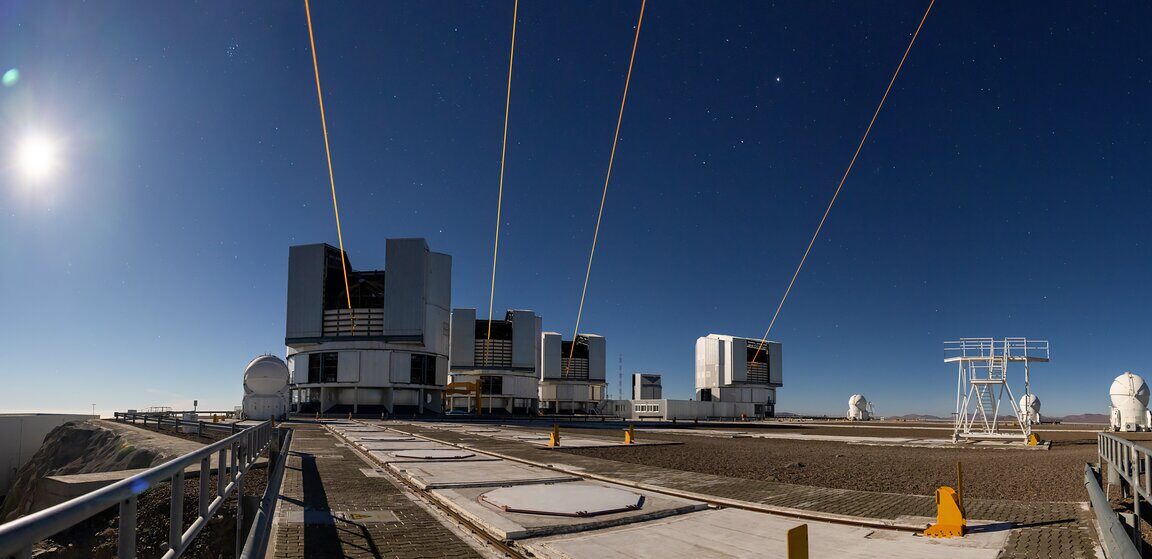
Image: courtesy of Ars Technica
Beyond the Discovery: How S301's Extreme Orbit Could Finally Measure Sagittarius A*'s Spin
Scientists have recently identified S301, a star orbiting closer to the Milky Way's central supermassive black hole, Sagittarius A*, than any other known star. This extreme proximity, with an orbit completed in just 8.7 years and an approach distance comparable to Saturn's orbit around the Sun, offers an unprecedented opportunity. While the discovery of S301 itself is a confirmed fact, its unique trajectory provides a new pathway to potentially measure the elusive spin of Sagittarius A*, a key parameter that has remained largely unknown. Understanding this spin could fundamentally reshape our understanding of black hole physics and galactic evolution.
Outlook
Background
At the heart of our Milky Way galaxy lies Sagittarius A (Sgr A), a supermassive black hole with a mass equivalent to about 4 million Suns. Despite its immense gravitational pull, directly observing Sgr A is challenging due to dense clouds of gas and dust that obscure it, and because black holes themselves do not emit light. Our understanding of Sgr A largely comes from observing the stars that orbit it, known as S-stars. These stars move at incredible speeds, providing clues about the black hole's mass and the spacetime curvature around it.
Before S301, stars like S2 and S0-102 were among the closest known, with S2 having an orbital period of about 16 years. The closer a star gets, the more pronounced the relativistic effects become, offering a window into the extreme physics near the event horizon. The recent confirmation of S301, which travels at approximately 25,000 kilometers (15,500 miles) per second at its closest approach, significantly surpasses previous observations in terms of orbital proximity and speed.
This discovery emerged from observations made in 2023. Scientists were able to track S301 as it moved away from the black hole, then used orbital estimations to predict its past positions, confirming its existence and trajectory in earlier data. The fact that S301 completes an orbit in just 8.7 years means astronomers can observe multiple passes in a relatively short timeframe, which is crucial for refining measurements. The environment around Sgr A* is extreme, with intense radiation and gravitational forces. Even so, recent observations by the James Webb Space Telescope, confirmed on August 11, 2026, have revealed that dust and water can surprisingly form and survive in this harsh region, adding another layer of complexity to the understanding of our galactic center.
Precedents
The study of stars orbiting Sagittarius A has a history of groundbreaking discoveries, consistently pushing the boundaries of astrophysics. For decades, astronomers have been meticulously tracking these 'S-stars' to probe the nature of the galactic center. The first major breakthrough came with the confirmation of Sgr A as a supermassive black hole, largely thanks to observations of S2's orbit. This star's elliptical path allowed scientists to precisely measure the black hole's mass and confirm its compact nature.
Later, the observation of S2's periapse (closest approach) in 2018 provided direct evidence of gravitational redshift, a prediction of Einstein's theory of general relativity, where light loses energy as it climbs out of a strong gravitational field. This was a significant validation of relativistic effects near a supermassive black hole.
Historically, each closer-orbiting star discovered has yielded new insights. The pattern is clear: increased proximity to the black hole allows for the detection of more subtle and extreme gravitational phenomena. The discovery of S301 follows this pattern, representing the next logical step in this observational progression. Each new, tighter orbit provides a more sensitive probe of the spacetime fabric, allowing scientists to test general relativity in ever more extreme conditions and potentially uncover new physics. The challenge, as always, has been the technological capability to resolve these faint, fast-moving objects in a crowded and obscured field of view. Advances in adaptive optics and infrared astronomy have been critical in enabling these successive discoveries.
Measuring the spin of Sagittarius A is one of the last major unknowns about our galaxy's central black hole, and its importance extends far beyond academic curiosity. A black hole's spin, or angular momentum, is a fundamental property, alongside its mass and electric charge. For Sgr A, its charge is considered negligible, making mass and spin the two defining characteristics. We have a relatively precise measurement of its mass, but spin has remained elusive.
Knowing Sgr A*'s spin rate would provide critical clues about its formation history. Did it grow primarily by slowly accreting gas and dust over billions of years, which would likely result in a lower spin? Or did it form through a series of mergers with other black holes or massive objects, which could impart a higher spin? The spin rate acts as a cosmic fossil, preserving information about the violent events that shaped the early Milky Way.
Furthermore, a precise spin measurement allows for a more rigorous test of Einstein's theory of general relativity in an extreme gravitational environment. Black hole spin causes a phenomenon called 'frame-dragging,' where the rotating black hole literally drags spacetime around with it. The closer an object is to the black hole, the more pronounced this effect. S301's incredibly tight orbit means it will experience frame-dragging more intensely than any previously observed star, offering a unique opportunity to detect and quantify this effect.
Finally, understanding the spin is vital for modeling the behavior of matter around Sgr A. The accretion disk of gas and dust feeding the black hole, as well as the powerful jets that some black holes emit, are strongly influenced by the black hole's spin. A spinning black hole can extract energy from its rotation, powering these energetic phenomena. A clearer picture of Sgr A's spin would enhance our simulations of how galactic centers evolve, how they interact with their host galaxies, and even how they might influence star formation in their vicinity.
Scenarios
AnalysisThe discovery of S301 opens several distinct paths for future scientific inquiry and potential breakthroughs:
1. First Definitive Measurement of Sagittarius A's Spin: The most immediate and significant outcome could be the first precise measurement of Sgr A's spin. The tight, elliptical orbit of S301 offers a unique opportunity to detect the subtle, relativistic effects of frame-dragging caused by a spinning black hole. By carefully tracking S301's orbital precession – how its elliptical path slowly rotates in space – scientists could isolate the signature of the black hole's spin. This would represent a major triumph for observational astrophysics and general relativity. If successful, it would move Sgr A* from a black hole whose mass we know, to one whose full characteristics, including spin, are understood.
2. Refined Tests of General Relativity in Extreme Gravity: Even if a definitive spin measurement proves difficult, the detailed observations of S301's orbit will provide unprecedented data for testing general relativity. The star's extreme proximity and speed mean it experiences gravitational forces far stronger than anything measurable in our solar system. Any deviation from the predictions of general relativity, however small, could point towards new physics beyond Einstein's theory. This could lead to a deeper understanding of gravity itself, particularly in the most extreme cosmic environments.
3. New Insights into Galactic Center Evolution: The eventual determination of Sgr A*'s spin rate will offer crucial insights into the history of the Milky Way's core. A high spin rate would suggest a history dominated by mergers of other black holes or significant, sustained accretion of matter with a consistent angular momentum. A low spin rate might point to a more chaotic accretion history or growth through smaller, randomly oriented gas clouds. This information would help refine models of how supermassive black holes grow and how they influence the evolution of their host galaxies over cosmic timescales.
4. Unveiling Unexpected Phenomena: It is also possible that the extreme environment S301 traverses could reveal entirely new and unexpected astrophysical phenomena. The region around Sgr A* is still poorly understood in many respects. The intensive, high-resolution observations required to track S301 might inadvertently detect other objects, transient events, or previously unobserved interactions between the black hole and its immediate surroundings. This could lead to unforeseen discoveries that reshape our understanding of black hole environments.
Timeline
Frequently Asked Questions
Discussion
Be the first to share your thoughts.