
Veridact
TechSportsFinanceGaming🎯 Predictions⭐ OpportunitiesAbout
Sign InSign Up
Veridact

Analysis before the headline. Veridact examines technology, finance, sports, and gaming events before they unfold through forecasting, probability modeling, historical precedent, and public prediction tracking.

Stay ahead of what's next

Forecasts, analysis, and prediction updates delivered to your inbox.

Coverage

  • Tech
  • Sports
  • Finance
  • Gaming

Company

  • About Us
  • Privacy Policy

© 2026 Veridact. Forecasting & analysis platform.

Content may include AI-assisted research and analysis. Predictions and opinions should not be considered financial, legal, medical, or investment advice.

tech
Salesforce renames AIForce to SIForce as Trump’s AI rebrand spreads

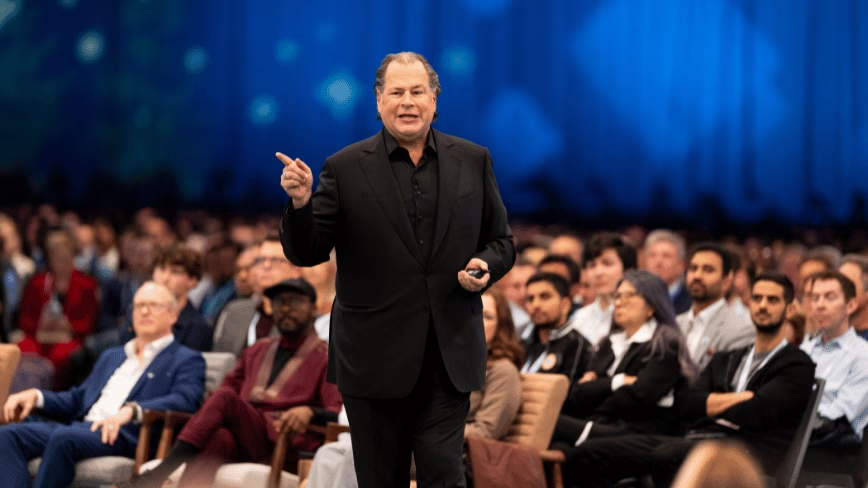
Image: courtesy of Thenextweb

techOctober 11, 2026By Veridact EditorialUpdated Oct 11

Behind Marc Benioff’s Quick Pivot to ‘SIForce’: What Enterprise Tech’s Lexicon Rebrand Really Signals

When Salesforce chief executive Marc Benioff announced on October 10, 2026, that his flagship enterprise agent suite was dropping the letters 'AI' in favor of 'SI'—rebranding AIForce as SIForce—it marked a rapid corporate concession to a presidential directive swapping 'artificial intelligence' for 'super intelligence.' Beyond the social media rhetoric, the shift reveals how fast software giants must move to safeguard federal procurement access, manage White House pressure, and insulate B2B operations from political friction.

Outlook

The swift renaming of Salesforce’s autonomous agent platform from AIForce to SIForce on October 10, 2026, offers a textbook lesson in corporate risk mitigation under regulatory pressure.

Following a White House executive directive instructing federal departments and high-profile commercial vendors to retire the term 'artificial intelligence' in favor of 'super intelligence,' Benioff chose compliance over debate. 'The era of Super Intelligence is here. AIForce is officially SIForce,' he posted on X. The shift followed a similar commitment from Elon Musk days prior to rebrand SpaceXAI as SpaceXSI.

Yet beneath the surface, the tactical limits of this rebranding are already apparent. The operational name change applies strictly to the company’s enterprise agent product line. Salesforce’s corporate structure, stock ticker, and San Francisco headquarters remain untouched. The fundamental architecture of the underlying software has not changed overnight. What has changed is the administrative shield surrounding the product line.

By moving quickly, Salesforce avoids potential friction in federal contracting cycles, where agencies may soon be required to align procurement terminology with executive branch mandates. For enterprise software providers whose revenue depends on government and heavily regulated sectors, aligning product terminology with presidential directives is a minor marketing adjustment that prevents major commercial friction.

Background

To understand why a major enterprise software platform changed its flagship product name in a matter of hours, one must look at the legal and financial mechanisms governing federal software sales.

Presidential directives regarding technology terminology carry significant weight across federal procurement offices. When an executive order mandates that executive branch agencies adopt specific framing—in this instance, prioritizing 'super intelligence' to describe high-capability autonomous software systems—the mandate trickles into agency requests for proposals, defense contracts, and civil agency software grants.

This creates an immediate dilemma for enterprise software vendors. A major cloud vendor maintaining a product explicitly labeled 'AIForce' risks administrative delays, contractual review hold-ups, or formal rejection from agency procurement officers tasked with adhering to White House directives.

This dynamic explains why Benioff acted rapidly following White House public commentary on corporate tech compliance. Salesforce generates substantial recurring revenue from government deployments, public sector utility systems, and state-level cloud modernizations. Maintaining terminology that clashes with executive directives creates unnecessary operational risk for a multi-billion-dollar product line.

Precedents

This is not the first time enterprise technology companies have altered core product branding and operational vocabulary to maintain political alignment or regulatory compliance.

During the passage of federal supply-chain security acts over the past decade, major software vendors quietly erased specific geographic and infrastructural references from their product lines to pass state department and defense sector auditing. Enterprise platforms routinely offer dual-branded interface layers and localized feature names when selling into international jurisdictions like China, Saudi Arabia, or the European Union, where local statutory definitions dictate acceptable terminology for security and data retention.

Historically, when administrative orders target industry terminology, commercial tech vendors rarely fight back on vocabulary. Instead, they comply at the product layer while preserving their primary corporate identity. Benioff’s decision to limit the rebrand strictly to the agent suite—while keeping the corporate Salesforce name untouched—mirrors how defense contractors and telecom providers historically segregated compliance-heavy software variants from their main corporate branding.

The enterprise software industry operates on predictable multi-year procurement cycles. Introducing arbitrary lexical mandates creates immediate operational questions for enterprise buyers, partners, and software integration teams.

So why would a software company rebrand its central growth product simply over a political mandate? The answer lies entirely in risk management. A three-character name change on a software suite costs a fraction of a single lost government enterprise contract.

For enterprise CIOs, the shift to 'SIForce' introduces practical administrative tasks. Integration documentation, enterprise deployment templates, and commercial software licensing agreements that previously referenced AIForce must be reviewed to ensure consistency. While the core codebase remains the same, enterprise compliance divisions now face the burden of ensuring their internal technical documentation matches updated software licensing labels.

Internationally, the rebrand creates friction. European and Asian regulators have codified the term 'Artificial Intelligence' into comprehensive statutory frameworks, such as the EU AI Act. US tech firms now face a split vocabulary: adopting 'Super Intelligence' for domestic public sector alignment while maintaining traditional 'AI' classification metrics for foreign regulatory bodies.

Scenarios

Analysis

Analysis suggests several operational trajectories will emerge as enterprise tech adapts to this political terminology shift:

1. Dual-Track Lexical Licensing: Enterprise cloud providers may offer dual-labeled software catalogs. Federal agencies and domestic B2B buyers will procure under 'Super Intelligence' (SI) product lines, while foreign commercial subsidiaries continue using 'Artificial Intelligence' (AI) packaging to align with local regulatory frameworks.

2. Federal Procurement Mandates: Federal contracting offices could begin formally updating contract language, requiring vendors bidding on government IT modernizations to explicitly certify compliance with 'Super Intelligence' platform definitions.

3. Enterprise Product Rebranding Ripple Effect: Other large enterprise software vendors with public sector exposure may follow Salesforce and SpaceX, quietly swapping product prefixes from 'AI' to 'SI' across automated workflows, customer service bots, and predictive analytics tools to avoid regulatory friction.

Timeline

October 2026
Presidential Directive Issued
The White House releases an executive order directing federal agencies and key corporate partners to adopt the term 'super intelligence' over 'artificial intelligence.'
October 8, 2026
Early Commercial Compliance
SpaceX commits to updating its internal and customer-facing technology labels, shifting SpaceXAI branding to SpaceXSI.
October 10, 2026
Salesforce Rebrands Agent Platform
Marc Benioff formally confirms on X that Salesforce's agent software line is changing from AIForce to SIForce, effective immediately.
Late 2026 (Expected)
Federal Procurement Updates
Federal agencies are expected to begin updating enterprise software RFP language to reflect updated presidential software classification guidelines.

Frequently Asked Questions

No. The rebranding applies exclusively to its autonomous agent platform, formerly known as AIForce and now named SIForce. The company's corporate identity, stock ticker (CRM), and San Francisco tower name remain entirely unchanged.

Discussion

0/100
0/1000

Be the first to share your thoughts.

Related Coverage

tech

Why Cirrus Logic Hunted Synaptics — And What Onsemi's $5.7 Billion Cash Response Means for Chipmakers

Oct 11
tech

Inside Nvidia's Pressure Cooker: What a Four-Month Comms Exit Says About Santa Clara's Scaling Pains

Oct 11
tech

Europe’s State-Backed Tech Push Hits 15 Unicorns. The Real Test Is Where They List.

Oct 11
tech

Turkey's Under-15 Social Media Ban Tests the Limits of State-Run Identity Verification

Oct 11

Stay ahead of the story

AI analysis delivered before events unfold. No spam.

ⓘ

Methodology: Veridact combines public data, historical precedent, and analytical models to evaluate the likelihood of future outcomes.