
Veridact
TechSportsFinanceGaming🎯 PredictionsAbout
Sign InSign Up
Veridact

AI-powered anticipation analysis. We cover tech, sports, finance, and gaming events before they happen — with historical context, scenario modeling, and evolving coverage.

Stay ahead of the story

Analysis delivered before events unfold.

Coverage

  • Tech
  • Sports
  • Finance
  • Gaming

Company

  • About Us
  • Privacy Policy

© 2026 Veridact. AI-assisted analysis platform.

Analysis is AI-generated and not professional financial, legal, or medical advice.

tech
Delivery robot startup Robot.com bets its next act on wheeled humanoids for kitchens and warehouses

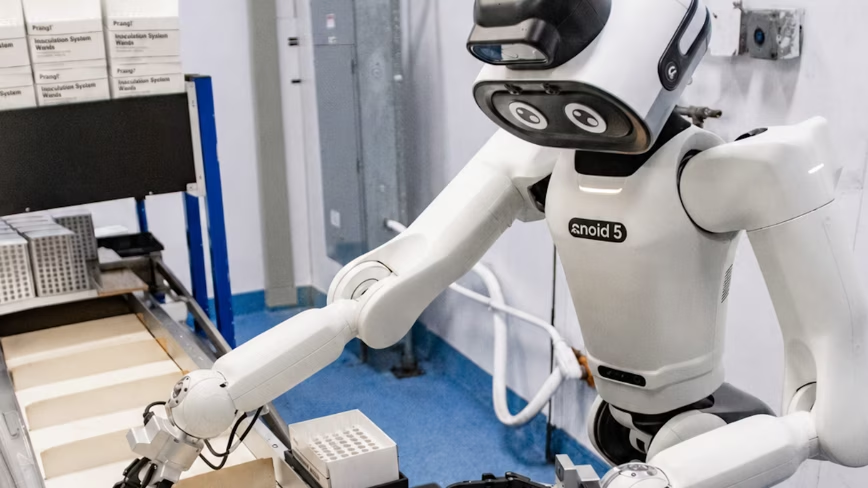
Image: courtesy of Thenextweb

techJune 23, 2026By Veridact EditorialUpdated Jun 23

Robot.com Pivots from Delivery Bots to Wheeled Humanoids for Industrial Work

Robot.com, known previously as Kiwibot for its campus delivery robots, has made a significant strategic shift, launching a wheeled humanoid robot named R-noid. This new robot is designed for repetitive tasks in industrial settings like kitchens and warehouses, including packaging orders, loading boxes, and preparing workstations. The move places Robot.com squarely in the emerging, yet challenging, market for workplace humanoids, a sector currently marked by low buyer satisfaction despite high potential.

Implications

Robot.com's new R-noid robot is a humanoid on wheels, built to tackle specific, repetitive physical tasks within commercial and industrial environments. The company, which revealed its pivot yesterday, on June 22, confirmed that R-noid is already deployed with roughly a dozen customers, performing roles in food service, logistics, and healthcare facilities. These tasks include packaging orders, efficiently loading and unloading boxes, and setting up workstations, aiming to streamline operations and reduce manual labor for these specific functions.

The R-noid integrates artificial intelligence developed by Physical Intelligence, a partner company. This collaboration suggests a focus on advanced robotic perception and manipulation capabilities, crucial for the robot to operate effectively and safely in dynamic human-centric environments. The wheeled design differentiates it from bipedal humanoids like Agility Robotics' Digit, potentially offering greater stability and load-carrying capacity for specific industrial applications, while sacrificing the ability to navigate stairs or uneven terrain.

Background

The strategic pivot by Robot.com, a San Francisco-based startup, represents a calculated move away from the increasingly crowded and competitive market for last-mile delivery robots. The company, originally operating as Kiwibot, gained recognition for its small, autonomous delivery vehicles on college campuses. However, the economics and scalability of campus delivery have proven difficult for many players, with high operational costs and regulatory hurdles. Serve Robotics, for instance, recently announced reaching 1,000 autonomous delivery robots, indicating the scale required to achieve significant market presence.

By contrast, the workplace humanoid market, while nascent, promises higher value applications and potentially larger contracts. Companies are looking for automation solutions that can adapt to existing human workspaces rather than requiring entirely new infrastructure. However, this market also carries substantial risks. The broader humanoid robotics sector is still in its early stages of development, characterized by complex technical challenges and, as recent reports indicate, relatively low buyer satisfaction rates. Early adopters often face high costs, integration difficulties, and robots that struggle with the variability of real-world tasks. Robot.com's success will depend on R-noid's ability to consistently perform its designated tasks reliably and cost-effectively, outperforming the current industry perception.

Precedents

The history of robotics is filled with companies attempting to transition from one niche to another, often driven by market pressures or technological breakthroughs. Early ventures into industrial robotics often began with highly specialized, fixed-arm systems for manufacturing, before expanding into more mobile or collaborative robots. The shift from delivery robots to industrial humanoids mirrors a pattern seen in other tech sectors: startups often begin with consumer-facing or simpler applications to build technology and gain initial funding, then leverage that experience for more complex, enterprise-grade solutions.

However, the leap to humanoids is particularly ambitious. Historically, general-purpose robots capable of diverse tasks have proven far more challenging to develop and deploy than specialized machines. Early humanoid robot initiatives, while technically impressive, often struggled with cost, reliability, and the ability to handle unstructured environments. The low buyer satisfaction rates in the current humanoid market are a direct echo of these past challenges. Companies like Boston Dynamics have showcased advanced bipedal robots for years, but their commercialization, particularly for widespread industrial adoption, has been slower than many expected. This suggests that even with significant technological advancements, the path to widespread deployment for humanoids is typically long and fraught with operational and integration hurdles. The key differentiator for Robot.com will be whether its 'wheeled humanoid' approach, combined with Physical Intelligence's AI, can offer a more practical, robust solution for specific industrial tasks than more general-purpose humanoid designs.

This pivot is a significant test for Robot.com, potentially defining its future trajectory in the rapidly evolving robotics industry. For a startup, moving from a crowded, low-margin segment like delivery robots to the high-stakes, high-potential world of industrial humanoids is a make-or-break decision. If successful, R-noid could establish Robot.com as a key player in automating critical, labor-intensive tasks in sectors facing chronic labor shortages, such as food service and logistics. This could unlock substantial revenue streams and attract further investment.

Conversely, failure to gain significant traction could deplete the company's resources and reputation. The broader robotics industry will be closely watching, as Robot.com's experience will offer valuable insights into the viability of wheeled humanoid designs for specific industrial applications, especially when compared to bipedal counterparts. For businesses, the availability of reliable, cost-effective automation like R-noid could fundamentally alter operational models, improving efficiency and potentially allowing human workers to focus on higher-value tasks. However, it also raises questions about the future of entry-level jobs and the societal implications of widespread robotic adoption in these sectors.

Scenarios

Analysis

One immediate outcome, should R-noid prove effective and reliable in its initial deployments, is that Robot.com could secure larger contracts and expand its customer base beyond the current dozen. This would validate their strategic pivot and attract more venture capital, allowing for further development and scaling of production. The company might then focus on deepening its presence in the initial target sectors—food service, logistics, and healthcare—before considering expansion into other industrial applications.

Another possible outcome is that R-noid, despite its initial deployments, struggles to overcome the prevailing skepticism and operational challenges that have plagued the broader humanoid market. If the robots prove too expensive to maintain, difficult to integrate with existing workflows, or unable to handle the inevitable variability of real-world industrial environments, adoption could stall. This could force Robot.com to either refine its technology significantly, seek another strategic pivot, or face financial difficulties as investment dries up.

A third scenario involves Robot.com finding a niche, but limited, success. R-noid might perform exceptionally well for very specific, highly structured tasks within certain facilities, but fail to achieve the broad, cross-industry adoption the company is likely aiming for. This could lead to a more modest growth trajectory, with the company becoming a specialized provider rather than a dominant force in the wider industrial humanoid market.

Timeline

2024-06-22
Pivot Decision Initiated
Robot.com CEO Felipe Chavez stated the pivot to humanoids has been nearly two years in the making, suggesting planning began around this time.
2026-06-22
R-noid Public Launch and Rebranding
Robot.com, formerly Kiwibot, officially announced the launch of R-noid, its wheeled humanoid robot, targeting industrial and food service applications.
2026-06-22
Initial Deployments Confirmed
The company confirmed R-noid is already deployed with approximately a dozen customers in food service, logistics, and healthcare facilities.

Frequently Asked Questions

R-noid is a wheeled humanoid robot developed by Robot.com (formerly Kiwibot). It is designed to perform repetitive tasks such as packaging orders, loading/unloading boxes, and preparing workstations in industrial settings like kitchens and warehouses.

Discussion

0/100
0/1000

Be the first to share your thoughts.

Related Coverage

tech

Cooling Crisis: Nvidia Takes Aim at Data Center Water, But AI's Thirst Runs Deeper

Jun 23
tech

Microsoft and Chevron Forge 20-Year Deal for Massive Gas-Powered AI Data Center in West Texas

Jun 23
tech

Unpatchable Hardware Flaw Opens Older iPhones to Permanent Jailbreak Risk

Jun 23
tech

AMD Bows to Customer Pressure, Restores Memory Encryption on Consumer Ryzen CPUs

Jun 23

Stay ahead of the story

AI analysis delivered before events unfold. No spam.

ⓘ

Disclosure: This article contains AI-assisted analysis based on publicly available information.