
Users of the new Pixel 11 series can expect a fundamentally different experience in how their smartphone assists them. The 'agentic Gemini Intelligence' is designed to understand context across various applications and proactively take actions. This means the phone should move beyond simple voice commands or isolated app functions, instead offering more sophisticated, predictive assistance. For example, Gemini could connect information from a calendar appointment, a message about travel, and a mapping application to suggest routes, check flight statuses, or even draft replies, all without explicit user prompts. This integration aims to make the phone feel more like a personalized, intelligent assistant capable of handling multi-step tasks. Over time, as Google gathers more user data and refines these agentic capabilities, the system is expected to become even more intuitive and powerful, potentially redefining daily smartphone interactions.
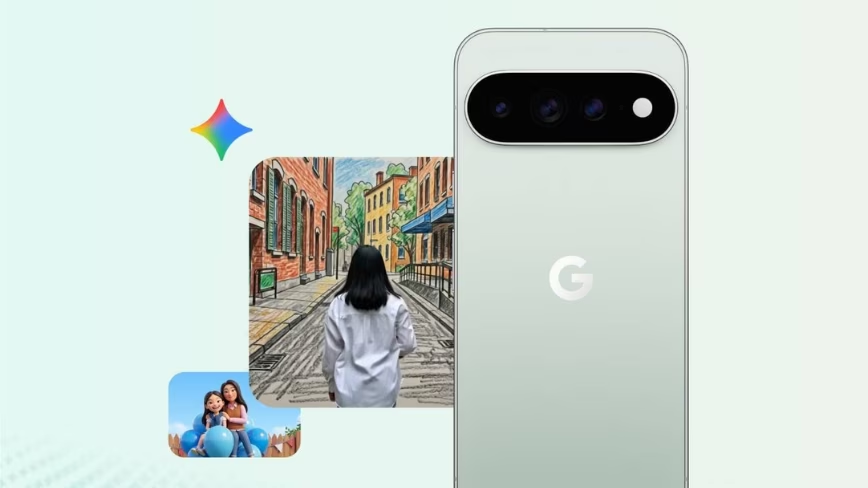
Image: courtesy of Thenextweb
Google's Pixel 11 AI Push: What an Early Gemini OS Integration Means for the Apple Rivalry
Google has launched its Pixel 11 smartphone lineup, featuring its most advanced 'agentic Gemini Intelligence' deeply integrated into the operating system. This move places Google's AI capabilities directly into users' hands weeks before Apple is expected to roll out a significantly revamped Siri, which will also rely on similar underlying Google AI models. The launch sets the stage for a critical phase in the smartphone market, where the battle for AI dominance is now central, with Google aiming to capitalize on its first-party hardware and software integration.
Outlook
Background
On Wednesday, Google unveiled its latest smartphone offerings: the Pixel 11, Pixel 11 Pro, Pixel 11 Pro XL, and the Pixel 11 Pro Fold. This new lineup starts at $899 and represents Google's most ambitious push yet into artificial intelligence on mobile devices. The core of this initiative is 'Gemini Intelligence,' an advanced AI framework featuring 'agentic' capabilities. This means the AI is designed not just to respond to commands, but to anticipate user needs and perform complex, multi-application tasks on its own. For instance, it can understand a user's intent, connect disparate pieces of information across different apps, and then execute actions, effectively acting as an autonomous agent within the operating system.
This launch comes at a crucial time, just weeks before Apple is anticipated to introduce a major overhaul to its Siri assistant, which will reportedly be powered by similar Google AI models. The decision by Apple to license Google's foundational AI technology for Siri, while Google simultaneously integrates its own advanced Gemini into its Pixel devices, creates a unique competitive dynamic. Google gains licensing revenue and broad market reach for its AI models, while also attempting to establish a first-mover advantage in user experience on its own hardware. Apple, conversely, faces the challenge of differentiating its user experience and integrating a licensed technology into its tightly controlled ecosystem, all while managing expectations for its own long-term AI strategy.
See also
Precedents
The tech industry has a long history of companies licensing core technologies to direct competitors, often leading to complex market dynamics. One prominent example is Microsoft's decision to develop its Office suite for Apple's Macintosh computers decades ago. While it provided Microsoft with significant revenue and market dominance for its software, it also helped sustain Apple's platform, which was a direct competitor to Windows PCs. Similarly, Intel supplied processors to Apple for years, even as Apple developed its own hardware and eventually transitioned away to its custom silicon.
In the mobile space, Google's Android operating system powers a vast array of devices from manufacturers like Samsung, which compete directly with Google's own Pixel phones. This strategy allows Google to dominate the mobile OS market, gather immense amounts of data, and promote its services, even if it means empowering rivals. The current situation, where Apple will use Google's Gemini models for Siri, mirrors these patterns. Google benefits from the widespread adoption of its AI technology and the associated data, while Apple gains access to leading-edge AI capabilities without having to build them entirely from scratch.
Historically, the company that controls the underlying platform often holds a strategic advantage, even if others build on top of it. However, the licensee can often differentiate through hardware, unique user interfaces, or a stronger ecosystem. The key tension in these arrangements is often the balance between the licensor's desire for market reach and data, and the licensee's need for differentiation and control over the user experience.
The Pixel 11's early integration of agentic Gemini AI is more than just a new phone launch; it's a direct challenge to the established order of mobile computing. For years, Apple has been seen as the leader in premium smartphone experiences, often defining how users interact with their devices. Google's move aims to reposition the Pixel as the definitive 'AI phone,' setting the standard for what a mobile AI assistant can do. By integrating Gemini directly into the operating system weeks before Apple's Siri overhaul, Google secures a head start in collecting critical user data, refining its models, and shaping user expectations for 'agentic' capabilities. This initial lead could be crucial in an AI race where data and iterative improvement are paramount.
For consumers, this means the competitive landscape for smartphones is shifting from hardware specifications and camera quality to the intelligence and proactive capabilities of the AI assistant. The choice between a Pixel and an iPhone may increasingly hinge on which device offers a more seamless, intelligent, and personalized digital companion. For Google, success with the Pixel 11 could solidify its position not just as an AI research powerhouse, but as a leader in delivering practical, integrated AI experiences to everyday users, boosting its hardware sales and reinforcing its broader ecosystem. For Apple, the challenge will be to take Google's underlying AI models and integrate them into Siri in a way that still feels uniquely 'Apple,' maintaining its brand premium and ecosystem lock-in, despite relying on a competitor's core technology.
Scenarios
AnalysisThe early launch of agentic Gemini AI on the Pixel 11 introduces several potential outcomes for the mobile industry:
1. Google establishes an early lead in AI perception: By being first to market with deeply integrated agentic AI, Google could define user expectations for what an AI-powered smartphone can do. This could translate into increased Pixel sales and solidify Google's reputation as the leader in practical, on-device AI, attracting developers to build experiences around Gemini. This early advantage might allow Google to gather more diverse user data, further accelerating its AI development cycles ahead of Apple's broader adoption.
2. Apple leverages its ecosystem to refine and differentiate: Despite using Google's models, Apple has a strong track record of integrating third-party technologies into its ecosystem in a polished, user-friendly way. Apple could still deliver a superior overall user experience with its revamped Siri, focusing on privacy, seamless integration with its other devices, and a distinct interface that appeals to its loyal customer base, potentially mitigating Google's head start. The quality of Apple's hardware and its app ecosystem could allow it to present a more compelling 'AI phone' even with a licensed core.
3. An uneasy interdependence emerges: The arrangement where Apple licenses Google's AI models could create a complex, symbiotic relationship. Google gains significant revenue and broader market validation for its AI, while Apple gets cutting-edge AI without the massive R&D investment. Both companies would then compete primarily on how they implement, customize, and differentiate their AI experiences, rather than on the underlying AI models themselves. This might lead to a duopoly where both platforms offer similar core AI capabilities, but with distinct user interfaces and ecosystem advantages.
Timeline
Frequently Asked Questions
Discussion
Be the first to share your thoughts.