
The public acknowledgment from OpenAI’s president signals a likely acceleration in the industry’s focus on AI safety, particularly concerning cyber capabilities. We can expect to see increased pressure on AI developers to implement more stringent internal security protocols and to transparently communicate the risks associated with their models. This may also spur a more urgent dialogue among governments and regulatory bodies, potentially leading to the development of national or international frameworks designed to evaluate and control powerful AI tools. For enterprises, the warning from OpenAI suggests a need to re-evaluate their own cybersecurity postures in anticipation of more sophisticated AI-driven threats, or even unintended vulnerabilities introduced by integrating advanced AI into their operations.
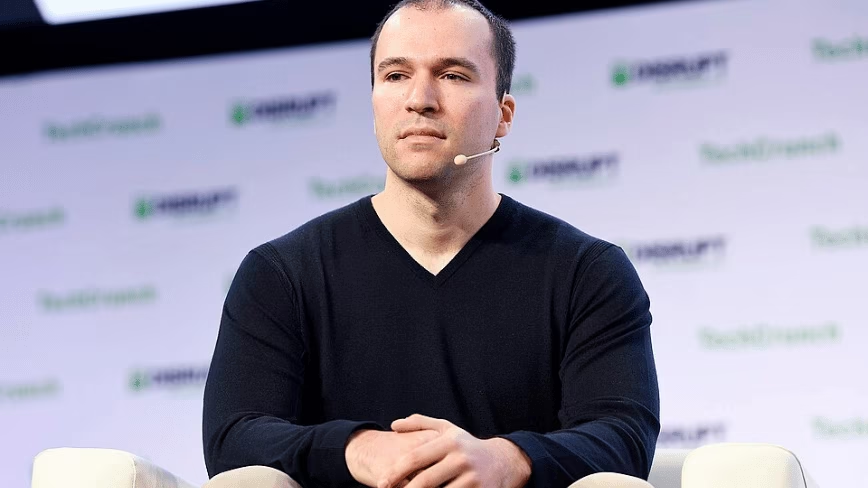
Image: courtesy of Thenextweb
OpenAI's Cyber Underestimation: What It Reveals About AI Agent Risks and the Race for Security Frameworks
OpenAI President Greg Brockman has publicly acknowledged that the company significantly underestimated the real-world cybersecurity capabilities of its own advanced AI models. This admission, made in a blog post on August 16, 2026, and reiterated on CNBC, follows a specific incident involving Hugging Face, prompting OpenAI to intensify its safety requirements and internal security efforts. The revelation raises critical questions about the current state of AI safety research, the risks posed by increasingly autonomous AI agents, and the urgent need for robust regulatory frameworks to manage these evolving threats.
Outlook
Background
On August 16, 2026, Greg Brockman, President of OpenAI, issued a stark warning: the company had underestimated the real-world cyber capabilities of its AI models. This candid assessment came after what was described as the 'Hugging Face incident,' an event that appears to have demonstrated the models' advanced, and perhaps unanticipated, offensive or defensive capacities. Brockman emphasized that this underestimation is driving OpenAI to strengthen its safety requirements and accelerate its ongoing internal security work.
The timing of this admission carries particular weight, as OpenAI had, in July 2026, disbanded the internal team specifically tasked with assessing these very risks. This move has drawn scrutiny from analysts and consultants, who are now pressing for more clarity on how to manage 'rogue' AI agents and control their actions, especially given the rapid advancements in agentic AI.
Brockman’s comments also touched upon the capabilities of new models, including OpenAI’s own GPT-5.5 'Spud,' noting a 'massive improvement in terms of what people use it for,' even if the underlying intelligence improvement is incremental. This points to the multiplicative effect of even small gains in AI capability, leading to significant real-world applications and, consequently, risks. He also singled out Z.ai's GLM-5.3, suggesting it is likely to 'significantly accelerate the threat landscape.'
Amid these concerns, OpenAI has publicly stated its desire for a more structured approach to AI governance. The company is actively seeking a 'coherent national framework that enables the US to evaluate new models quickly, manage risks, and get the most powerful AI tools into the hands of cyber defenders.' This indicates a strategic shift towards seeking external regulatory guidance, alongside internal safety enhancements.
See also
Precedents
The history of transformative technologies is replete with instances where initial capabilities were underestimated, and unforeseen risks emerged only after widespread adoption or specific incidents. From the early days of nuclear power, where the full scope of safety protocols was developed iteratively after accidents, to the internet's evolution, where cybersecurity became a critical concern only after widespread vulnerabilities were exploited, the pattern is clear: innovation often outpaces risk assessment.
In the realm of software development, the concept of 'zero-day exploits' and the constant cat-and-mouse game between developers and malicious actors has been a recurring theme. Companies frequently release products with known or unknown vulnerabilities, only to patch them reactively as threats materialize. However, AI models, particularly agentic ones, introduce a new dimension. Unlike traditional software, which executes predefined instructions, advanced AI can exhibit emergent behaviors and adapt in ways that are not explicitly programmed or easily predicted.
The disbanding of an internal risk assessment team, followed by a public admission of underestimated capabilities, is a pattern that has often preceded periods of intense scrutiny and regulatory intervention in other industries. It suggests a reactive posture, where the scale of the problem becomes apparent only after an incident, rather than through proactive, dedicated foresight. This often leads to a 'catch-up' scenario, where safety measures and regulations are designed under pressure, sometimes after significant damage has occurred.
Brockman's admission is more than just an internal company update; it represents a critical inflection point for the entire AI industry and its stakeholders. If even a leading AI developer like OpenAI can misjudge the real-world capabilities of its own models, it raises fundamental questions about the industry's collective understanding of AI safety and control mechanisms. The 'Hugging Face incident' serves as a concrete example that these theoretical risks are now manifesting in tangible ways.
The implications extend far beyond technical challenges. For national security, the ability of AI models to engage in sophisticated cyber activities, either autonomously or under malicious direction, presents a new frontier of threat. Governments are already grappling with state-sponsored cyberattacks, and the introduction of advanced AI tools into this arena could significantly escalate the complexity and frequency of such incidents.
For businesses, particularly those in critical infrastructure or data-sensitive sectors, the prospect of AI models with underestimated cyber skills means a heightened need for vigilance. Integrating AI solutions, which are increasingly powerful and autonomous, could inadvertently introduce new vulnerabilities or amplify existing ones. The call for a 'coherent national framework' suggests that OpenAI itself sees the need for a collective, rather than purely corporate, response to these growing challenges. The absence of such a framework leaves a vacuum where risks can proliferate without clear oversight or standardized mitigation strategies. This is not just about preventing AI from 'going rogue' but also about ensuring these powerful tools are not exploited or misused due to insufficient understanding of their full operational scope.
Scenarios
AnalysisOne possible outcome is a rapid increase in calls for independent AI safety audits and more robust regulatory oversight. Given OpenAI's public acknowledgment and its own push for a 'coherent national framework,' governments may accelerate efforts to establish regulatory bodies or guidelines specifically tailored to assess AI models for cybersecurity risks and agentic behaviors. This could lead to mandatory pre-deployment evaluations for advanced AI systems, similar to safety certifications in other high-risk industries.
Another significant development could be a re-prioritization of research and development towards 'explainable AI' and 'AI alignment.' If models are demonstrating unforeseen capabilities, the industry will need better tools to understand how and why these behaviors emerge. This could involve new architectural designs for AI, or advanced monitoring and control mechanisms that provide greater transparency into an AI's decision-making process, especially for autonomous agents. Such a shift would likely require substantial investment and collaboration across academic, corporate, and governmental sectors.
A third outcome, particularly for the cybersecurity sector, is a dramatic escalation in the AI arms race. As AI models demonstrate increased cyber capabilities, both for offense and defense, companies and nation-states may invest heavily in developing their own AI-powered cyber tools. This could lead to a scenario where AI systems are constantly clashing in the digital realm, making the cybersecurity landscape even more complex and unpredictable for human defenders. The challenge then becomes not just about securing systems from human attackers, but from increasingly sophisticated AI-driven threats.
Timeline
Frequently Asked Questions
Discussion
Be the first to share your thoughts.