
Expect continued high-profile departures of AI talent from established tech firms as specialized startups attract significant venture capital. The AI drug discovery sector is likely to see more intense competition and larger, earlier-stage funding rounds. However, the path from early valuation to a viable drug remains long and complex, requiring substantial further investment and navigating stringent regulatory hurdles. Initial product announcements or more concrete funding details for Wang's venture could emerge in the coming months, offering a clearer picture of its strategic direction and specific technological approach.
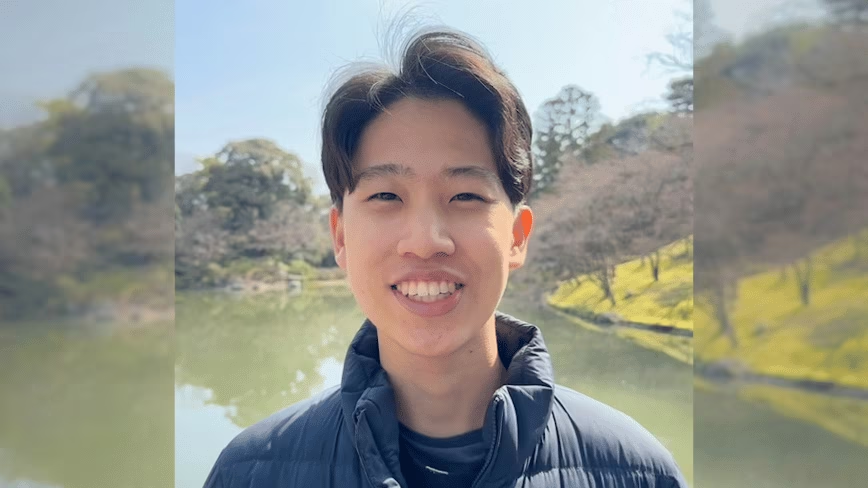
Image: courtesy of Thenextweb
The Implicit Trust: Why an Unnamed AI Drug Startup is Worth $2 Billion Before It Even Has a Product
An OpenAI researcher, Miles Wang, is reportedly leaving the artificial intelligence giant to launch an AI drug discovery company that currently has neither a name nor a product. Despite this early stage, investors are said to be willing to back the venture at a valuation that could reach $2 billion. This move highlights a growing trend of top AI talent moving into specialized applications like biotechnology, and reflects the immense capital flowing into the promise of AI to transform traditionally slow and expensive industries.
Outlook
Background
On July 15, 2026, news emerged that Miles Wang, a researcher at OpenAI, is departing the organization to establish an AI drug discovery company. What makes this particular departure notable is the reported investor interest: even without a formal name or a tangible product, the venture is reportedly attracting a potential valuation of $2 billion. This signals an unusual level of confidence from the venture capital community, placing a significant bet on both Wang’s expertise and the perceived potential of artificial intelligence to revolutionize pharmaceutical research.
OpenAI, known for its foundational work in large language models and generative AI, has become a talent incubator for the broader AI industry. Departures from such high-profile labs are not uncommon, but the scale of the early valuation for Wang’s new company is particularly striking. It suggests that investors are not merely funding an idea, but rather the implicit trust in the individual's ability to translate cutting-edge AI research into a commercially viable and impactful product in a highly complex field like drug development.
AI drug discovery itself is a burgeoning field, promising to accelerate the notoriously slow, expensive, and failure-prone process of bringing new medicines to market. Traditional drug development can take over a decade and cost billions of dollars for a single successful compound. AI's potential lies in its ability to analyze vast datasets, predict molecular interactions, design novel compounds, and optimize clinical trials, theoretically reducing both time and cost. Companies in this space are using AI for everything from identifying new drug targets to synthesizing compounds and predicting their efficacy and toxicity, aiming to streamline every stage of the pipeline.
See also
Precedents
The movement of top research talent from established technology companies to new ventures is a well-established pattern, particularly in emergent fields. Think back to the dot-com boom, or more recently, the rush of machine learning experts into autonomous vehicle startups or specialized AI applications. In many cases, the allure is not just financial, but also the opportunity to apply groundbreaking research to real-world problems with a greater degree of autonomy than is often possible within larger corporate structures.
Historically, early-stage startups with significant valuations, even before a product is launched, are typically led by individuals with a proven track record, often involving previous successful exits or foundational contributions to a technology. Miles Wang's background at OpenAI, a company at the forefront of AI innovation, provides this kind of credibility. Investors are effectively buying into the 'founder market,' where the individual's reputation and expertise are the primary assets, rather than a mature business plan or existing revenue streams.
The biotechnology sector has also seen waves of heavy investment based on promising new technologies, from gene therapy to CRISPR. These cycles often involve substantial capital deployed early, driven by the potential for massive returns if a breakthrough drug is developed. However, they also come with significant execution risk. The graveyard of biotech startups is filled with companies that showed initial promise but failed to navigate the scientific, clinical, and regulatory gauntlets. The difference now is the integration of AI, which investors believe can mitigate some of these historical risks by making the process more efficient and predictable.
The reported $2 billion valuation for an AI drug startup with no name or product carries significant implications, signaling a new phase in the intersection of artificial intelligence and biotechnology. It suggests that venture capital firms are not just incrementally funding AI applications, but are making large, speculative bets on foundational shifts in how industries operate.
For OpenAI, this departure, alongside others like Jason Wei's move to Meta (as noted in unrelated reports), highlights a quiet but persistent talent drain. While such movements are natural in a dynamic industry, the scale of funding available to departing researchers means that leading AI labs face an ongoing challenge in retaining their brightest minds, particularly those eager to commercialize their research in specific verticals. This could lead to a decentralization of cutting-edge AI development, with more innovation happening in smaller, highly funded startups rather than exclusively within a handful of tech giants.
For the pharmaceutical industry, this influx of AI talent and capital could accelerate the pace of drug discovery, potentially leading to new treatments for diseases that have long baffled researchers. Faster, more efficient drug development could ultimately translate into lower costs for pharmaceutical companies and, eventually, more affordable or accessible medicines for patients. However, it also raises questions about intellectual property, data sharing, and the ethical implications of AI-driven drug design. The success or failure of ventures like Wang's will serve as a bellwether for how effectively AI can transition from a general-purpose technology to a specialized, impactful tool in a highly regulated and scientifically demanding field.
Scenarios
Analysis1. Rapid Acceleration and Early Product Development: Given the significant upfront capital and the expertise of its founder, the unnamed startup could quickly attract a top-tier team and rapidly move towards identifying promising drug candidates or a specific therapeutic area. This could lead to an early announcement of a strategic partnership with a larger pharmaceutical company or a clear product pipeline within 12-18 months.
2. Extended Research and Development Phase: Despite the high valuation, drug discovery is inherently a long-term process. The company may choose to prioritize deep scientific validation and platform development over quick commercialization. This could mean a longer period of quiet research, focusing on building robust AI models and experimental validation, delaying public announcements of specific drug candidates for several years.
3. Acquisition by a Larger Player: The early, high valuation could make the startup an attractive acquisition target for a major pharmaceutical company or an established biotech firm looking to rapidly integrate advanced AI capabilities. This could happen even before a drug reaches clinical trials, as the platform and talent itself would be valuable.
4. Challenges in Clinical Translation: Even with sophisticated AI, the leap from computational prediction to successful human trials remains the biggest hurdle in drug development. The startup could face unforeseen biological complexities, safety issues, or efficacy challenges during preclinical or clinical testing, leading to delays or even the termination of promising programs. This is a common outcome even for well-funded biotech ventures.
Timeline
2017
Transformer Architecture Paper Co-Authored
Noam Shazeer co-authored a pioneering paper on AI, exploring the transformer architecture. While not directly about Miles Wang, this highlights the foundational research that has shaped current AI capabilities and attracted top talent to institutions like OpenAI.
2024-05-14
OpenAI Chief Scientist Ilya Sutskever Departs
Ilya Sutskever, OpenAI's chief scientist, officially left the company. This event, while separate from Miles Wang's departure, signals a broader trend of significant talent movement within and out of OpenAI.
2026-07-15
Miles Wang's Departure and Startup Announcement
Miles Wang, an OpenAI researcher, announced his departure to start an AI drug-discovery company. Reports indicate investors may value this unnamed, unproducted startup at $2 billion.
Frequently Asked Questions
AI drug discovery uses artificial intelligence and machine learning algorithms to analyze vast amounts of biological and chemical data. The goal is to identify new drug targets, design novel molecules, predict their effectiveness and safety, and optimize the entire drug development process, which traditionally takes many years and costs billions of dollars.
Discussion
Be the first to share your thoughts.