
Nvidia's new AI safety team is a direct response to the escalating demand for reliable AI infrastructure. The company expects that by investing in security and promoting open standards, it will accelerate the deployment of AI across more industries and applications. This approach implies a future where AI developers and enterprises, reassured by enhanced safety protocols and transparent models, will require an even greater volume of Nvidia's high-performance chips to power their operations. The focus on open-weight models suggests a future where a broader community of developers contributes to AI innovation, further entrenching Nvidia's hardware as the industry standard. Expect to see Nvidia more actively participate in and potentially lead initiatives that define security and interoperability standards for AI, pushing a vision where the 'safest' AI is also the 'most open' AI.
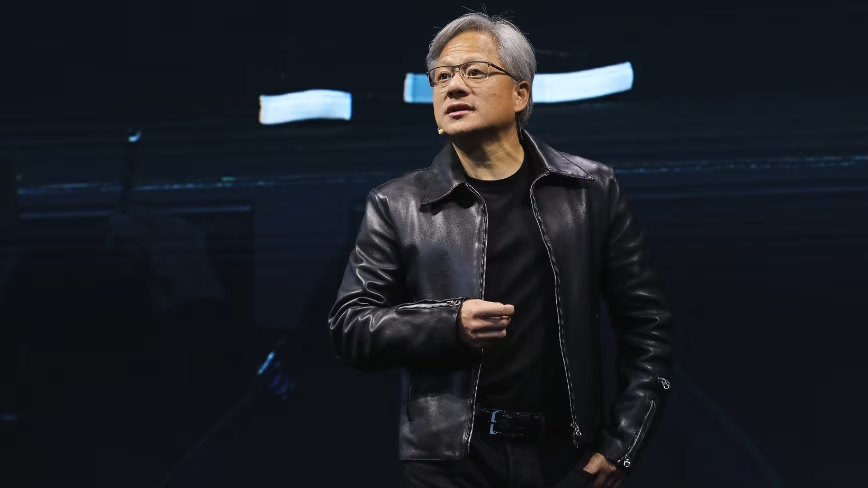
Image: courtesy of Thenextweb
Nvidia's Strategic Bet: How AI Safety and Open Models Drive Its Chip Ambitions
Nvidia is forming a dedicated AI safety and security engineering team, a move driven less by abstract ethical concerns and more by a clear business imperative. The chipmaker is betting that fostering trust through safer, open-weight AI models will ultimately lead to wider adoption of artificial intelligence, thereby increasing demand for its powerful graphics processing units (GPUs). This initiative, revealed through recent job postings, includes vetting AI agents before deployment and developing tools to patch software vulnerabilities, aligning Nvidia with the Open Secure AI Alliance and its broader strategy to position itself as the foundational hardware provider for a rapidly expanding AI ecosystem.
Outlook
Background
Nvidia, a dominant force in the high-performance computing market, particularly for AI workloads, is quietly assembling a new AI safety and security engineering team. The details of this initiative emerged from job advertisements posted late last month, indicating a strategic shift rather than a reactive one. The company is actively seeking senior talent, including a 'founding technical leader,' a 'security research engineer,' an 'evaluation engineer,' and a 'senior manager,' to staff this small but high-impact group.
The core mandate of this new team is two-fold: first, to rigorously vet AI agents before they are deployed into real-world applications, and second, to develop advanced, AI-powered tools specifically designed to identify and patch software vulnerabilities. This approach extends beyond mere compliance; it is rooted in Nvidia's belief, articulated in its job postings, that trust is a fundamental prerequisite for widespread AI adoption.
Crucially, this safety push is intertwined with Nvidia's strong advocacy for open-weight AI models. Unlike proprietary, closed-source models, open-weight models allow researchers and developers to inspect, modify, and build upon their underlying code and data. Nvidia's CEO, Jensen Huang, has been a vocal proponent of this philosophy, and the company is a participant in the Open Secure AI Alliance.
The business logic here is clear: by making AI more secure and transparent through open models, Nvidia aims to lower the barrier to entry and increase the comfort level for a wider array of customers. More customers experimenting with, developing, and deploying AI translates directly into greater demand for the powerful GPUs that form the backbone of Nvidia's revenue stream. This strategy positions AI safety not as a cost center or a regulatory burden, but as a direct enabler of market expansion for its core products.
Precedents
The technology industry has a long history of companies investing in ecosystem development to drive demand for their foundational products. Microsoft, in its early days, heavily supported software developers to create applications for Windows, ensuring its operating system became indispensable. Intel similarly fostered a robust PC ecosystem, driving demand for its processors. Nvidia's current strategy echoes this pattern: by investing in AI safety and promoting open models, it is effectively nurturing the broader AI ecosystem, making it more robust, accessible, and trustworthy. This, in turn, is designed to create a larger market for its GPUs, much like how widespread software availability fueled demand for operating systems and processors in previous eras.
Historically, the adoption of new, powerful technologies has often been slowed by concerns around security, reliability, and control. From the early internet to the rise of cloud computing, initial hesitation often gave way to rapid expansion once security frameworks and industry standards matured. Nvidia's move suggests an awareness of this historical arc, attempting to preempt potential roadblocks to AI adoption by proactively addressing safety and transparency. Their participation in alliances like the Open Secure AI Alliance also reflects a long-standing industry pattern where dominant players collaborate on standards to expand the overall market, even while competing within it. This collective action helps establish a baseline of trust and interoperability that benefits all participants, but disproportionately those with the most to gain from market growth, like Nvidia.
Nvidia's decision to build a dedicated AI safety team, explicitly linking it to business growth and the promotion of open-weight models, reshapes the conversation around AI development. It moves AI safety from a purely academic or ethical debate into the realm of core strategic investment for a major hardware provider. For developers, this could mean more secure and transparent tools to build upon, potentially accelerating innovation and reducing the inherent risks of deploying complex AI systems. For enterprises considering large-scale AI integration, Nvidia's commitment to safety and open models might lower perceived risks, making the leap into AI adoption less daunting.
This also creates a significant competitive dynamic within the AI hardware market. If Nvidia successfully positions its GPUs as the safest and most reliable foundation for open AI, it could further solidify its market leadership against rivals like AMD and Intel, who are also vying for a share of the burgeoning AI chip market. The move implicitly challenges the notion that closed, proprietary AI models are inherently safer, suggesting that transparency and community scrutiny, when properly managed, can be a superior path to security.
Ultimately, the real stakes here involve the pace and direction of global AI adoption. By making AI more trustworthy and accessible, Nvidia isn't just selling more chips; it's actively shaping the foundational infrastructure and philosophical approach that will underpin the next generation of technological advancement. The broader consequence is a potential shift in how the industry views and implements AI safety – not as an afterthought, but as an integral, market-driving feature.
Scenarios
AnalysisOne potential outcome is that Nvidia's leadership in AI safety and open models could significantly accelerate the overall adoption of AI across various industries. By offering vetted AI agents and tools to patch vulnerabilities, Nvidia could reduce the operational risks for businesses looking to integrate AI into their core functions. This would directly translate into increased demand for their GPUs, strengthening their market position further and potentially setting an industry standard for how AI safety is approached within hardware and software ecosystems.
Another outcome, however, could see Nvidia facing challenges in balancing the openness of its models with the stringent security requirements of enterprise clients. While open models foster innovation, some critics argue they could also be more accessible to malicious actors. If the new safety team struggles to effectively mitigate these risks, or if the open-weight model philosophy encounters significant pushback from highly regulated sectors, Nvidia's strategy might need to adapt. This could lead to a more nuanced approach, perhaps offering different tiers of 'openness' or security assurances depending on customer needs.
A third possibility is that this move spurs other major tech players to ramp up their own AI safety initiatives, potentially leading to a fragmented landscape of competing safety standards and alliances. While competition can drive innovation, a lack of unified standards could slow down overall AI development and adoption as companies navigate different security protocols and model architectures. Nvidia's success may depend on its ability to not only build its own safety framework but also influence broader industry consensus on best practices for secure and open AI.
Timeline
Frequently Asked Questions
Discussion
Be the first to share your thoughts.