
The impending shutdown of Notion Mail means current users will need to export all their data by September 21, 2026, to avoid losing it. Notion's focus will now shift entirely to its AI agent offerings, which are designed to manage email tasks autonomously. This includes features like summarizing threads, drafting responses, and organizing information without requiring direct interaction with an inbox interface. The company's strategy suggests a future where email is less about a visual inbox and more about an underlying stream of information handled by intelligent automation.
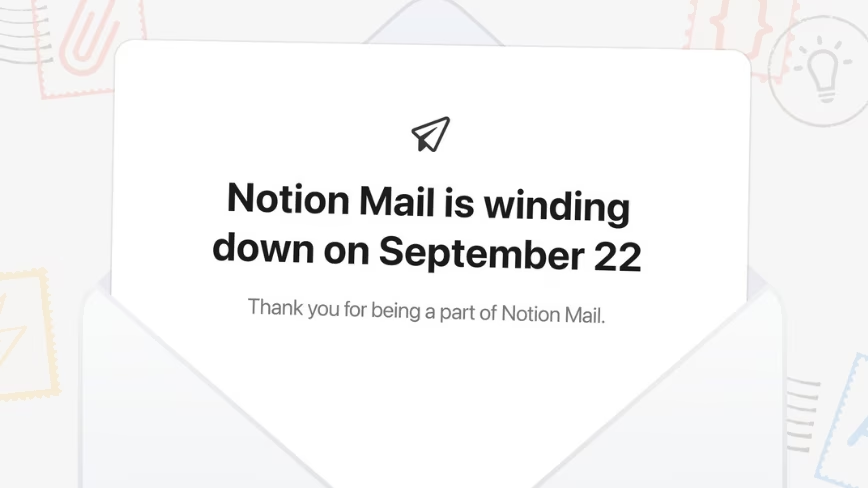
Image: courtesy of Thenextweb
Notion Mail Shutdown: AI Agents Are Making the Traditional Inbox Obsolete
Notion has announced it will shut down its email client, Notion Mail, on September 22, 2026. The company stated the decision stems from a fundamental shift in user behavior: more than half of its Notion Mail users already manage their email without ever opening the traditional inbox, relying instead on AI agents to handle tasks. This move signals a broader industry trend where autonomous AI systems are beginning to replace conventional user interfaces, particularly in productivity tools.
Outlook
Background
Notion's decision to discontinue Notion Mail comes just 14 months after its public launch in April 2025. The email client itself was born out of Notion's acquisition of Skiff, an encrypted email and productivity software startup, in February 2024. Following the acquisition, Notion had already shut down Skiff's original email service, consolidating its efforts into Notion Mail. This rapid pivot away from a recently launched product, especially one built on an acquisition, highlights the urgency and conviction behind Notion's belief in AI agents.
The core reasoning, as stated by Notion, is startling: over 50% of Notion Mail users are already managing their email without ever opening the inbox application itself. This indicates that their AI agents are effectively handling the majority of their email-related workflows, making the traditional visual interface redundant. For a company like Notion, which positions itself at the forefront of productivity, this data point is not just a curiosity but a strong signal about the future direction of work tools. It implies that the value is no longer in presenting an email list, but in automatically processing the information contained within those emails.
Notion's AI agents are designed to act as intelligent assistants that can read, understand, and act upon email content. This could involve prioritizing important messages, extracting key information for project management, scheduling meetings based on email conversations, or even drafting replies. The promise is to free users from the constant triage of an overflowing inbox, allowing them to focus on higher-value tasks while the AI handles the routine and administrative burden.
See also
Precedents
The history of technology is rife with examples of established interfaces and workflows being disrupted by new paradigms. The shift from command-line interfaces to graphical user interfaces (GUIs) in the 1980s and 90s is one such example, fundamentally changing how users interacted with computers. More recently, the rise of mobile apps challenged the dominance of desktop software, leading to a re-imagining of how services are delivered and consumed.
In the realm of communication, we've seen similar evolutions. Instant messaging platforms eroded the traditional role of email for quick, informal exchanges, while collaboration tools like Slack and Microsoft Teams have carved out a niche for internal team communication, reducing the volume of internal emails. Each of these shifts didn't necessarily kill email, but they redefined its purpose and reduced the scope of the traditional inbox.
What Notion is proposing with AI agents is arguably a more profound shift. It's not just about a new channel or a different way to view messages, but about outsourcing the management of those messages entirely. This mirrors earlier innovations like spam filters, which automatically removed unwanted emails, but on a far more sophisticated and proactive scale. If AI agents can reliably perform tasks that previously required human attention within an inbox, then the rationale for opening that inbox diminishes significantly. This reflects a broader trend of automation moving up the cognitive stack, from simple repetitive tasks to more complex decision-making and information processing.
The shutdown of Notion Mail is more than just a product discontinuation; it is a clear signal about the future of productivity software and the accelerating impact of AI on daily workflows. For users, it prompts a re-evaluation of how they manage their digital lives. If AI can effectively handle email, what other tasks might soon become automated?
For the tech industry, this move by Notion, a prominent player in the productivity space, could catalyze similar strategic shifts across other companies. Email has long been the central nervous system of digital work, and its potential automation by AI agents represents a significant disruption. Other companies, especially those with large email client offerings like Google (Gmail) and Microsoft (Outlook), will be closely watching user adoption and satisfaction with Notion's AI-centric approach. Should Notion's model prove successful, it could force competitors to accelerate their own AI agent development, potentially leading to a paradigm shift in how email services are designed and used.
Furthermore, this raises important questions about data privacy, control, and the 'black box' nature of AI. As more of our communication is handled by autonomous agents, understanding how these systems process sensitive information and make decisions becomes critical. The human element of review and oversight will need to be carefully balanced with the efficiency gains offered by AI, ensuring that users maintain a sense of control over their digital communication.
Scenarios
AnalysisOne possible outcome is that Notion's move validates a new model for email interaction, leading other productivity companies to significantly expand their own AI agent capabilities. This could mean a future where email is largely invisible to the user, with AI systems surfacing only the most critical information or requiring human intervention for specific, complex tasks. Major players like Google and Microsoft, already investing heavily in AI, may accelerate their integration of similar autonomous features into Gmail and Outlook, moving beyond smart replies and summaries to full-scale inbox management.
Conversely, there could be significant user resistance to a fully agent-driven email experience. Concerns around privacy, the potential for missed nuances in communication, or a general desire for human control over their inbox might lead some users to prefer traditional interfaces, even with AI enhancements. This could result in a bifurcated market, where some users embrace full automation while others opt for hybrid models that offer AI assistance without completely relinquishing direct control. The adoption rate of Notion's AI agents and the feedback from its user base will be crucial in shaping these future dynamics.
Another scenario involves the emergence of specialized AI agent platforms that are email-agnostic. Instead of being tied to a specific email client, these agents could integrate across various communication platforms, offering a unified layer of automation for all digital correspondence. This could empower users with greater choice and flexibility, but also introduce new complexities around interoperability and data synchronization.
Timeline
2024-02-01
Notion Acquires Skiff
Notion acquired Skiff, an encrypted email and productivity software startup, marking its entry into the email space.
2025-04-01
Notion Mail Public Launch
Notion launched Notion Mail, an email client that integrated with its broader productivity platform, after shutting down Skiff's original email service.
2026-06-25
Notion Announces Shutdown
Notion publicly announced that Notion Mail would be discontinued, citing a shift towards AI agents for email management.
2026-09-21
Data Export Deadline
The final day for Notion Mail users to export their data before the service is fully shut down.
2026-09-22
Notion Mail Shuts Down
Notion Mail will be fully discontinued, with Notion focusing entirely on its AI agent offerings for email management.
Frequently Asked Questions
Notion's AI agents are autonomous systems designed to process and manage email content without requiring direct user interaction with an inbox. They can summarize messages, draft responses, prioritize communications, and integrate email tasks into broader productivity workflows within Notion.
Discussion
Be the first to share your thoughts.