
The bill is expected to come up for a vote in the New Jersey legislature later in 2026. This timing suggests a period of intense advocacy from both sides: lawmakers and safety advocates arguing for enhanced sensor requirements, and Tesla, likely through its community and lobbying efforts, pushing back against the prescriptive nature of the legislation. Should the bill pass, it would create an immediate operational hurdle for Tesla's planned Robotaxi service in the state, potentially delaying its launch or forcing a significant, costly hardware redesign specific to New Jersey. The outcome will also be closely watched by other states considering their own autonomous vehicle regulations.
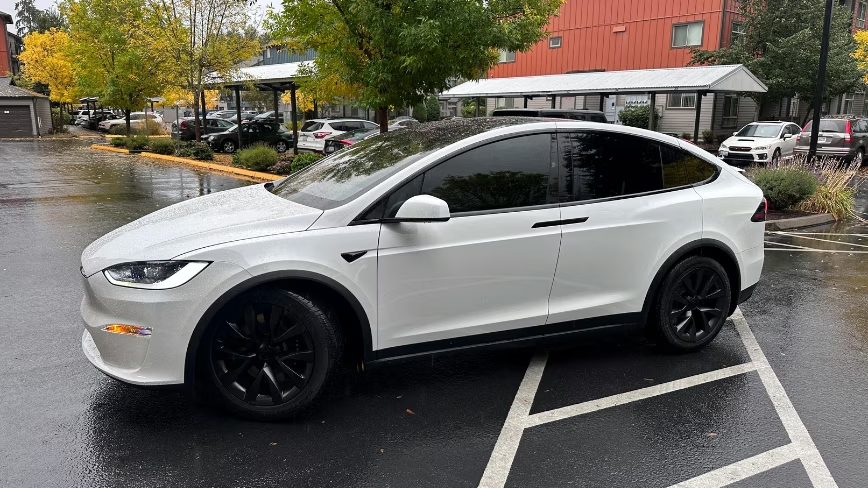
Image: courtesy of Thenextweb
New Jersey's Sensor Mandate Challenges Tesla's Robotaxi Vision and Could Redraw AV Rules
New Jersey lawmakers are considering a bill that would effectively ban Tesla's camera-only Robotaxi service from operating in the state. The proposed legislation mandates that fully autonomous vehicles must use cameras alongside two additional sensor types, such as lidar and radar. This requirement directly conflicts with Tesla's long-held 'vision-only' strategy for self-driving technology. If passed, New Jersey would become the first U.S. state to codify such a hardware mandate, setting a potential precedent for the broader autonomous vehicle industry and forcing Tesla to either adapt its core engineering approach or forgo a significant market.
Outlook
Background
At the heart of the New Jersey proposal is a fundamental disagreement about how autonomous vehicles should perceive the world. Tesla, led by CEO Elon Musk, has long championed a 'vision-only' approach, arguing that a sophisticated network of cameras combined with powerful artificial intelligence can replicate and even surpass human visual perception. This strategy avoids the additional cost and complexity of other sensor types.
In contrast, most other major players in the autonomous vehicle space, including companies like Waymo and Cruise, employ a multi-sensor suite. This typically includes cameras for visual data, lidar (Light Detection and Ranging) which uses lasers to create detailed 3D maps of the environment, and radar (Radio Detection and Ranging) which uses radio waves to detect objects and measure their speed, particularly effective in adverse weather conditions like fog or heavy rain. Proponents of this multi-sensor approach argue it provides redundancy and robustness, allowing the vehicle to operate more safely and reliably across a wider range of conditions.
New Jersey's proposed bill, as reported earlier this week, would require driverless commercial vehicles to carry cameras plus two additional sensor types, specifically citing lidar and radar as examples. This mandate directly targets the hardware configuration of Tesla's anticipated Robotaxi, which is designed to operate solely on camera inputs. If enacted, it would make New Jersey the first state to embed such a detailed hardware requirement into law, moving ahead of a similar proposal reportedly pending in neighboring New York.
Precedents
The development of autonomous vehicle regulation has, for years, been a patchwork of state-level initiatives rather than a unified federal approach. States like California, Arizona, and Texas have often been at the forefront, establishing frameworks for testing and deployment that vary significantly in their stringency and scope. This fragmented regulatory environment has created operational challenges for AV companies seeking to scale their services nationally.
Historically, there's been a tension between innovation and regulation. Technology companies often push for less restrictive rules, arguing that rapid iteration and real-world data are crucial for progress. Regulators, on the other hand, prioritize public safety, often reacting to incidents or perceived risks with more prescriptive measures. Tesla itself has a history of pushing boundaries with its Autopilot and Full Self-Driving (FSD) Beta programs, which have drawn scrutiny from regulators and safety advocates over their capabilities and naming conventions.
This isn't the first time a specific technology choice has become a regulatory flashpoint. Debates over data privacy, cybersecurity, and the level of human oversight required for autonomous systems have all seen state legislatures and federal agencies weigh in. The New Jersey bill represents a new front in this regulatory evolution, moving beyond operational rules to dictate specific hardware requirements. The precedent set here, or the lack thereof, could significantly influence how other states approach the sensor question, especially given the ongoing competition among states to attract and regulate emerging technologies.
The New Jersey bill is more than just a localized regulatory skirmish; it represents a direct challenge to Tesla's foundational strategy for autonomous vehicles and could have far-reaching consequences for the entire industry.
For Tesla, the implications are substantial. Elon Musk has consistently maintained that lidar and radar are unnecessary, even detrimental, to developing a truly intelligent autonomous system. Forcing Tesla to integrate these sensors in New Jersey would not only add significant cost and engineering complexity but also undermine a core philosophical tenet of its self-driving program. If one state successfully mandates a multi-sensor suite, it creates a powerful precedent. Other states, particularly those with similar safety concerns or political pressures, could follow suit, potentially forcing Tesla to abandon its vision-only approach for its Robotaxi service across multiple markets or embark on a costly, state-by-state hardware customization.
For the broader autonomous vehicle industry, the New Jersey bill could mark a turning point. If a state successfully codifies a hardware mandate, it signals a shift in regulatory thinking, potentially favoring the multi-sensor approach adopted by many of Tesla's competitors. This could standardize expectations for AV hardware, creating a more uniform — but potentially more expensive — entry barrier for new players. It might also accelerate consolidation within the industry as smaller companies struggle to meet escalating hardware requirements.
Ultimately, the debate boils down to public safety and technological philosophy. Regulators are grappling with how to ensure the safest possible deployment of autonomous technology, while companies are pushing their distinct visions for how best to achieve that safety. The outcome in New Jersey will offer a strong signal about which philosophy might prevail in the critical, early stages of robotaxi commercialization.
Scenarios
AnalysisThe legislative process in New Jersey could unfold in several ways, each carrying distinct implications for Tesla and the autonomous vehicle sector.
One potential outcome is that the bill passes in its current form, mandating the use of cameras plus two additional sensor types. This would force Tesla to confront a difficult strategic choice. The company could decide to integrate lidar and radar into its Robotaxi vehicles specifically for the New Jersey market, a move that would represent a significant pivot from its established engineering philosophy and likely incur substantial development and hardware costs. Alternatively, Tesla could choose to delay or forgo the launch of its Robotaxi service in New Jersey entirely, effectively ceding that market to competitors who already utilize multi-sensor systems. This would be a blow to Tesla's ambitions for widespread robotaxi deployment.
A second scenario is that the bill is defeated, significantly modified, or indefinitely postponed. Intensive lobbying efforts by Tesla, coupled with arguments from industry groups about stifling innovation or the lack of federal standardization, could sway lawmakers. If the bill fails, it would preserve Tesla's ability to deploy its camera-only Robotaxi system in New Jersey, at least until future legislative attempts. This would allow the vision-only approach to continue its real-world testing and deployment without a state-mandated hardware constraint, potentially giving Tesla an advantage in terms of cost and speed to market compared to competitors with more complex sensor suites.
A third possibility is that the debate in New Jersey, regardless of the bill's immediate outcome, galvanizes similar legislative efforts in other states. With New York reportedly considering a nearly identical proposal, a high-profile legislative push in New Jersey could accelerate discussions elsewhere. This could lead to a fragmented regulatory environment across the U.S., where some states mandate specific hardware while others remain open to different technological approaches. Such a patchwork of rules would complicate national deployment strategies for all autonomous vehicle companies, potentially slowing the overall rollout of robotaxi services across the country.
Timeline
2026-07-08
Reports Emerge on New Jersey Bill
News outlets begin reporting on a proposed New Jersey bill that would require autonomous vehicles to use cameras plus two additional sensor types, specifically citing lidar and radar.
2026-07-09
Tesla's Robotaxi Impact Detailed
Further reports clarify that the proposed bill would effectively ban Tesla's camera-only Robotaxi (Cybercab) from operating in New Jersey if passed, making it the first state to codify such a hardware mandate.
2026-07-09
Tesla Urges Opposition
Tesla begins urging its owners and community members to contact New Jersey lawmakers to oppose the proposed bill, highlighting the company's intent to fight the legislation.
2026-07-XX
Anticipated Legislative Vote
The New Jersey legislature is expected to bring the proposed bill up for a vote later in 2026, which will determine its fate and the immediate future of Tesla's Robotaxi in the state.
Frequently Asked Questions
Tesla primarily relies on a 'vision-only' system, using cameras and artificial intelligence to perceive the environment. Most competitors, like Waymo and Cruise, use a multi-sensor suite that includes cameras, lidar (laser-based mapping), and radar (radio wave detection) for redundancy and improved performance in various conditions.
Discussion
Be the first to share your thoughts.