
Consumers can expect greater peace of mind regarding the longevity of an EV battery, which has historically been a major point of anxiety and a primary driver of depreciation fears in the used EV market. This new understanding could eventually shift market perception, but it will not automatically translate into higher sales. Instead, the industry will likely be forced to focus more intently on other pain points for buyers: the upfront cost of EVs, the perceived complexity and expense of collision repairs, and the availability and reliability of public charging networks. Policymakers, too, may need to adjust incentives and infrastructure strategies, moving beyond battery performance to address these broader consumer concerns.
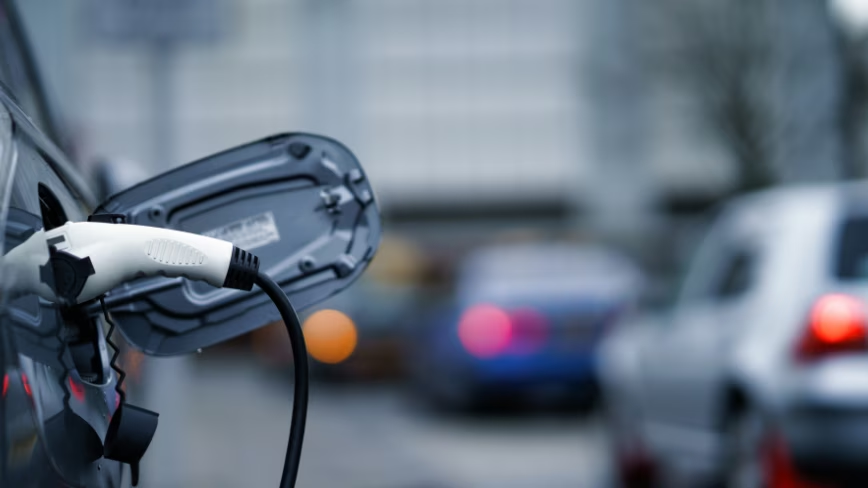
Image: courtesy of Thenextweb
EV Batteries Are Lasting Longer Than Expected, So Why Are US Sales Still Falling?
New data confirms that modern electric vehicle (EV) batteries are remarkably durable, retaining as much as 95% of their original range after five years of use. This directly challenges a core concern that has long deterred potential buyers. Despite this technical improvement and the debunking of the 'battery degradation myth,' U.S. EV sales continue to decline. This disconnect suggests that other factors, such as high repair costs, a lack of charging infrastructure, and general consumer skepticism about the overall ownership experience, are now the primary barriers to wider adoption.
Outlook
Background
A long-held apprehension about electric vehicles — that their expensive battery packs would quickly degrade and require costly replacement — is proving largely unfounded. Recent analyses from multiple vehicle data companies have provided concrete evidence challenging this 'battery myth.'
According to a new analysis by EV data company Recurrent, modern electric vehicles retain an average of 97 percent of their original range after three years and 95 percent after five years. To put this in perspective, a 2026 model EV with a rated range of 325 miles would still offer approximately 309 miles of range after half a decade of driving. This performance far exceeds what many consumers and even early industry projections anticipated.
Further reinforcing these findings, a separate study by Recurrent indicated that the actual battery replacement rate for newer EVs is remarkably low. For vehicles with model years 2022 and later, the replacement rate stood at just 0.3%. This suggests that the instances of catastrophic battery failure or degradation requiring full replacement are exceedingly rare in the current generation of EVs.
Vehicle data company Geotab also contributed to this growing body of evidence. After examining data from over 22,700 electric vehicles, Geotab found that the average annual degradation of EV batteries was around 2.3%. This rate is consistent with the Recurrent data and points to a robust and long-lasting core component.
Another innovative study by Dekra, which tested more than 25,000 batteries, revealed that real-world EV batteries maintain up to 97% of their health. These collective studies confirm that the fundamental technology behind EV batteries has advanced to a point where longevity is no longer a primary technical hurdle.
Despite these positive developments on the technical front, U.S. EV sales continue to face headwinds and have been falling. This indicates that while battery life was a significant psychological barrier, it was not the sole, or even the most impactful, obstacle to mass adoption.
Precedents
Early generations of electric vehicles, particularly those from the late 2010s, did sometimes exhibit more noticeable battery degradation. These initial experiences, combined with the high cost of replacement packs and limited public understanding of the technology, cemented a narrative of EVs having a short lifespan. This perception was often amplified by anecdotal evidence or isolated incidents, making it a persistent concern for anyone considering an EV purchase. For years, the question of 'how long will the battery last?' remained a significant factor in resale values and consumer confidence.
The automotive industry itself did little to proactively address these fears, often focusing on range and charging speed rather than long-term durability. This left a void that was filled by consumer skepticism and misinformation. However, as EV technology matured and battery management systems improved, real-world data began to diverge sharply from these early concerns. The current data reflects a significant leap in battery chemistry, thermal management, and software optimization, allowing modern EVs to perform more like traditional internal combustion engine (ICE) vehicles in terms of overall lifespan, if not exceeding them in some aspects. The challenge now is changing the deeply ingrained public perception, which lags behind the technological reality.
The persistent decline in U.S. EV sales, even as a major technical hurdle like battery longevity is overcome, reveals a deeper challenge for the entire electric vehicle transition. This is not merely about an engineering success; it is about the complex interplay of consumer psychology, economic realities, and infrastructure development. If the industry and policymakers cannot convert technical advancements into tangible consumer confidence and convenience, the ambitious goals for EV adoption will remain out of reach.
For manufacturers, this means the marketing message must evolve. Simply touting range or charging speed is no longer enough. The focus must shift to the total cost of ownership, the reliability of charging infrastructure, and the affordability of repair networks. Ignoring these other factors could lead to continued sales stagnation, despite pouring billions into R&D for better batteries and more efficient drivetrains.
For consumers, this data offers genuine financial reassurance. The long-term value proposition of an EV is stronger than previously understood, potentially lowering concerns about depreciation and the need for expensive out-of-warranty repairs. However, the continued sales decline suggests that other anxieties—such as the high initial purchase price, the availability of public charging, and the cost of collision repairs—are now taking precedence. These are practical, everyday concerns that directly impact the ownership experience.
Ultimately, the situation highlights a critical disconnect: technological progress alone cannot drive market adoption. The broader ecosystem, from policy incentives and infrastructure to service networks and consumer education, must mature in parallel. The 'battery myth' may be dead, but the industry now faces the more nuanced and perhaps more challenging task of addressing the full spectrum of consumer doubts.
Scenarios
AnalysisThe current market dynamic, where technical battery superiority meets falling sales, presents several distinct paths forward for the EV industry and regulatory bodies.
One possible outcome is that the industry pivots its strategy, moving beyond simply improving battery technology and focusing more intently on the 'softer' aspects of EV ownership. This would involve significant investment in expanding and standardizing public charging infrastructure, which remains a key pain point for many potential buyers. It could also mean a concerted effort to lower the cost of collision repairs through better design, more accessible parts, and expanding the network of qualified repair shops. If manufacturers can effectively communicate these improvements and build trust in the entire ownership experience, consumer skepticism could gradually erode, potentially leading to a rebound in sales.
Alternatively, if the industry fails to address these broader concerns, U.S. EV sales could continue to stagnate or even decline further. This scenario might force a recalibration of ambitious EV production targets, leading to slower investment in new models or even a temporary shift back towards hybrid vehicles as a more palatable transition technology for consumers. This could also prompt a more aggressive intervention from policymakers, perhaps through new subsidies for charging infrastructure or incentives for repair training, to accelerate adoption. The risk here is that the U.S. market could fall further behind other regions in EV adoption, impacting climate goals and domestic manufacturing competitiveness.
Timeline
2024-12-18
Dekra Battery Study Published
Dekra released a study showing that real-world EV batteries retain up to 97% of their health after testing over 25,000 units, providing early evidence of strong longevity.
2026-02-27
The Electric Viking Video Posted
A popular YouTube channel, The Electric Viking, published a video titled 'The Battery Myth is Dead: New Study Proves EVs Last Longer Than Expected,' reflecting a growing public awareness of new battery data.
2026-07-25
Recurrent Analysis Released
EV data company Recurrent published a new analysis confirming that modern EV batteries retain an average of 97% of their original range after three years and 95% after five years, further debunking long-standing degradation fears.
Frequently Asked Questions
New data from companies like Recurrent and Geotab indicates that modern EV batteries are highly durable. They retain an average of 97% of their original range after three years and 95% after five years. The average annual degradation rate is around 2.3%.
Discussion
Be the first to share your thoughts.