
Investors and industry observers will be watching closely to see if Tesla can meet its revised production timelines for Optimus. The initial target for full-scale production was early 2026, but current expectations indicate production is now anticipated later in 2026. This suggests an initial delay from the company's aggressive internal goals. The coming months will likely reveal more details about Tesla's progress in establishing this bespoke supply chain and developing its manufacturing processes. Any further shifts in the production schedule or significant capital expenditure announcements related to Optimus could influence investor sentiment and Tesla's broader strategic direction.
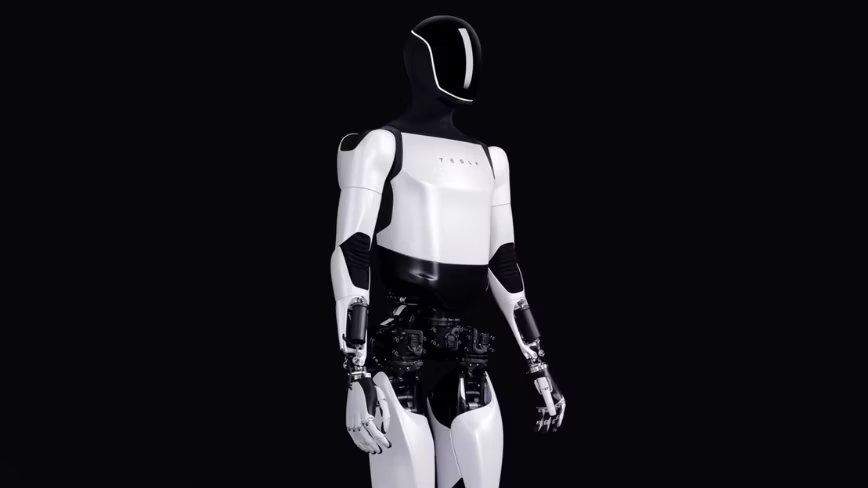
Image: courtesy of Thenextweb
Tesla's Robot Ambition Meets Reality: Why Optimus Scaling Is Musk's Toughest Challenge Yet
Elon Musk has stated that scaling production of Tesla's humanoid robot, Optimus, will be the most difficult manufacturing task the company has ever undertaken. This difficulty stems from the fact that virtually every component of Optimus, from its actuators to its sensors, is custom-designed and cannot be sourced off-the-shelf. The company must build an entirely new supply chain to support mass production, a hurdle that has historically presented significant challenges for Tesla.
Outlook
Background
The core of Tesla's challenge with Optimus lies in its custom design. Musk explicitly stated that 'everything on the robot is new,' emphasizing that components like motors, gearboxes, power electronics, control electronics, and sensors are not available 'out of a catalog, at any price.' This necessitates a 'physics-first principles' approach to design and manufacturing for every single part. The robot itself weighs 154 pounds and is slated for production in the facilities previously used for the Model S and Model X vehicles.
This approach means Tesla cannot simply leverage existing automotive supply chains or readily available industrial components. Instead, it must either develop these parts internally from scratch or find and cultivate new suppliers capable of producing highly specialized, bespoke robotics components at scale. The current version of the robot is described as Optimus 2.5, with Version 3 prototypes having been targeted for the end of 2025. The shift from an 'early 2026' full-scale production plan to an expectation of 'later in 2026' already indicates the inherent complexities in this undertaking.
Precedents
Tesla has a well-documented history of encountering significant manufacturing hurdles when scaling new products. The 'production hell' faced during the ramp-up of the Model 3 sedan in 2017-2018 is a prominent example. During that period, the company struggled to automate its assembly lines, leading to missed targets, significant cash burn, and intense pressure on its operational teams. Musk himself famously slept on the factory floor to oversee the effort.
While the company ultimately overcame these challenges, achieving high-volume production for the Model 3 and later the Model Y, those vehicles still relied on established automotive supply chains for many components. The Optimus project, requiring an entirely new, custom ecosystem, presents a challenge arguably more complex than any previous automotive ramp-up. The historical precedent suggests that Tesla often sets ambitious timelines that prove difficult to meet, particularly when introducing entirely new manufacturing processes or product categories.
Optimus is not just another product for Tesla; it represents a fundamental shift in the company's long-term vision and potential valuation. Musk has repeatedly called Optimus Tesla's 'biggest product ever,' suggesting it could eventually eclipse the automotive and even the proposed Robotaxi businesses. If successful, mass-produced humanoid robots could unlock vast new markets for automated labor, both industrial and domestic, fundamentally reshaping economies and societies. This would dramatically expand Tesla's addressable market beyond transportation and energy.
However, the high degree of difficulty in scaling Optimus means that significant capital and engineering resources will be diverted to this project. Delays or cost overruns could impact Tesla's profitability, its ability to fund other initiatives, and investor confidence. The success or failure of Optimus's scale manufacturing will dictate whether Tesla can truly transition from an automotive and energy company into a diversified robotics and AI powerhouse, or if its ambitions will remain constrained by the realities of hardware production.
Scenarios
AnalysisOne possible outcome is that Tesla, leveraging its past experience with manufacturing bottlenecks and its considerable engineering talent, ultimately succeeds in establishing a robust supply chain and scaling Optimus production, albeit perhaps with further delays beyond the current 'later in 2026' expectation. This could lead to a gradual but steady rollout of the robots, initially for internal use within Tesla's factories or for limited industrial applications, before expanding to broader markets. The potential revenue streams from this could be transformative for the company's long-term financial outlook.
Conversely, the custom nature of Optimus and the need to build a supply chain from scratch could lead to more substantial and prolonged 'production hell.' This might result in significant cost overruns, further delays, and a slower-than-anticipated market penetration. Such an outcome could strain Tesla's finances, impact its stock performance, and force a re-evaluation of the project's scope or timeline. It could also open the door for competitors, particularly from countries like China, which Musk has identified as a 'toughest rival,' to gain ground in the nascent humanoid robotics market.
A third scenario involves Tesla focusing on a more modular or iterative approach, perhaps initially releasing versions of Optimus with fewer custom components or targeting niche applications that require lower production volumes. This could allow the company to refine its manufacturing processes and supply chain relationships over time, gradually increasing customization and scale as efficiencies are gained. This approach might mitigate some of the immediate scaling risks but could also delay the realization of Musk's grand vision for the robot's widespread impact.
Timeline
2025-12-31
Optimus Version 3 Prototypes Expected
Elon Musk stated that prototypes for Optimus Version 3 were expected to be ready by the end of 2025, representing a significant leap forward in the robot's design from the current Version 2.5.
2026-01-01
Initial Full-Scale Production Target
Tesla had initially planned for full-scale production of Optimus to begin in early 2026. This aggressive timeline reflected the company's ambition for rapid market entry.
2026-07-23
Musk Highlights Scaling Difficulty
Elon Musk publicly stated that scaling Optimus manufacturing will be Tesla's hardest product challenge, citing the entirely custom nature of its components and the need for a new supply chain. Production is now expected later in 2026, indicating a potential adjustment to the original early 2026 target.
Frequently Asked Questions
The primary challenge is that nearly every part of Optimus – including its motors, gears, electronics, and sensors – is custom-designed by Tesla, rather than being components that can be bought from existing suppliers. This means Tesla must build an entirely new supply chain and manufacturing process from the ground up.
Discussion
Be the first to share your thoughts.