
Microsoft's Copilot 'super app' is expected to launch by the end of summer 2026. It will bring together various AI functionalities, including chatbot interactions, coding assistance (likely leveraging GitHub Copilot), and agentic capabilities like 'Autopilots' and 'Cowork' features. This consolidation aims to offer users a more unified and seamless AI experience across Microsoft's Windows ecosystem and beyond. The company may offer further details, though not a full app showcase, at its upcoming Build developer conference in early August 2026. The success of this launch will hinge on Microsoft's ability to integrate these disparate tools effectively and deliver a genuinely intuitive user interface.
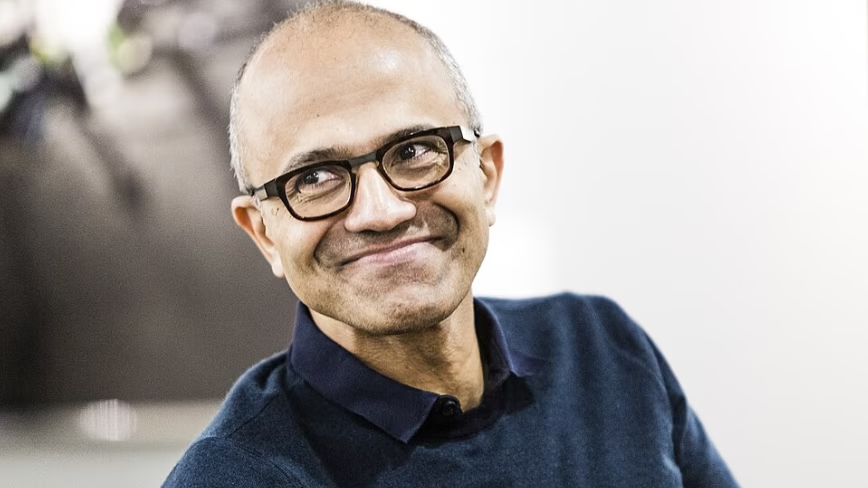
Image: courtesy of Thenextweb
Microsoft's 'Super App' Gamble: Can One Copilot Unify a Fragmented AI Future?
Microsoft is moving to consolidate its diverse array of AI tools into a single 'super app' called Copilot, with CEO Satya Nadella confirming plans for a launch by the end of summer 2026. This ambitious initiative aims to merge chat, coding, and agentic AI features, spanning both consumer and commercial use cases. The strategy addresses the growing fragmentation in the AI market but faces significant technical and user experience challenges, as well as intense competition from other tech giants.
Outlook
Background
The digital world is awash in AI tools. From specialized chatbots to coding assistants and content generators, the proliferation of artificial intelligence has been rapid and, at times, overwhelming. Microsoft, a significant player in this space, has introduced various 'Copilot' branded AI features across its product line, including Windows, Microsoft 365, and GitHub. While these individual Copilots offer powerful capabilities, their scattered nature has led to a fragmented user experience. Users often navigate different interfaces and learn new interaction patterns for each AI-powered task.
Microsoft CEO Satya Nadella confirmed on Wednesday, July 30, 2026, that the company is actively working to address this by merging these distinct AI tools into a single, cohesive 'super app.' This application, referred to internally by the slogan 'Delivering one Copilot,' is designed to act as a central hub for all AI interactions, unifying consumer and enterprise offerings. The planned launch by the end of summer 2026 signals an aggressive push to simplify the AI experience and establish Copilot as the definitive interface for artificial intelligence within the Microsoft ecosystem. This move also comes as rivals, notably OpenAI, have explored similar 'super app' concepts, facing their own integration challenges.
Precedents
The concept of a 'super app' is not new, though its application to AI represents a fresh challenge. In Asia, particularly with platforms like WeChat in China, super apps have become ubiquitous, integrating messaging, social media, payments, commerce, and other services into a single, indispensable application. These platforms succeed by creating a sticky, comprehensive ecosystem that users rarely leave. However, attempts to replicate this model in Western markets have largely faltered, often due to different consumer behaviors, regulatory environments, and entrenched competition from specialized apps.
Historically, Microsoft has a mixed record with platform consolidation and integration. While its Windows operating system has long served as a foundational platform, the company has also seen challenges in unifying disparate services, particularly during its mobile era. The success of an AI super app will depend heavily on seamless integration and a compelling user experience, areas where many past 'all-in-one' solutions have struggled. The current drive is distinct because it centers on AI, an emergent technology that fundamentally changes how users interact with software.
The 'super app' model in AI is also distinct from its Asian predecessors. Instead of merely aggregating existing services, an AI super app aims to create a central intelligence layer, allowing users to interact with various AI agents and tools through a single conversational interface. This requires sophisticated backend integration, robust AI models, and an intuitive front-end design that can manage complex tasks without overwhelming the user. OpenAI's recent acknowledgement that its own super app attempt is 'kind of a mess' highlights the inherent difficulties in this ambitious undertaking. Microsoft, with its vast resources and deep integration across software and cloud services, is uniquely positioned to tackle these challenges, but historical precedent suggests that user adoption and perceived value are never guaranteed, even for tech giants.
Microsoft's push for a Copilot 'super app' represents a pivotal moment in the battle for AI dominance. The real stakes here are not just about convenience, but about controlling the primary interface through which millions of users interact with artificial intelligence. If successful, this unified Copilot could become the default gateway to AI, much like Windows became the default operating system for personal computing or Google Search became the default for information retrieval.
For consumers, a truly integrated Copilot promises to simplify their digital lives, reducing the cognitive load of switching between different AI tools. Imagine a single point of interaction where you can ask for a code snippet, draft an email, summarize a document, and schedule a meeting, all within the same conversational flow. This could significantly enhance productivity and make advanced AI capabilities accessible to a broader audience, moving beyond early adopters to mainstream users.
For businesses, the implications are even more profound. A unified Copilot could streamline workflows across Microsoft 365, Azure, and other enterprise applications, driving efficiency and innovation. It could serve as a powerful agent for automating complex tasks, generating insights from vast datasets, and empowering employees with intelligent assistance. This would deepen Microsoft's entrenchment in the enterprise sector, making its ecosystem even more indispensable.
However, the success of this 'super app' will also shape the competitive landscape. By consolidating its AI offerings, Microsoft aims to create a formidable moat against rivals like Google, Apple, and even its partner, OpenAI. If Microsoft can deliver a superior, seamless AI experience, it could capture a significant share of the emerging AI interaction market, influencing how future AI applications are built and consumed. The challenge, of course, lies in execution. Building a true AI super app requires not just technical prowess but also a deep understanding of user needs and the ability to integrate diverse functionalities without creating a confusing or bloated product. The industry will be watching closely to see if Microsoft can deliver on this ambitious vision and redefine the user's relationship with AI.
Scenarios
AnalysisOne possible outcome is that Microsoft successfully launches the Copilot 'super app' by the end of summer 2026, delivering a genuinely cohesive and intuitive AI experience. This could lead to widespread user adoption across both consumer and enterprise segments, cementing Microsoft's position as a leader in AI interaction. A well-executed super app could significantly boost user productivity, drive deeper engagement with the Microsoft ecosystem, and create a powerful competitive advantage by simplifying access to advanced AI capabilities. This would likely strengthen Microsoft's market share in productivity software and cloud services, potentially attracting more developers to build on its platforms.
Conversely, the 'super app' could face significant challenges during its rollout and adoption. The complexity of integrating diverse AI models and functionalities into a single, seamless interface is substantial. If the initial release is buggy, lacks critical features, or proves difficult for users to navigate, it could lead to frustration and slow adoption. Users might find the app too generic, preferring specialized AI tools that excel at specific tasks. This outcome could dilute the Copilot brand, cede ground to competitors offering more focused or performant AI solutions, and force Microsoft to re-evaluate its consolidation strategy. Such a scenario might lead to a more gradual, iterative approach to integration, or even a return to a more modular AI toolset.
Timeline
2026-05-30
Reports Surface on Microsoft's AI Super App
Fortune's Sebastian Herrera reports that Microsoft is working on an AI 'super app' to combine its Copilot chatbot, GitHub Copilot, and Cowork agentic features.
2026-07-30
Microsoft CEO Confirms Copilot 'Super App'
Satya Nadella, Microsoft's CEO, confirms the development of a long-rumored Copilot 'super app' during an earnings call. He states it will span consumer and commercial experiences and combine chat, coding, and agentic capabilities like Autopilots and Cowork, launching 'this year'.
2026-08-01 (estimated)
Microsoft Build Developer Conference
Microsoft's Build developer conference is expected to take place in early August 2026. While the 'super app' itself is not planned for showcase, some underlying elements or related AI advancements could be referenced, providing further clues about its direction and capabilities.
2026-09-22 (estimated)
Targeted Launch of Copilot 'Super App'
Microsoft aims to launch the Copilot 'super app' by the end of summer 2026, which typically concludes around September 22nd. This would be the public release of the unified AI experience.
Frequently Asked Questions
The Microsoft Copilot 'super app' is a planned consolidated application that will merge various AI tools under the Copilot brand into a single, unified interface. It aims to combine features like chatbot interactions, coding assistance (from GitHub Copilot), and agentic functionalities (like Autopilots and Cowork) for both consumer and business users.
Discussion
Be the first to share your thoughts.